



Cymatogaster aggregata Gibbons, 1854
Shiner perch
Adicionar as suas observações no Fish Watcher
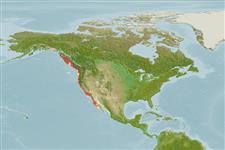
| Native range | All suitable habitat | Point map | Year 2050 |
|
| This map was computer-generated and has not yet been reviewed. |
| Cymatogaster aggregata AquaMaps Data sources: GBIF OBIS |
Adicionar o seu Fotografias e vídeos
Fotografias | vídeos | Imagem do Google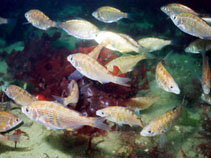 Cymatogaster aggregata
Fotografia de Nichols, J.
Fotografias | vídeos | Imagem do Google
Fotografia de Nichols, J.
Classificação / Nomes Nomes comuns | Sinónimos | Catalog of Fishes(Género, Espécies) | ITIS | CoL | WoRMS | Cloffa
> Ovalentaria/misc (Various families in series Ovalentaria) > Embiotocidae (Surfperches)
Etymology: Cymatogaster: Greek, kyma,-atos = wave, swelling, bump + Greek, gaster = stomach (Ref. 45335); aggregata: Cymatogater foetus belly - alluding to the fact that it is a live bearer; aggregata crowded together (Ref. 4930).
Etymology: Cymatogaster: Greek, kyma,-atos = wave, swelling, bump + Greek, gaster = stomach (Ref. 45335); aggregata: Cymatogater foetus belly - alluding to the fact that it is a live bearer; aggregata crowded together (Ref. 4930).
Ambiente: milieu / zona climática / intervalo de profundidade / gama de distribuição Ecologia
marinhas; estuarina demersal; não migratória; intervalo de profundidade 1 - 146 m (Ref. 2850). Subtropical; 57°N - 21°N, 137°W - 105°W
Distribuição Territórios | Áreas FAO | Ecossistemas | Ocorrências | Mapa dos pontos | Introduções | Faunafri
Eastern Pacific: Wrangell, southeastern Alaska to Bahia San Quintin, northern Baja California, Mexico.
Tamanho / Peso / Idade
Maturidade: Lm ? range ? - ? cm
Max length : 20.3 cm TL macho/indeterminado; (Ref. 27547); common length : 11.5 cm TL macho/indeterminado; (Ref. 12193); Idade máx. registada: 9 anos (Ref. 56049)
Max length : 20.3 cm TL macho/indeterminado; (Ref. 27547); common length : 11.5 cm TL macho/indeterminado; (Ref. 12193); Idade máx. registada: 9 anos (Ref. 56049)
Descrição breve Chaves de identificação | Morfologia | Morfometria
Espinhos dorsais (total) : 8 - 11; Raios dorsais moles (total) : 19 - 22; Espinhos anais: 3; Raios anais moles: 22 - 25; Vértebras: 33 - 37. Distinguished by the rather deep, compressed body, the large scales, and the three spines in the anal fin (Ref. 27547). Lateral line slightly arched, complete (Ref. 27547). Generally silvery, with back dusky to greenish; middle of sides toward head are scales with groups of fine black dots on them, forming about eight longitudinal stripes; the stripes are often interrupted, especially in females, by three pale yellow, vertical bands; paired fins colorless; dorsal and caudal fins plain or dusky; anal fin usually colorless, sometimes with a yellow blotch toward the front (Ref. 27547). Breeding males may be almost solid black and develop fleshy lobes on both sides of anal fin (Ref. 27547).
Body shape (shape guide): short and / or deep.
Body shape (shape guide): short and / or deep.
Usually in shallow water, around eelgrass beds, piers and pilings and commonly found in bays and quiet back waters (Ref. 2850). Also in calm areas of exposed coast (Ref. 2850). Enter estuaries and brackish waters (Ref. 114138) [noted from freshwaters in Ref. 2850, but it is unlikely or rarely]. Found in loose schools or aggregations (Ref. 2850, Ref. 114138). Young feed mainly on copepods, while adults eat various small crustaceans, mollusks, and algae (Ref. 27547). Viviparous, female carries the developing young (Ref. 205). Exhibit seasonal onshore-offshore movements (Ref. 27547).
Ciclo de vida e comportamento de acasalamento Maturidade | Reprodução | Desova | Ovos | Fecundidade | Larvas
Viviparous. Mating is preceded by courtship. The male moves slowly toward the female, who retreats. Her flight stimulates pursuit by up to 10 males. During the pursuit, males attempt to bring their anal regions in contact with that of the female. One male heads off the female, urging her away from the group of males and also driving them away. The female is conducted to the shelter of a rock or other object, where the courtship dance begins. In this dance, the male, with dorsal fin fully erect, swims by means of his pectoral fin in a figure eight pattern over the female, udulating in both the horizontal and vertical planes. The male then stops, faces the female head to head, quivers, then moves his jaws and undulates his dorsal fin. He then moves beside the female, facing in the same direction, and repeats the movements. Finally, the male tilts on his side, the female tilts slightly away from hin, and the anal regions are brought in contact with each other. Copulation lasts less than a second. Gestation takes five to six months. Bears 3 to 36 young. Female carries the developing young (Ref. 205). Males are mature and ripe at birth. Juvenile females are mated soon after being born (Ref. 27547).
Referência principal
Carregar as suas referências | Referências | Coordenador | Colaboradores
Eschmeyer, W.N., E.S. Herald and H. Hammann, 1983. A field guide to Pacific coast fishes of North America. Boston (MA, USA): Houghton Mifflin Company. xii+336 p. (Ref. 2850)
Categoria na Lista Vermelha da IUCN (Ref. 130435: Version 2025-2 (Global))
Preocupação menor (LC) ; Date assessed: 04 March 2019
CITES
Not Evaluated
Ameaça para o homem
Harmless
Utilização humana
Pescarias: pouco comercial; peixe desportivo: sim; isco: occasionally
FAO - Publication: search | FishSource |
Mais informação
Ecologia Trófica
Produtos alimentares (presas)
Composição da dieta
Consumo alimentar
Rações alimentares
Predadores
Produtos alimentares (presas)
Composição da dieta
Consumo alimentar
Rações alimentares
Predadores
Dinâmica das populações
Parâmetros de crescimento
Idades / tamanhos máximos
Comprimento-peso rel.
Comprimento-comprimento rel.
Frequência de comprimento
Conversão de massa
Recrutamento
Abundância
Parâmetros de crescimento
Idades / tamanhos máximos
Comprimento-peso rel.
Comprimento-comprimento rel.
Frequência de comprimento
Conversão de massa
Recrutamento
Abundância
Ciclo de vida
Reprodução
Maturidade
Maturidade/Rel. das guelras
Fecundidade
Desova
Agregações de desova
Ovos
Desenvolvimento dos ovos
Larvas
Dinâmica larvar
Reprodução
Maturidade
Maturidade/Rel. das guelras
Fecundidade
Desova
Agregações de desova
Ovos
Desenvolvimento dos ovos
Larvas
Dinâmica larvar
Anatomia
Área branquial
Cérebro
Otólitos
Área branquial
Cérebro
Otólitos
Fisiologia
Composição corporal
Nutrientes
Consumo de oxigénio
Tipo de natação
Velocidade de natação
Pigmentos visuais
Som de peixe
Doenças e Parasitas
Toxicidade (LC50s)
Composição corporal
Nutrientes
Consumo de oxigénio
Tipo de natação
Velocidade de natação
Pigmentos visuais
Som de peixe
Doenças e Parasitas
Toxicidade (LC50s)
Relacionado com o ser humano
Sistemas de aquacultura
Perfis para aquacultura
Estirpes
Casos de Ciguatera
Selos, moedas, diversos.
Sistemas de aquacultura
Perfis para aquacultura
Estirpes
Casos de Ciguatera
Selos, moedas, diversos.
Ferramentas
Questionário orgânico | E-book | Guia de campo | Ferramenta auxiliar de frequências de comprimento | Ferramenta sobre a história de vida | Mapa dos pontos |
Captura-MSY |
Relatórios especiais
Descarregue XML
Fontes da internet
AFORO (otoliths) | Aquatic Commons | BHL | Cloffa | Websites from users | Consultar FishWatcher | CISTI | Catalog of Fishes: Género, Espécies | DiscoverLife | ECOTOX | FAO - Publication: search | Faunafri | Fishipedia | Fishtrace | GloBI | Google Books | Google Scholar | Google | IGFA World Record | OceanAdapt | OneZoom | Open Tree of Life | Otolith Atlas of Taiwan Fishes | Aquários públicos | PubMed | Reef Life Survey | Socotra Atlas | TreeBase | Árvore da vida | Wikipedia: ir para, procurar | World Records Freshwater Fishing | Registo zoológico
Estimativas baseadas em modelos
Temperatura preferida (Ref. 123201): 8 - 12.1, mean 9.7 °C (based on 100 cells).
Índice de diversidade filogenética (Ref. 82804): PD50 = 1.0000 [Uniqueness, from 0.5 = low to 2.0 = high].
Bayesian length-weight: a=0.01905 (0.00831 - 0.04372), b=2.97 (2.76 - 3.18), in cm total length, based on LWR estimates for this (Sub)family-body shape (Ref. 93245).
Nível Trófico (Ref. 69278): 3.0 ±0.31 se; based on food items.
Resiliência (Ref. 120179): Elevada, tempo mínimo de duplicação da população menor que 15 meses (tm=1; tmax=9; Fec=3-78).
Nutrientes (Ref. 124155): Calcium = 138 [81, 257] mg/100g; Iron = 1.39 [0.71, 2.41] mg/100g; Protein = 18.6 [17.6, 19.7] %; Omega3 = 0.345 [0.203, 0.581] g/100g; Selenium = 29 [15, 58] μg/100g; VitaminA = 7.59 [2.44, 25.34] μg/100g; Zinc = 1.03 [0.72, 1.51] mg/100g (wet weight);