This website uses cookies to enhance your browsing experience and ensure the functionality of our site. For more detailed information about the types of cookies we use and how we protect your privacy, please visit our Privacy Information page.
×
Cookie Settings
This website uses different types of cookies to enhance your experience. Please select your preferences below:
> Eupercaria/misc (Various families in series Eupercaria) > Labridae (Wrasses) > Julidinae
Etymology: Coris:Greek, kore, -es = pupil and also with themenaing of "maid" (Ref. 45335). More on author: Lacepède.
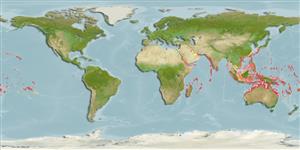
Ambiente: milieu / zona climática / intervalo de profundidade / gama de distribuição Ecologia
marinhas associadas(os) a recifes; intervalo de profundidade 2 - 30 m (Ref. 1602), usually 2 - 30 m (Ref. 27115). Tropical; 24°C - 28°C (Ref. 27115); 30°N - 30°S
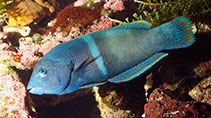
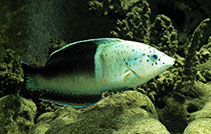
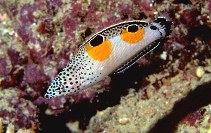
Espinhos dorsais (total) : 9; Raios dorsais moles (total) : 12 - 13; Espinhos anais: 3; Raios anais moles: 12. Caudal fin slightly rounded in females, truncate and with filamentous rays in large males; pelvic fins of males very long. Large males also become uniformly dark-green and develop a gibbus forehead and an elongate first dorsal spine (Ref. 1602). Juveniles distinct with the false eyes, shaded by orange (Ref. 48636). Body shape (shape guide): fusiform / normal; Cross section: compressed.
Occurs in the vicinity of sand or rubble patches of exposed outer reef flats, lagoon reefs, and seaward reefs (Ref. 1602), often in semi-exposed surge zones (Ref. 48636). Adults solitary. Juveniles common in shallow tide pools (Ref. 30573). Feeds mainly on hard-shelled invertebrates including crustaceans, mollusks and sea urchins (Ref. 9823). Minimum depth reported from Ref. 27115. Randall (1999, Ref. 33411) question identity of specimens exceeding 70 cm.
Ciclo de vida e comportamento de acasalamento Maturidade | Reprodução | Desova | Ovos | Fecundidade | Larvas
Oviparous, with distinct pairing during breeding (Ref. 205).
Randall, J.E., 1999. Revision of the Indo-Pacific labrid fishes of the genus Coris, with descriptions of five new species. Indo-Pac. Fish. (29):74 p. (Ref. 33411)
Categoria na Lista Vermelha da IUCN (Ref. 130435: Version 2025-2 (Global))
Ciclo de vida Reprodução Maturidade Maturidade/Rel. das guelras Fecundidade Desova Agregações de desova Ovos Desenvolvimento dos ovos Larvas Dinâmica larvar
Fisiologia Composição corporal Nutrientes Consumo de oxigénio Tipo de natação Velocidade de natação Pigmentos visuais Som de peixe Doenças e Parasitas Toxicidade (LC50s)
Temperatura preferida (Ref. 123201): 24.6 - 29, mean 27.5 °C (based on 892 cells).
Índice de diversidade filogenética (Ref. 82804): PD50 = 0.5000 [Uniqueness, from 0.5 = low to 2.0 = high].
Bayesian length-weight: a=0.00813 (0.00464 - 0.01422), b=3.12 (2.97 - 3.27), in cm total length, based on LWR estimates for this species & (Sub)family-body (Ref. 93245).
Nível Trófico (Ref. 69278): 3.7 ±0.53 se; based on food items.
Resiliência (Ref. 120179): Muito baixo, tempo mínimo de duplicação da população maior que 14 anos (Preliminary K or Fecundity.).
Vulnerabilidade da pesca (Ref. 59153): High to very high vulnerability (72 of 100). 🛈