This website uses cookies to enhance your browsing experience and ensure the functionality of our site. For more detailed information about the types of cookies we use and how we protect your privacy, please visit our Privacy Information page.
×
Cookie Settings
This website uses different types of cookies to enhance your experience. Please select your preferences below:
> Eupercaria/misc (Various families in series Eupercaria) > Labridae (Wrasses) > Hypsigenyinae
Etymology: Bodianus:Bodianus after Bodiano or Pudiano, from the Portuguese pudor, meaning modesty (Jordan & Evermann, 1896). More on authors: Bloch & Schneider.
Environnement : milieu / zone climatique / profondeur / gamme de distribution Écologie
marin récifal; profondeur 8 - 100 m (Ref. 89896), usually ? - 40 m (Ref. 9626). Tropical; 34°N - 8°N, 98°W - 60°W
Western Atlantic: Bermuda, southern Florida (USA), and Bahamas to northern South America.
Taille / Poids / Âge
Maturité: Lm? range ? - ? cm Max length : 30.0 cm TL mâle / non sexé; (Ref. 7251); common length : 22.0 cm TL mâle / non sexé; (Ref. 5217); poids max. publié: 320.00 g (Ref. 9626)
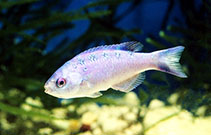
Épines dorsales (Total) : 12; Rayons mous dorsaux (Total) : 10; Épines anales: 3; Rayons mous anaux: 12 - 13. Moderately elongate, compressed fish with equally curved upper and lower profiles (Ref. 26938). Color primarily violet or purple; large individuals with a wash of yellow on lower two-thirds of body; prolonged portions of dorsal and anal fins and tips of pelvic fins blackish (Ref. 13442). Caudal fin emarginate in young, lunate in adults (Ref 52831). Body shape (shape guide): fusiform / normal.
Inhabits seaward reef slopes; occasionally on shallow patch reefs (Ref. 9710). Found in large midwater aggregations feeding on plankton (Ref. 9710), small jellyfishes, pteropods, pelagic tunicates and various invertebrate larvae (Ref. 13442). Form leks during breeding (Ref. 55367). Also caught with beach nets (Ref. 5217).
Cycle de vie et comportement reproducteur Maturité | Reproduction | Frai | Œufs | Fécondité | Larves
Forms lek during breeding (Ref. 55367). A monandric species (Ref. 55367). Length at sex change = 15.78 cm TL (Ref. 55367).
Dynamique des populations Paramètres de croissance Âges / tailles maximales Longueur-poids rel. Rel. longueur-longueur. Fréquences de longueurs Conversion de masse Recrutement Abondance
Cycle de vie Reproduction Maturité Maturité/épines rel. Fécondité Frai Agrégats de frai Œufs Développement de l'œuf Larves Dynamique des populations larvaires
Physiologie Composition corporelle Nutriments Consommation d'oxygène Type de natation Vitesse de nage Pigments visuels Son de poisson Maladies et parasites Toxicité (CL50)
Température préférée (Réf. 123201): 24.3 - 28, mean 26.8 °C (based on 170 cells).
Indice de diversité phylogénétique (Réf. 82804): PD50 = 0.5000 [Uniqueness, from 0.5 = low to 2.0 = high].
Bayesian length-weight: a=0.01047 (0.00493 - 0.02225), b=3.08 (2.90 - 3.26), in cm total length, based on LWR estimates for this Genus-body shape (Ref. 93245).
Niveau trophique (Réf. 69278): 3.4 ±0.2 se; based on diet studies.
Résilience (Réf. 120179): Milieu, temps minimum de doublement de population : 1,4 à 4,4 années (Preliminary K or Fecundity.).
Vulnérabilité de la pêche (Ref. 59153): Low vulnerability (20 of 100). 🛈