



Add your observation in Fish Watcher
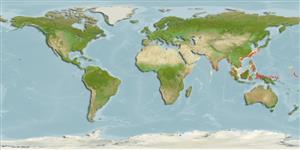
| Native range | All suitable habitat | Point map | Year 2050 |
|
| This map was computer-generated and has not yet been reviewed. |
| Arius maculatus AquaMaps Data sources: GBIF OBIS |
Upload your photos and videos
Pictures | Google image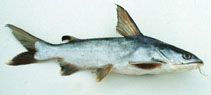 Arius maculatus
Picture by Gloerfelt-Tarp, T.
Pictures | Google image
Picture by Gloerfelt-Tarp, T.
Classification / Names Common names | Synonyms | Catalog of Fishes(genus, species) | ITIS | CoL | WoRMS | Cloffa
Teleostei (teleosts) > Siluriformes (Catfishes) > Ariidae (Sea catfishes) > Ariinae
Etymology: Arius: Greek, arios, areios = dealing with Mars, warlike, bellicose (Ref. 45335).
Etymology: Arius: Greek, arios, areios = dealing with Mars, warlike, bellicose (Ref. 45335).
Environment: milieu / climate zone / depth range / distribution range Ecology
Marine; freshwater; brackish; demersal; potamodromous (Ref. 51243); depth range 50 - 100 m (Ref. 28016). Tropical; 33°N - 4°S
Distribution Territories | FAO areas | Ecosystems | Occurrences | Point map | Introductions | Faunafri
Indo-West Pacific: off the west and east coast of India, Sri Lanka, Pakistan, Bangladesh, Myanmar to the Arafura Sea (Ref. 9819) and the Indo-Australian Archipelago (excluding Australia). Known from the Mekong Delta (Ref. 12693).
Length at first maturity / Size / Weight / Age
Maturity: Lm ?, range 38 - ? cm
Max length : 80.0 cm TL male/unsexed; (Ref. 11441); common length : 30.0 cm TL male/unsexed; (Ref. 3290)
Max length : 80.0 cm TL male/unsexed; (Ref. 11441); common length : 30.0 cm TL male/unsexed; (Ref. 3290)
Short description Identification keys | Morphology | Morphometrics
Dorsal spines (total): 1; Dorsal soft rays (total): 7; Anal soft rays: 16 - 30. Head shield somewhat rugose; deep and long median fontanelle groove.
Body shape (shape guide): fusiform / normal; Cross section: oval.
Body shape (shape guide): fusiform / normal; Cross section: oval.
Adults occurs in inshore waters and estuaries. Occasionally form schools. Feed on invertebrates and small fishes. Males incubate eggs in the mouth (Ref. 205). Caught mainly with set bag nets and bamboo stake traps. Marketed fresh (Ref. 3290). Air bladders are exported as isinglass used by the wine industry (Ref. 43081). Strong venomous dorsal and pectoral spines provide protection for the fish (Ref. 43081).
Life cycle and mating behavior Maturity | Reproduction | Spawning | Eggs | Fecundity | Larvae
Males incubate eggs in buccal cavity. During incubation, males starve which sometimes make them resort to swallowing one or two eggs probably to maintain basal metabolism (Ref. 43081). Early hatching embryos commence feeding on inhaled particles by the female when still in possession of large yolk.
Main reference
Upload your references | References | Coordinator : Ferraris, Jr., Carl J. | Collaborators
Kailola, P.J., 1999. Ariidae (=Tachysuridae): sea catfishes (fork-tailed catfishes). p. 1827-1879. In K.E. Carpenter and V.H. Niem (eds.) FAO species identification guide for fishery purposes. The living marine resources of the Western Central Pacific. Vol. 3. Batoid fishes, chimaeras and bony fishes part 1 (Elopidae to Linophrynidae). FAO, Rome. (Ref. 38478)
CITES
Not Evaluated
Threat to humans
Traumatogenic (Ref. 58010)
Human uses
Fisheries: commercial
FAO - Publication: search | FishSource |
More information
Population dynamics
Growth parameters
Max. ages / sizes
Length-weight rel.
Length-length rel.
Length-frequencies
Mass conversion
Recruitment
Abundance
Growth parameters
Max. ages / sizes
Length-weight rel.
Length-length rel.
Length-frequencies
Mass conversion
Recruitment
Abundance
Life cycle
Reproduction
Maturity
Maturity/Gills rel.
Fecundity
Spawning
Spawning aggregations
Eggs
Egg development
Larvae
Larval dynamics
Reproduction
Maturity
Maturity/Gills rel.
Fecundity
Spawning
Spawning aggregations
Eggs
Egg development
Larvae
Larval dynamics
Anatomy
Gill area
Brain
Otolith
Gill area
Brain
Otolith
Physiology
Body composition
Nutrients
Oxygen consumption
Swimming type
Swimming speed
Visual pigments
Fish sound
Diseases & Parasites
Toxicity (LC50s)
Body composition
Nutrients
Oxygen consumption
Swimming type
Swimming speed
Visual pigments
Fish sound
Diseases & Parasites
Toxicity (LC50s)
Genetics
Genome
Genetics
Heterozygosity
Heritability
Genetic Diversity
Genome
Genetics
Heterozygosity
Heritability
Genetic Diversity
Human related
Aquaculture systems
Aquaculture profiles
Strains
Ciguatera cases
Stamps, coins, misc.
Aquaculture systems
Aquaculture profiles
Strains
Ciguatera cases
Stamps, coins, misc.
Tools
E-book | Field guide | Identification keys | Length-frequency wizard | Life-history tool | Point map |
Catch-MSY |
Special reports
Download XML
Internet sources
AFORO (otoliths) | Aquatic Commons | BHL | Cloffa | Websites from users | Check FishWatcher | CISTI | Catalog of Fishes: genus, species | DiscoverLife | ECOTOX | FAO - Publication: search | Faunafri | Fishipedia | Fishtrace | GloBI | Google Books | Google Scholar | Google | IGFA World Record | National databases | OneZoom | Open Tree of Life | Otolith Atlas of Taiwan Fishes | PubMed | Reef Life Survey | Socotra Atlas | TreeBase | Tree of Life | Wikipedia: Go, Search | | Zoological Record
Estimates based on models
|
Phylogenetic diversity index (Ref. 82804) |
PD50 = 0.5000 [Uniqueness, from 0.5 = low to 2.0 = high]. |
| Bayesian length-weight | a=0.00912 (0.00582 - 0.01430), b=3.06 (2.93 - 3.19), in cm total length, based on LWR estimates for this species & (Sub)family-body (Ref. 93245). |
|
Trophic level (Ref. 69278) |
3.4 ±0.46 se; based on food items. |
| Generation time | 3.1 ( na - na) years. Estimated as median ln(3)/K based on 1 growth studies. |
|
Resilience (Ref. 120179) |
Medium, minimum population doubling time 1.4 - 4.4 years (tmax=7). |
|
Fishing Vulnerability (Ref. 59153) |
Moderate vulnerability (36 of 100). 🛈 |
|
Price category (Ref. 80766) |
Medium. |
|
Nutrients (Ref. 124155) |
Calcium = 153 [36, 364] mg/100g; Iron = 1.11 [0.72, 1.91] mg/100g; Protein = 17.6 [15.9, 19.4] %; Omega3 = 0.274 [0.153, 0.495] g/100g; Selenium = 75.9 [39.8, 145.3] μg/100g; VitaminA = 10.6 [4.7, 23.5] μg/100g; Zinc = 2.14 [0.49, 6.58] mg/100g (wet weight); based on nutrient studies. |