



Scleromystax reisi Britto, Fukakusa & Malabarba, 2016
Upload your photos and videos
Google image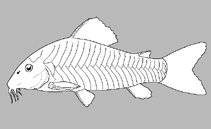 No image available for this species;
drawing shows typical species in Callichthyidae.
Google image
drawing shows typical species in Callichthyidae.
Classification / Names Common names | Synonyms | Catalog of Fishes(genus, species) | ITIS | CoL | WoRMS | Cloffa
Teleostei (teleosts) > Siluriformes (Catfishes) > Callichthyidae (Callichthyid armored catfishes) > Corydoradinae
Etymology: reisi: Named after Roberto Esser dos Reis, for his many contributions to Neotropical ichthyology, including studies in callichthyid fish; noun in the genitive case.
Eponymy: Dr Roberto Esser dos Reis is a Brazilian ichthyologist. [...] (Ref. 128868), visit book page.
Etymology: reisi: Named after Roberto Esser dos Reis, for his many contributions to Neotropical ichthyology, including studies in callichthyid fish; noun in the genitive case.
Eponymy: Dr Roberto Esser dos Reis is a Brazilian ichthyologist. [...] (Ref. 128868), visit book page.
Environment: milieu / climate zone / depth range / distribution range Ecology
Freshwater; benthopelagic; depth range 0 - 1 m (Ref. 138468). Tropical
Distribution Territories | FAO areas | Ecosystems | Occurrences | Point map | Introductions | Faunafri
South America: Brazil.
Size / Weight / Age
Short description Identification keys | Morphology | Morphometrics
This species is distinguished by the following characters: infraorbital 2 expanded ventrally, adjacent to small, almost imperceptible, naked area between sphenotic, compound pterotic, opercle and preopercle; with a roughly oblique, elongate, dark brown blotches along body; large specimens with cranial fontanel completely occluded, leaving just a shallow fossae, delimited by frontal bones, and reaching
anterior tip of parieto-supraoccipital; absence of a black dot on the base of median caudal-fin rays and sexually dimorphic features inconspicuous, i.e. cheek
region similar in males and females, with only minute, scattered odontodes in the former, dorsal and pectoral fins of males slightly longer than in females; tip of snout roughly truncate (Ref. 138468).
Body shape (shape guide): elongated; Cross section: oval.
Body shape (shape guide): elongated; Cross section: oval.
This species was found mainly in very small (0.5-2 m wide) and shallow streams (30-60 cm depth), with slow current water and surrounded by relatively preserved riparian vegetation; bottom was sandy, sometimes covered with a thin layer of mud or fallen leaves (although there were rocky bottom stretches in the same creeks, the species was never found there). The streams may have a small amount of submerged vegetation. Associated species collected along with this species were Astyanax eigenmanniorum, Cheirodon interruptus, Corydoras paleatus, Heptapterus mustelinus, H. sympterygium, Mimagoniates inequalis, Phalloceros caudimaculatus, Pseudobunocephalus iheringii, Rhamdia sp. and Scleronema sp. (Ref. 138468).
Life cycle and mating behavior Maturity | Reproduction | Spawning | Eggs | Fecundity | Larvae
Main reference
Upload your references | References | Coordinator : Reis, Roberto E. | Collaborators
Britto, M.R., C.K. Fukakusa and L.R. Malabarba, 2016. New species of Scleromystax Günther, 1864 (Siluriformes: Callichthyidae) - extending the meridional distribution of genera endemic to the Atlantic Forest. Neotropical Ichthyol. 14(3):e150158: [1-10]. (Ref. 138468)
CITES
Not Evaluated
Threat to humans
Harmless
Human uses
FAO - Publication: search | FishSource |
More information
Trophic ecology
Food items (preys)
Diet composition
Food consumption
Food rations
Predators
Food items (preys)
Diet composition
Food consumption
Food rations
Predators
Ecology
Ecology
Ecology
Population dynamics
Growth parameters
Max. ages / sizes
Length-weight rel.
Length-length rel.
Length-frequencies
Mass conversion
Recruitment
Abundance
Growth parameters
Max. ages / sizes
Length-weight rel.
Length-length rel.
Length-frequencies
Mass conversion
Recruitment
Abundance
Life cycle
Reproduction
Maturity
Maturity/Gills rel.
Fecundity
Spawning
Spawning aggregations
Eggs
Egg development
Larvae
Larval dynamics
Reproduction
Maturity
Maturity/Gills rel.
Fecundity
Spawning
Spawning aggregations
Eggs
Egg development
Larvae
Larval dynamics
Anatomy
Gill area
Brain
Otolith
Gill area
Brain
Otolith
Physiology
Body composition
Nutrients
Oxygen consumption
Swimming type
Swimming speed
Visual pigments
Fish sound
Diseases & Parasites
Toxicity (LC50s)
Body composition
Nutrients
Oxygen consumption
Swimming type
Swimming speed
Visual pigments
Fish sound
Diseases & Parasites
Toxicity (LC50s)
Genetics
Genome
Genetics
Heterozygosity
Heritability
Genetic Diversity
Genome
Genetics
Heterozygosity
Heritability
Genetic Diversity
Human related
Aquaculture systems
Aquaculture profiles
Strains
Ciguatera cases
Stamps, coins, misc.
Aquaculture systems
Aquaculture profiles
Strains
Ciguatera cases
Stamps, coins, misc.
Tools
Special reports
Download XML
Internet sources
AFORO (otoliths) | Aquatic Commons | BHL | Cloffa | Websites from users | Check FishWatcher | CISTI | Catalog of Fishes: genus, species | DiscoverLife | ECOTOX | FAO - Publication: search | Faunafri | Fishipedia | Fishtrace | GloBI | Google Books | Google Scholar | Google | IGFA World Record | OneZoom | Open Tree of Life | Otolith Atlas of Taiwan Fishes | PubMed | Reef Life Survey | Socotra Atlas | TreeBase | Tree of Life | Wikipedia: Go, Search | World Records Freshwater Fishing | Zoobank | Zoological Record
Estimates based on models
Phylogenetic diversity index (Ref. 82804): PD50 = 0.5078 [Uniqueness, from 0.5 = low to 2.0 = high].
Bayesian length-weight: a=0.00741 (0.00287 - 0.01912), b=3.14 (2.92 - 3.36), in cm total length, based on LWR estimates for this (Sub)family-body shape (Ref. 93245).
Trophic level (Ref. 69278): 3.0 ±0.3 se; based on size and trophs of closest relatives
Resilience (Ref. 120179): High, minimum population doubling time less than 15 months (Preliminary K or Fecundity.).