



Protomelas krampus Dierickx & Snoeks, 2020
Adicionar o seu Fotografias e vídeos
Imagem do Google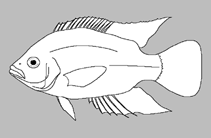 No image available for this species;
drawing shows typical species in Cichlidae.
Imagem do Google
drawing shows typical species in Cichlidae.
Classificação / Nomes Nomes comuns | Sinónimos | Catalog of Fishes(Género, Espécies) | ITIS | CoL | WoRMS | Cloffa
> Cichliformes (Cichlids, convict blennies) > Cichlidae (Cichlids) > Pseudocrenilabrinae
Etymology: Protomelas: Greek, protos = the first + Greek, melas, melanos = black (Ref. 45335); krampus: The specific name, 'krampus', is a noun in apposition and was chosen in reference to the European folklore character Krampus; this demon puts naughty children in a bag and takes them away, which is reminiscent of a paedophagous behaviour; the goat-like appearance of Krampus also implicitly refers to the head-butting behaviour of this species; the same implicit reference to this behaviour is also found in the genus name Caprichromis of other paedophagous species of Lake Malawi (Ref. 122325).
Etymology: Protomelas: Greek, protos = the first + Greek, melas, melanos = black (Ref. 45335); krampus: The specific name, 'krampus', is a noun in apposition and was chosen in reference to the European folklore character Krampus; this demon puts naughty children in a bag and takes them away, which is reminiscent of a paedophagous behaviour; the goat-like appearance of Krampus also implicitly refers to the head-butting behaviour of this species; the same implicit reference to this behaviour is also found in the genus name Caprichromis of other paedophagous species of Lake Malawi (Ref. 122325).
Ambiente: milieu / zona climática / intervalo de profundidade / gama de distribuição Ecologia
; Água doce bentopelágico. Tropical
Distribuição Territórios | Áreas FAO | Ecossistemas | Ocorrências | Mapa dos pontos | Introduções | Faunafri
Africa: Lake Malawi (Ref. 122325).
Tamanho / Peso / Idade
Descrição breve Chaves de identificação | Morfologia | Morfometria
Espinhos dorsais (total) : 17; Raios dorsais moles (total) : 11 - 12; Raios anais moles: 9 - 10; Vértebras: 31 - 32. Diagnosis: Protomelas krampus differs from most species of Protomelas, i.e. P. annectens, P. fenestratus, P. kirkii, P. labridens, P. macrodon, P. marginatus, P. pleurotaenia, P. similis, P. spilonotus, P. taeniolatus, P. triaenodon and P. virgatus, by having only one inner tooth row, whereas the other species have two rows (Ref. 122325). It can be distinguished from P. spilopterus by a shorter premaxillary pedicel, 17.0-19.2% of head length vs. 21.8-28.4%; a larger gape inclination, 70-80° vs. 40-60°; a shallower body, 33.3-34.3% of standard length vs. 36.0-42.8%; a smaller predorsal distance, 27.4-29.1% of standard length vs. 33.4-37.4%; a smaller prepectoral distance, 29.4-29.8% of standard length vs. 31.8-40.0%; a shorter and more slender head, its length 27.8-29.2% of standard length vs. 30.4-34.6%, and width 39.3-40.3% of head length vs. 41.4-50.7%; and a smaller interorbital width, 22.9-23.4% of head length vs. 25.0-33.6%; in addition, it has more gill rakers on the outer epibranchial than P. spilopterus, 5 vs. 3-4, and more vertebrae, 31-32 vs. 29; the inner teeth are tricuspid in P. krampus while mixed unicuspid/tricuspid or unicuspid in P. spilopterus; the outer teeth of the lower jaw of P. krampus are oriented straight up, whereas those of P. spilopterus are angled forward (Ref. 122325). It differs from P. insignis by a shorter premaxillary pedicel, 17.0-19.2% of head length vs. 27.9-30.0%; a deeper cheek, 31.6-40.2% of head length vs. 23.2-28.5%; the larger gape inclination, 70-80° vs. 30°; a smaller predorsal distance, 27.4-29.1% of standard length vs. 34.2-35.9%; a smaller prepectoral distance, 29.4-29.8% of standard length vs. 32.7-35.4%; a shorter and more slender head, its length 27.8-29.2% of standard length vs. 31.6-34.3%, and width 39.3-40.3% of head length vs. 41.3-44.8%; a shallower lacrimal, 19.6-20.4% of head length vs. 21.4-22.4%; a smaller interorbital width, 22.9-23.4% of head length vs. 26.9-32.8%; and a longer lower jaw, 37.7-38.8% of head length vs. 31.2-37.3%; the upper jaw has fewer outer teeth in P. krampus than in P. insignis, 37-40 vs. 43-50; outer lower jaw teeth are straight in P. krampus but curved inwards in P. insignis (Ref. 122325). It differs from both species of the genus Hemitaeniochromis by its continuous midlateral stripe, which places it in Protomelas, whereas H. urotaenia and H. brachyrhynchus have an anteriorly spotted stripe (Ref. 122325). It differs from the paedophagous species of the genus Caprichromis by its melanin pattern: it has a midlateral band from behind the opercle to the base of the caudal fin, whereas species of Caprichromis have a diagonal stripe from the nape to the base of the caudal fin (Ref. 122325). It differs from Diplotaxodon greenwoodi by the lack of a melanin pattern in the latter species; it has isognathous jaws, whereas D. greenwoodi has a protruding lower jaw (Ref. 122325). Protomelas krampus differs from Naevochromis chrysogaster by its melanin pattern, which consists of three large spots on the lateral sides in the latter instead of a continuous midlateral line; it has a more strongly inclined gape than N. chrysogaster; and it has only one inner tooth row on the lower jaw, whereas N. chrysogaster has two (Ref. 122325).
Body shape (shape guide): fusiform / normal.
Body shape (shape guide): fusiform / normal.
This species is observed feeding on eggs and fry while stealing them from mouth-brooding females of other cichlid species; the paedophage rams these females from above on the snout and the brooding females may release some eggs or larvae upon this impact; the brood can then be snatched by Protomelas krampus (Ref. 122325). The inclined position of the mouth enables the fish to immediately grab the brood since it is already in a good position relative to the prey after ramming from above (Ref. 122325).
Ciclo de vida e comportamento de acasalamento Maturidade | Reprodução | Desova | Ovos | Fecundidade | Larvas
Referência principal
Carregar as suas referências | Referências | Coordenador : Kullander, Sven O. | Colaboradores
Dierickx, K. and J. Snoeks, 2020. Protomelas krampus, a new paedophagous cichlid from Lake Malawi (Teleostei, Cichlidae). Eur. J. Taxon. 672:1-18. (Ref. 122325)
CITES
Not Evaluated
Ameaça para o homem
Harmless
Utilização humana
FAO - Publication: search | FishSource |
Mais informação
Ecologia Trófica
Produtos alimentares (presas)
Composição da dieta
Consumo alimentar
Rações alimentares
Predadores
Produtos alimentares (presas)
Composição da dieta
Consumo alimentar
Rações alimentares
Predadores
Ecologia
Ecologia
Ecologia
Dinâmica das populações
Parâmetros de crescimento
Idades / tamanhos máximos
Comprimento-peso rel.
Comprimento-comprimento rel.
Frequência de comprimento
Conversão de massa
Recrutamento
Abundância
Parâmetros de crescimento
Idades / tamanhos máximos
Comprimento-peso rel.
Comprimento-comprimento rel.
Frequência de comprimento
Conversão de massa
Recrutamento
Abundância
Ciclo de vida
Reprodução
Maturidade
Maturidade/Rel. das guelras
Fecundidade
Desova
Agregações de desova
Ovos
Desenvolvimento dos ovos
Larvas
Dinâmica larvar
Reprodução
Maturidade
Maturidade/Rel. das guelras
Fecundidade
Desova
Agregações de desova
Ovos
Desenvolvimento dos ovos
Larvas
Dinâmica larvar
Anatomia
Área branquial
Cérebro
Otólitos
Área branquial
Cérebro
Otólitos
Fisiologia
Composição corporal
Nutrientes
Consumo de oxigénio
Tipo de natação
Velocidade de natação
Pigmentos visuais
Som de peixe
Doenças e Parasitas
Toxicidade (LC50s)
Composição corporal
Nutrientes
Consumo de oxigénio
Tipo de natação
Velocidade de natação
Pigmentos visuais
Som de peixe
Doenças e Parasitas
Toxicidade (LC50s)
Genética
genoma
Genética
Heterozigotia
Hereditariedade
Diversidade genética
genoma
Genética
Heterozigotia
Hereditariedade
Diversidade genética
Relacionado com o ser humano
Sistemas de aquacultura
Perfis para aquacultura
Estirpes
Casos de Ciguatera
Selos, moedas, diversos.
Sistemas de aquacultura
Perfis para aquacultura
Estirpes
Casos de Ciguatera
Selos, moedas, diversos.
Ferramentas
E-book | Guia de campo | Ferramenta auxiliar de frequências de comprimento | Ferramenta sobre a história de vida | Mapa dos pontos |
Captura-MSY |
Relatórios especiais
Descarregue XML
Fontes da internet
AFORO (otoliths) | Aquatic Commons | BHL | Cloffa | Websites from users | Consultar FishWatcher | CISTI | Catalog of Fishes: Género, Espécies | DiscoverLife | ECOTOX | FAO - Publication: search | Faunafri | Fishipedia | Fishtrace | GloBI | Google Books | Google Scholar | Google | IGFA World Record | OneZoom | Open Tree of Life | Otolith Atlas of Taiwan Fishes | PubMed | Reef Life Survey | Socotra Atlas | TreeBase | Árvore da vida | Wikipedia: ir para, procurar | World Records Freshwater Fishing | Zoobank | Registo zoológico
Estimativas baseadas em modelos
Índice de diversidade filogenética (Ref. 82804): PD50 = 0.5000 [Uniqueness, from 0.5 = low to 2.0 = high].
Bayesian length-weight: a=0.00389 (0.00180 - 0.00842), b=3.12 (2.94 - 3.30), in cm total length, based on all LWR estimates for this body shape (Ref. 93245).
Nível Trófico (Ref. 69278): 3.3 ±0.4 se; based on size and trophs of closest relatives
Resiliência (Ref. 120179): Elevada, tempo mínimo de duplicação da população menor que 15 meses (Preliminary K or Fecundity.).