



Hapalogenys analis Richardson, 1845
Broadbanded velvetchin
Adicionar as suas observações no Fish Watcher
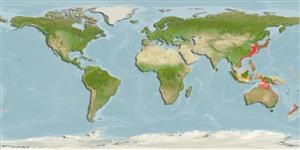
| Native range | All suitable habitat | Point map | Year 2050 |
|
| This map was computer-generated and has not yet been reviewed. |
| Hapalogenys analis AquaMaps Data sources: GBIF OBIS |
Adicionar o seu Fotografias e vídeos
Fotografias | Imagem do Google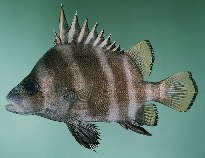 Hapalogenys analis
Fotografia de Randall, J.E.
Fotografias | Imagem do Google
Fotografia de Randall, J.E.
Classificação / Nomes Nomes comuns | Sinónimos | Catalog of Fishes(Género, Espécies) | ITIS | CoL | WoRMS | Cloffa
> Acanthuriformes (Surgeonfishes) > Lobotidae (Tripletails)
Etymology: Hapalogenys: Greek, hapalos = soft * Greek, geny, -yos = face (Ref. 45335).
More on author: Richardson.
Etymology: Hapalogenys: Greek, hapalos = soft * Greek, geny, -yos = face (Ref. 45335).
More on author: Richardson.
Ambiente: milieu / zona climática / intervalo de profundidade / gama de distribuição Ecologia
marinhas bentopelágico; intervalo de profundidade 20 - 100 m (Ref. 76777), usually ? - 100 m (Ref. 76777). Tropical
Distribuição Territórios | Áreas FAO | Ecossistemas | Ocorrências | Mapa dos pontos | Introduções | Faunafri
Northwest Pacific: East Asian Shelf to the Sea of Japan and Pacific coast of southern Japan (except Ryukyu and Ogasawara Is.), including the western part of Taiwan and South China Sea; questionable from Singapore.
Tamanho / Peso / Idade
Descrição breve Chaves de identificação | Morfologia | Morfometria
Espinhos dorsais (total) : 11; Raios dorsais moles (total) : 15 - 16; Espinhos anais: 3; Raios anais moles: 9 - 10. This species is distinguished by the following characters: lower lip fleshy with dense cluster of short papillae and barbels anteriorly, on and behind chin with 10 pores, 4 anterioriormost pairs hidden by papillae, slightly scaly posteriorly (posterior abdominal part of angular of lower jaws; maxilla with small scales; 5-7 alternating whitish and dark-brown bands on head and body, the first (often indistinct) from just before eye to posterior of lower jaw, the second somewhat oblique, becoming wider posteriorly, from nape to between eye and pelvic-fin base, third one from base of 2nd and 3rd dorsal-fin spines to just behind pelvic-fin base, the fourth from 7th and 8th dorsal-fin spine base to just before 1st anal-fin spine, the fifth from 2nd and 3rd dorsal-fin soft ray base to anterior of anal-fin soft ray base, the sixth on caudal peduncle, and the seventh (often indistinct) on caudal-fin base; soft rayed portions of dorsal and anal fins are somewhat rounded posteriorly and slightly angulated posteriorly, respectively, spinous dorsal-fin and anal fin (until first anal-fin ray) membranes are dense black; membrane of soft dorsal- anal- (especially in juveniles and young) and caudal-fins somewhat yellowish in fresh specimens, a dense black margin posteriorly, about same width as pupil diameter (juveniles) or half of this width (adults); pelvic-fin tip not reaching to base of 1st anal-fin spine when depressed; pored lateral-line scales 44-47 (rarely 43 or 48); procumbent spine-like process (exposed tip of first pterygiophore) at origin of dorsal fin usually covered by predorsal scales (Ref. 76777).
Body shape (shape guide): short and / or deep; Cross section: compressed.
Body shape (shape guide): short and / or deep; Cross section: compressed.
Inhabits the sublittoral zone on sandy mud bottom (Ref. 11230). Most specimens were collected by bottom trawl in depths less than 100 m and smaller individuals (about 10.0 cm SL) by set nets at 20-50 m (Ref. 76777).
Ciclo de vida e comportamento de acasalamento Maturidade | Reprodução | Desova | Ovos | Fecundidade | Larvas
Referência principal
Carregar as suas referências | Referências | Coordenador | Colaboradores
Iwatsuki, Y. and B.C. Russell, 2006. Revision of the genus Hapalogenys (Teleostei: Perciformes) with two new species from the Indo-West Pacific. Mem. Mus. Victoria 63(1):29-46. (Ref. 76777)
CITES
Not Evaluated
Ameaça para o homem
Harmless
Utilização humana
Pescarias: bycatch
FAO - Publication: search | FishSource |
Mais informação
Ecologia Trófica
Produtos alimentares (presas)
Composição da dieta
Consumo alimentar
Rações alimentares
Predadores
Produtos alimentares (presas)
Composição da dieta
Consumo alimentar
Rações alimentares
Predadores
Dinâmica das populações
Parâmetros de crescimento
Idades / tamanhos máximos
Comprimento-peso rel.
Comprimento-comprimento rel.
Frequência de comprimento
Conversão de massa
Recrutamento
Abundância
Parâmetros de crescimento
Idades / tamanhos máximos
Comprimento-peso rel.
Comprimento-comprimento rel.
Frequência de comprimento
Conversão de massa
Recrutamento
Abundância
Anatomia
Área branquial
Cérebro
Otólitos
Área branquial
Cérebro
Otólitos
Fisiologia
Composição corporal
Nutrientes
Consumo de oxigénio
Tipo de natação
Velocidade de natação
Pigmentos visuais
Som de peixe
Doenças e Parasitas
Toxicidade (LC50s)
Composição corporal
Nutrientes
Consumo de oxigénio
Tipo de natação
Velocidade de natação
Pigmentos visuais
Som de peixe
Doenças e Parasitas
Toxicidade (LC50s)
Genética
genoma
Genética
Heterozigotia
Hereditariedade
Diversidade genética
genoma
Genética
Heterozigotia
Hereditariedade
Diversidade genética
Relacionado com o ser humano
Sistemas de aquacultura
Perfis para aquacultura
Estirpes
Casos de Ciguatera
Selos, moedas, diversos.
Sistemas de aquacultura
Perfis para aquacultura
Estirpes
Casos de Ciguatera
Selos, moedas, diversos.
Ferramentas
E-book | Guia de campo | Chaves de identificação | Ferramenta auxiliar de frequências de comprimento | Ferramenta sobre a história de vida | Mapa dos pontos |
Captura-MSY |
Relatórios especiais
Descarregue XML
Fontes da internet
AFORO (otoliths) | Aquatic Commons | BHL | Cloffa | Websites from users | Consultar FishWatcher | CISTI | Catalog of Fishes: Género, Espécies | DiscoverLife | ECOTOX | FAO - Publication: search | Faunafri | Fishipedia | Fishtrace | GloBI | Google Books | Google Scholar | Google | IGFA World Record | Bases de dados nacionais | OneZoom | Open Tree of Life | Otolith Atlas of Taiwan Fishes | PubMed | Reef Life Survey | Socotra Atlas | TreeBase | Árvore da vida | Wikipedia: ir para, procurar | World Records Freshwater Fishing | Zoobank | Registo zoológico
Estimativas baseadas em modelos
Temperatura preferida (Ref. 123201): 9.7 - 25, mean 19 °C (based on 249 cells).
Índice de diversidade filogenética (Ref. 82804): PD50 = 0.5039 [Uniqueness, from 0.5 = low to 2.0 = high].
Bayesian length-weight: a=0.01905 (0.00861 - 0.04217), b=3.01 (2.81 - 3.21), in cm total length, based on LWR estimates for this (Sub)family-body shape (Ref. 93245).
Nível Trófico (Ref. 69278): 4.1 ±0.68 se; based on food items.
Resiliência (Ref. 120179): Elevada, tempo mínimo de duplicação da população menor que 15 meses (Preliminary K or Fecundity.).