



Adicionar o seu Fotografias e vídeos
Fotografias | Imagem do Google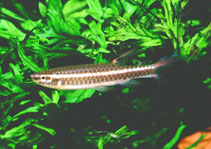 Copella compta
Fotografia de Hoffmann, P. and M. Hoffmann
Fotografias | Imagem do Google
Fotografia de Hoffmann, P. and M. Hoffmann
Classificação / Nomes Nomes comuns | Sinónimos | Catalog of Fishes(Género, Espécies) | ITIS | CoL | WoRMS | Cloffa
> Characiformes (Characins) > Lebiasinidae (Pencilfishes) > Pyrrhulininae
Eponymy: Edward Drinker Cope (1840–1897) was an American palaeontologist, anatomist, herpetologist and ichthyologist. [...] (Ref. 128868), visit book page.
More on author: Myers.
Eponymy: Edward Drinker Cope (1840–1897) was an American palaeontologist, anatomist, herpetologist and ichthyologist. [...] (Ref. 128868), visit book page.
More on author: Myers.
Taxonomic Remarks
Myers did not originally illustrate this fish but Géry (1977:147) published a drawing by Pablo Bravo prepared under Myers’ direction, probably from the holotype. Until rather recently it was not known except for the preserved types. It occurs in acid clear and black water streams and is collected with the green neon, Paracheirodon simulans, and imported with it at times. It is a very slender fish, and the dorsal fin is placed far back on the body, almost over the anal fin. In life it grows to 6 cm or more. Its breeding behavior has not been noted. Marilyn Weitzman, pers. comm., Eschmeyer, 1998:402.
Ambiente: milieu / zona climática / intervalo de profundidade / gama de distribuição Ecologia
; Água doce bentopelágico. Subtropical
Distribuição Territórios | Áreas FAO | Ecossistemas | Ocorrências | Mapa dos pontos | Introduções | Faunafri
South America: Upper rio Negro upstream from São Gabriel da Cachoeira, Brazil and Venezuela.
Tamanho / Peso / Idade
Maturidade: Lm ? range ? - ? cm
Max length : 6.9 cm SL macho/indeterminado; (Ref. 137764); 4.8 cm SL (female)
Max length : 6.9 cm SL macho/indeterminado; (Ref. 137764); 4.8 cm SL (female)
Descrição breve Chaves de identificação | Morfologia | Morfometria
Raios dorsais moles (total) : 8; Raios anais moles: 9; Vértebras: 36 - 37. This species is distinguished from all its congeners, except C. vilmae, by having 16±18 scales in the first longitudinal scale row (vs. 13±15), and by having 26±27 scales in the fourth longitudinal scale row (vs. 23±25); the males can be distinguished from that of C. vilmae by the absence of rows of conspicuous dark scales irregularly arranged on body (vs. presence); while females differs from the those of C. vilmae by the absence of a dark longitudinal band on body (vs. presence). Among Copella species, this is the largest species of the genus, with males reaching 6.89 cm SL and the females 4.81 cm SL (vs. less than 5.55 cm SL and 4.42cmm SL, respectively, in the congeners) (Ref. 137764).
Body shape (shape guide): elongated; Cross section: compressed.
Body shape (shape guide): elongated; Cross section: compressed.
Ciclo de vida e comportamento de acasalamento Maturidade | Reprodução | Desova | Ovos | Fecundidade | Larvas
Referência principal
Carregar as suas referências | Referências | Coordenador : Weitzman, Marilyn | Colaboradores
Marinho, M.M.F. and N.A. Menezes, 2017. Taxonomic review of Copella (Characiformes: Lebiasinidae) with an identification key for the species. PLoS ONE 12(8):e0183069:1-53. (Ref. 137764)
Categoria na Lista Vermelha da IUCN (Ref. 130435: Version 2025-2 (Global))
Preocupação menor (LC) ; Date assessed: 11 September 2020
CITES
Not Evaluated
Ameaça para o homem
Harmless
Utilização humana
FAO - Publication: search | FishSource |
Mais informação
Ecologia Trófica
Produtos alimentares (presas)
Composição da dieta
Consumo alimentar
Rações alimentares
Predadores
Produtos alimentares (presas)
Composição da dieta
Consumo alimentar
Rações alimentares
Predadores
Ecologia
Ecologia
Ecologia
Dinâmica das populações
Parâmetros de crescimento
Idades / tamanhos máximos
Comprimento-peso rel.
Comprimento-comprimento rel.
Frequência de comprimento
Conversão de massa
Recrutamento
Abundância
Parâmetros de crescimento
Idades / tamanhos máximos
Comprimento-peso rel.
Comprimento-comprimento rel.
Frequência de comprimento
Conversão de massa
Recrutamento
Abundância
Ciclo de vida
Reprodução
Maturidade
Maturidade/Rel. das guelras
Fecundidade
Desova
Agregações de desova
Ovos
Desenvolvimento dos ovos
Larvas
Dinâmica larvar
Reprodução
Maturidade
Maturidade/Rel. das guelras
Fecundidade
Desova
Agregações de desova
Ovos
Desenvolvimento dos ovos
Larvas
Dinâmica larvar
Anatomia
Área branquial
Cérebro
Otólitos
Área branquial
Cérebro
Otólitos
Fisiologia
Composição corporal
Nutrientes
Consumo de oxigénio
Tipo de natação
Velocidade de natação
Pigmentos visuais
Som de peixe
Doenças e Parasitas
Toxicidade (LC50s)
Composição corporal
Nutrientes
Consumo de oxigénio
Tipo de natação
Velocidade de natação
Pigmentos visuais
Som de peixe
Doenças e Parasitas
Toxicidade (LC50s)
Genética
genoma
Genética
Heterozigotia
Hereditariedade
Diversidade genética
genoma
Genética
Heterozigotia
Hereditariedade
Diversidade genética
Relacionado com o ser humano
Sistemas de aquacultura
Perfis para aquacultura
Estirpes
Casos de Ciguatera
Selos, moedas, diversos.
Sistemas de aquacultura
Perfis para aquacultura
Estirpes
Casos de Ciguatera
Selos, moedas, diversos.
Ferramentas
E-book | Guia de campo | Ferramenta auxiliar de frequências de comprimento | Ferramenta sobre a história de vida | Mapa dos pontos |
Captura-MSY |
Relatórios especiais
Descarregue XML
Fontes da internet
AFORO (otoliths) | Aquatic Commons | BHL | Cloffa | Websites from users | Consultar FishWatcher | CISTI | Catalog of Fishes: Género, Espécies | DiscoverLife | ECOTOX | FAO - Publication: search | Faunafri | Fishipedia | Fishtrace | GloBI | Google Books | Google Scholar | Google | IGFA World Record | OneZoom | Open Tree of Life | Otolith Atlas of Taiwan Fishes | PubMed | Reef Life Survey | Socotra Atlas | TreeBase | Árvore da vida | Wikipedia: ir para, procurar | | Registo zoológico
Estimativas baseadas em modelos
|
Índice de diversidade filogenética (Ref. 82804) |
PD50 = 0.5156 [Uniqueness, from 0.5 = low to 2.0 = high]. |
| Bayesian length-weight | a=0.00661 (0.00287 - 0.01523), b=3.13 (2.93 - 3.33), in cm total length, based on LWR estimates for this (Sub)family-body shape (Ref. 93245). |
|
Nível Trófico (Ref. 69278) |
3.4 ±0.4 se; based on size and trophs of closest relatives |
|
Vulnerabilidade da pesca (Ref. 59153) |
Low vulnerability (10 of 100). 🛈 |