



Pomacentrus flavoaxillaris Allen, Erdmann & Pertiwi, 2017
Yellow-axil damselfish
Hochladen Photos und videos
Bilder | Google Bild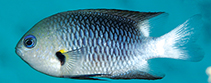 Pomacentrus flavoaxillaris
Photo von Allen, G.R.
Bilder | Google Bild
Photo von Allen, G.R.
Klassifizierung / Names Namen | Synonyme | Catalog of Fishes(Gattung, Arten) | ITIS | CoL | WoRMS | Cloffa
> Ovalentaria/misc (Various families in series Ovalentaria) > Pomacentridae (Damselfishes) > Pomacentrinae
Etymology: Pomacentrus: Greek, poma, -atos = cover, operculum + Greek, kentron = sting (Ref. 45335); flavoaxillaris: Named for diagnostic color, usually bright yellow (except pale gray at Ngulu Atoll) of the inner pectoral-fin axil; a compound adjective.
Etymology: Pomacentrus: Greek, poma, -atos = cover, operculum + Greek, kentron = sting (Ref. 45335); flavoaxillaris: Named for diagnostic color, usually bright yellow (except pale gray at Ngulu Atoll) of the inner pectoral-fin axil; a compound adjective.
Umwelt: Milieu / Klimazone / Tiefenbereich / Verbreitungsgebiet Ökologie
seewasser riff-verbunden; tiefenbereich 8 - 20 m (Ref. 114927). Tropical
Verbreitung Territorien | FAO Gebiete | Ökosysteme | Vorkommen | Punkt Karte | Einführungen | Faunafri
Western Central Pacific: Micronesia (Kosrae and Pohnpei).
Größe / Gewicht / Alter
Kurzbeschreibung Bestimmungsschlüssel | Morphologie | Morphometrie
Rückenflossenstacheln (insgesamt) : 13; Rückenflossenweichstrahlen (insgesamt) : 13 - 14; Afterflossenstacheln: 2; Afterflossenweichstrahlen: 13 - 15; Wirbelzahl: 26. This species is distinguished by the following characters: D XIII,13-14; A II,13-15 (usually 14); pectoral-fin rays 16-18 (usually 18); tubed lateral-line scales 17-18; total gill rakers on first arch 23-25; body depth 1.9-2.1 in SL; no scales on preorbital; with a single row of scales on suborbital, often restricted to posterior part, continuing around posterior margin of eye; colour in life generally gray to bluish gray with a thick black or dark-brown scale margins producing a network pattern; with a black spot covering the entire pectoral-fin base; inner surface of pectoral-fin axil usually bright yellow (except pale gray at Ngulu Atoll); dorsal and anal fins are dark gray or blackish with translucent portion posteriorly with white basal area; caudal fin and adjacent peduncle whitish; the dorsal scleral surface of eye is bright blue. This species differs from other members of the P. philippinus complex by the yellow marking on the inner pectoral-fin axil, by the pronounced white areas at the base of the posterior dorsal
and anal fins, the whitish caudal peduncle, and the overall general paler coloration of the ventral body (Ref. 114927).
Body shape (shape guide): short and / or deep; Cross section: compressed.
Body shape (shape guide): short and / or deep; Cross section: compressed.
Lebenszyklus und Paarungsverhalten Geschlechtsreife | Fortpflanzung | Ablaichen | Eier | Fruchtbarkeit | Larven
Hauptreferenz
Laden Sie Ihre Referenzen hoch | Referenzen | Koordinator : Allen, Gerald R. | Partner
Allen, G.R., M.V. Erdmann and P.D. Pertiwi, 2017. Descriptions of four new species of damselfishes (Pomacentridae) in the Pomacentrus philippinus complex from the tropical western Pacific Ocean. J. Ocean Sci. Found. 25:47-76. (Ref. 114927)
CITES
Not Evaluated
Bedrohung für Menschen
Harmless
Nutzung durch Menschen
FAO - Publication: search | FishSource |
Mehr Information
Trophische Ökologie
Lebensmittel (Beutetiere)
Nahrungszusammensetzung
Nahrungsaufnahme
Lebensmittelrationen
Räuber
Lebensmittel (Beutetiere)
Nahrungszusammensetzung
Nahrungsaufnahme
Lebensmittelrationen
Räuber
Ökologie
Ökologie
Ökologie
Populationsdynamik
Wachstumsparameter
Max. Alter/Größen
Länge-Gewicht-Rel.
Länge-Länge-Verhältnis.
Längenhäufigkeiten
Massenkonvertierung
Rekrutierung
Dichte
Wachstumsparameter
Max. Alter/Größen
Länge-Gewicht-Rel.
Länge-Länge-Verhältnis.
Längenhäufigkeiten
Massenkonvertierung
Rekrutierung
Dichte
Lebenszyklus
Fortpflanzung
Geschlechtsreife
Reifung/Kiemen rel.
Fruchtbarkeit
Ablaichen
Laichaggregationen
Eier
Eientwicklung
Larven
Larven Pop.Dyn.
Fortpflanzung
Geschlechtsreife
Reifung/Kiemen rel.
Fruchtbarkeit
Ablaichen
Laichaggregationen
Eier
Eientwicklung
Larven
Larven Pop.Dyn.
Anatomie
Kiemenoberfläche
Gehirn
Otolith
Kiemenoberfläche
Gehirn
Otolith
Physiologie
Körperliche Zusammensetzung
Nährstoffe
Sauerstoffverbrauch
Schwimmart
Schwimmgeschwindigkeit
Visuelle Pigmente
Fischgeräusche
Krankheiten und Parasiten
Toxizität (LC50s)
Körperliche Zusammensetzung
Nährstoffe
Sauerstoffverbrauch
Schwimmart
Schwimmgeschwindigkeit
Visuelle Pigmente
Fischgeräusche
Krankheiten und Parasiten
Toxizität (LC50s)
Genetik
Genom
Genetik
Heterozygotie
Vererbbarkeit
Genetische Vielfalt
Genom
Genetik
Heterozygotie
Vererbbarkeit
Genetische Vielfalt
Menschenbezogen
Aquakultur-Systeme
Aquakultur Profile
Zuchtlinien
Ciguatera-Fälle
Briefmarken, Münzen, Verschiedenes.
Aquakultur-Systeme
Aquakultur Profile
Zuchtlinien
Ciguatera-Fälle
Briefmarken, Münzen, Verschiedenes.
Tools
Zusatzinformationen
Download XML
Zusammenfassung | Punktdaten | Namen | Photos
Internet Quellen
AFORO (otoliths) | Aquatic Commons | BHL | Cloffa | Websites from users | FishWatcher Einträge suchen | CISTI | Catalog of Fishes: Gattung, Arten | DiscoverLife | ECOTOX | FAO - Publication: search | Faunafri | Fishipedia | Fishtrace | GloBI | Google Books | Google Scholar | Google | IGFA World Record | OneZoom | Open Tree of Life | Otolith Atlas of Taiwan Fishes | PubMed | Reef Life Survey | Socotra Atlas | TreeBase | Tree of Life | Wikipedia: Gehe zu, Suchen | World Records Freshwater Fishing | Zoobank | Zoologischer Rekord
Schätzungen auf der Grundlage von Modellen
Phylogenetischer Diversitätsindex (Ref. 82804): PD50 = 0.5000 [Uniqueness, from 0.5 = low to 2.0 = high].
Bayesian length-weight: a=0.02399 (0.01134 - 0.05074), b=2.98 (2.81 - 3.15), in cm total length, based on LWR estimates for this Genus-body shape (Ref. 93245).
Trophische Ebene (Ref. 69278): 2.7 ±0.3 se; based on size and trophs of closest relatives
Widerstandsfähigkeit (Ref. 120179): hoch, Verdopplung der Population dauert weniger als 15 Monate. (Preliminary K or Fecundity.).