



Загрузить свой Фото и Видео
Изображение на Google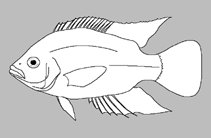 No image available for this species;
drawing shows typical species in Cichlidae.
Изображение на Google
drawing shows typical species in Cichlidae.
Классификация / Имена народные названия | синонимы | Catalog of Fishes(род, виды) | ITIS | CoL | WoRMS | Cloffa
> Cichliformes (Cichlids, convict blennies) > Cichlidae (Cichlids) > Pseudocrenilabrinae
Etymology: ejagham: The species name ejagham refers both to Lake Ejagham as well as to the Ejagham people, whose major sacred site is Lake Ejagham; a noun in apposition (Ref. 85854).
Etymology: ejagham: The species name ejagham refers both to Lake Ejagham as well as to the Ejagham people, whose major sacred site is Lake Ejagham; a noun in apposition (Ref. 85854).
Окружающая среда: среда / климатическая зона / пределы глубины / диапазон распространения экология
; пресноводный донно-пелагический. Tropical
распространение Территории | регионы FAO | Экосистемы | места находок | карта точек | интродукции | Faunafri
Africa: Lake Ejagham in Cameroon (Ref. 85854).
Размер / Вес / Возраст
Краткое описание определительные ключи | морфология | морфометрия
колючие лучи спинного плавника (общее число) : 15 - 16; членистые (мягкие) лучи спинного плавника (общее число) : 10 - 12; колючие лучи анального плавника: 3; членистые (мягкие) лучи анального плавника: 8 - 10. Diagnosis: Coptodon ejagham differs from Tilapia species, except Coelotilapia joka and Congolapia bilineata, and all members of the genus Coptodon in tricuspid, rarely quadricuspid, pharyngeal teeth in the posterior two rows of lower pharyngeal jaw (Ref. 85854). It differs from Coelotilapia joka in more gill rakers on first ceratobranchial, 9-10 vs. 6-8; from Congolapia bilineata in not having a densely scaled caudal fin; it differs from Coptodon walteri, C. rendalli, C. congica and C. dageti in lower body depth, 33.8-40.6% of standard length vs. 41.4-51.3%; from C. cameronensis in lesser number of dorsal rays, 10-12 vs. 13-14; from C. kottae in narrower interorbital width, 9.2-12.2% of standard length vs. 12.4-14.0%; from C. imbriferna in shorter head length, 32.6-39.7% of standard length vs. 40.1-42.6%; from C. thysi in higher number of gill rakers on first ceratobranchial, 9-10 vs. 7-8; from C. snyderae in longer snout length, 13.5-16.9% of standard length vs. 11.3-13.3%; from C. bakossiorum in higher cheek depth, 12.0-15.4% of standard length vs. 8.7-11.2%; from C. bythobates in shorter caudal peduncle length, 12.6-15.7% of standard length vs. 15.9-17.5%; from C. guineensis, C. margaritacea, C. discolor, C. tholloni, C. flava, and C. gutturosa in a lower caudal peduncle depth, 13.0-15.1% of standard length vs. 15.2-19.2%; from C. ismailiaensis, C. camerunensis, C. coffea, C. louka, and C. nyongana in greater lower jaw length, 12.4-16.2% of standard length vs. 7.8-12.2%; and from C. bemini in robust, non-spatulate outer row jaw teeth, vs. gracile spatulate teeth (Ref. 85854). It differs from C. deckerti in shorter eye length, 6.2-8.4% of standard length vs. 8.5-10.7%; from C. nigrans in flank scales with dark scale margins and a light centre, especially on scales below the lateral line, vs. dark square-shaped blotches at base of each flank scale, filled or with a light coloured window at centre of blotch; and from C. fusiforme in greater snout length, 13.5-16.9% of standard length vs. 10.3-13.3% (Ref. 85854). Coptodon spongotroktis is distinguishable by combination of characters: interorbital width, lower jaw length and caudal peduncle length; C. zillii is distinguished by a combination of characters: anal spine length, length of last dorsal spine, snout length, lower jaw length, caudal peduncle depth and head length (Ref. 85854).
Body shape (shape guide): fusiform / normal.
Body shape (shape guide): fusiform / normal.
Pairs breed exclusively in the shallow inshore region above 2 m; pairs excavate large nest-pits under large branches or logs (Ref. 85854). Non-breeding Coptodon ejagham are moving solitarily and are and appear to permanently scan their environment for prey while swimming permanently without a hast, and rarely being motionless (Ref. 85854). Observations suggest that this species are predators of small fish, mostly juvenile cichlids (Ref. 85854).
Жизненный цикл и брачное поведение половая зрелость | размножение | нерест | икра | Плодовитость | личинки
Основная ссылка
Загрузите свои рекомендации | ссылки | координатор : Kullander, Sven O. | соавторы
Dunz, A.R. and U.K. Schliewen, 2013. Molecular phylogeny and revised classification of the haplotilapiine cichlid fishes formerly referred to as "Tilapia". Mol. Phylogenet. Evol. 68(1):64-80. (Ref. 93285)
Статус Красного Списка МСОП (Ref. 130435: Version 2025-2 (Global))
В критическом состоянии (CR) (B1ab(iii)+2ab(iii)); Date assessed: 09 March 2023
CITES
Not Evaluated
Угроза для людей
Harmless
Использование человеком
FAO - Publication: search | FishSource |
дополнительная информация
Трофическая экология
Пищевые предметы (добыча)
состав пищи
потребление пищи
Продовольственные пайки
хищники
Пищевые предметы (добыча)
состав пищи
потребление пищи
Продовольственные пайки
хищники
Динамика численности населения
Параметры роста
Макс. возраст / размер
Отношение длины к весу.
Отношение длины к длине.
Размерный состав
Преобразование массы
пополнение
численность
Параметры роста
Макс. возраст / размер
Отношение длины к весу.
Отношение длины к длине.
Размерный состав
Преобразование массы
пополнение
численность
Жизненный цикл
размножение
половая зрелость
Зрелость/Жиры относительно.
Плодовитость
нерест
Нерестовые скопления
икра
Развитие икры
личинки
динамика численности личинок
размножение
половая зрелость
Зрелость/Жиры относительно.
Плодовитость
нерест
Нерестовые скопления
икра
Развитие икры
личинки
динамика численности личинок
Анатомия
жаберная область
Мозг
Отолит
жаберная область
Мозг
Отолит
Физиология
Состав тела
Питательные вещества
Потребление кислорода
Тип плавания
Скорость плавания
Зрительные пигменты
Звук рыбы
Болезни и паразиты
Токсичность (LC50s)
Состав тела
Питательные вещества
Потребление кислорода
Тип плавания
Скорость плавания
Зрительные пигменты
Звук рыбы
Болезни и паразиты
Токсичность (LC50s)
генетика
Геном
генетика
Гетерозиготность
наследуемость
Генетическое разнообразие
Геном
генетика
Гетерозиготность
наследуемость
Генетическое разнообразие
Связанные с человеком
Системы аквакультуры
особенности рыбоводства
степень растяжения
Случаи заболевания сигуатерой
Марки, монеты и прочее.
Системы аквакультуры
особенности рыбоводства
степень растяжения
Случаи заболевания сигуатерой
Марки, монеты и прочее.
инструменты
Специальные отчеты
Проверить содержание в аквариумах | Проверить опубликованные видовые данные | Проверить опубликованные данные по аквакультуре
Скачать в формате XML
ресурсы в Интернет
AFORO (otoliths) | Aquatic Commons | BHL | Cloffa | Websites from users | Проверить FishWatcher | CISTI | Catalog of Fishes: род, виды | DiscoverLife | ECOTOX | FAO - Publication: search | Faunafri | Fishipedia | Fishtrace | GloBI | Google Books | Google Scholar | Google | IGFA World Record | OneZoom | Open Tree of Life | Otolith Atlas of Taiwan Fishes | PubMed | Reef Life Survey | Socotra Atlas | TreeBase | Tree of Life | Wikipedia: Вперёд, поиск | World Records Freshwater Fishing | Зоологическая летопись
Оценки, основанные на моделях
Индекс филогенетического разнообразия (ссылка 82804): PD50 = 0.5000 [Uniqueness, from 0.5 = low to 2.0 = high].
Bayesian length-weight: a=0.01905 (0.00846 - 0.04293), b=3.01 (2.82 - 3.20), in cm total length, based on LWR estimates for this (Sub)family-body shape (Ref. 93245).
Трофический уровень (ссылка 69278): 2.5 ±0.1 se; based on size and trophs of closest relatives
устойчивость к внешним воздействиям (ссылка 120179): высокий, минимальное время удвоения популяции до 15 месяцев (Preliminary K or Fecundity.).