-

- About this page
- Languages
- User feedbacks
- Citation
- Uploads
-
Related species
- Species in
Aphyonus - Species in
Bythitidae - - Classification -
- Bythitidae
- Ophidiiformes
- Teleostei
- Chordata
- Animalia
- Species in
-



Aphyonus gelatinosus Günther, 1878
Gelatinous blindfish
Add your observation in Fish Watcher
| Native range | All suitable habitat | Point map | Year 2050 |
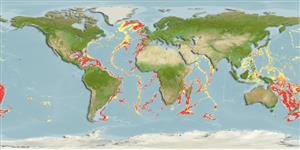
|
| This map was computer-generated and has not yet been reviewed. |
| Aphyonus gelatinosus AquaMaps Data sources: GBIF OBIS |
Upload your photos and videos
Pictures | Google image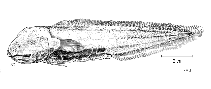 Aphyonus gelatinosus
Picture by FAO
Pictures | Google image
Picture by FAO
Classification / Names Common names | Synonyms | Catalog of Fishes(genus, species) | ITIS | CoL | WoRMS | Cloffa
Teleostei (teleosts) > Ophidiiformes (Cusk eels) > Bythitidae (Livebearing brotulas)
Etymology: Aphyonus: Greek, aphyes = sardine + Greek, onos = hake.
More on author: Günther.
Etymology: Aphyonus: Greek, aphyes = sardine + Greek, onos = hake.
More on author: Günther.
Environment: milieu / climate zone / depth range / distribution range Ecology
Marine; bathydemersal; depth range 625 - 2560 m (Ref. 105129). Deep-water
Distribution Territories | FAO areas | Ecosystems | Occurrences | Point map | Introductions | Faunafri
Indo-West Pacific: from off East Africa eastwards to Japan and New Zealand and in the Atlantic Ocean.
Size / Weight / Age
Maturity: Lm ? range ? - ? cm
Max length : 15.0 cm SL male/unsexed; (Ref. 7408); 14.8 cm SL (female)
Max length : 15.0 cm SL male/unsexed; (Ref. 7408); 14.8 cm SL (female)
Short description Identification keys | Morphology | Morphometrics
Dorsal soft rays (total): 92 - 118; Anal soft rays: 61 - 78. This species is distinguished by the following characters: with joined vertical fins and loose, transparent, scaleless skin; body depth at origin of anal fin 13.0-16.5% SL; eyes are small or not externally visible; mouth almost horizontal; upper jaw ends well behind the eye; palatines edentate; jaws with small blunt or pointed teeth, no fangs; vomer with 3-7 fangs; anterior gill arch with 3-4 long rakers; D 92-118; A 61-78; pectoral fin 17-20 rays, with peduncle as long as or a little longer than high; pelvic fin with one ray; caudal fin rays 6-8; precaudal vertebrae 28-33, total vertebrae 77-87; vertebral centra in adults almost rectangular in lateral view; vertebrae generally poorly ossified; sagittal otolith rather large, oval and thin; penis partly covered ventrally by genital hood that ends in a medially placed clasper ventral to penis; no paired claspers in both sexes; fresh specimens with black peritoneum (Ref. 105129).
Cross section: compressed.
Cross section: compressed.
Found on or near bottom (Ref. 6527). The well-developed penis and reported presence of numerous spermatophores in histologically examined testes indicate internal fertilization. Eggs are found up 1 mm in diameter, but embryos were not observed (Ref. 105129). Uncommon species (Ref. 34024).
Life cycle and mating behavior Maturity | Reproduction | Spawning | Eggs | Fecundity | Larvae
Main reference
Upload your references | References | Coordinator | Collaborators
Nielsen, J.G., 2015. Revision of the aphyonid genus Aphyonus (Teleostei: Ophidiiformes) with a new genus and two new species. Zootaxa 4039(2):323-344. (Ref. 105129)
CITES
Not Evaluated
Threat to humans
Harmless
Human uses
Fisheries: of no interest
FAO - Publication: search | FishSource |
More information
Trophic ecology
Food items (preys)
Diet composition
Food consumption
Food rations
Predators
Food items (preys)
Diet composition
Food consumption
Food rations
Predators
Ecology
Ecology
Ecology
Population dynamics
Growth parameters
Max. ages / sizes
Length-weight rel.
Length-length rel.
Length-frequencies
Mass conversion
Recruitment
Abundance
Growth parameters
Max. ages / sizes
Length-weight rel.
Length-length rel.
Length-frequencies
Mass conversion
Recruitment
Abundance
Life cycle
Reproduction
Maturity
Maturity/Gills rel.
Fecundity
Spawning
Spawning aggregations
Eggs
Egg development
Larvae
Larval dynamics
Reproduction
Maturity
Maturity/Gills rel.
Fecundity
Spawning
Spawning aggregations
Eggs
Egg development
Larvae
Larval dynamics
Anatomy
Gill area
Brain
Otolith
Gill area
Brain
Otolith
Physiology
Body composition
Nutrients
Oxygen consumption
Swimming type
Swimming speed
Visual pigments
Fish sound
Diseases & Parasites
Toxicity (LC50s)
Body composition
Nutrients
Oxygen consumption
Swimming type
Swimming speed
Visual pigments
Fish sound
Diseases & Parasites
Toxicity (LC50s)
Genetics
Genome
Genetics
Heterozygosity
Heritability
Genetic Diversity
Genome
Genetics
Heterozygosity
Heritability
Genetic Diversity
Human related
Aquaculture systems
Aquaculture profiles
Strains
Ciguatera cases
Stamps, coins, misc.
Aquaculture systems
Aquaculture profiles
Strains
Ciguatera cases
Stamps, coins, misc.
Tools
E-book | Field guide | Identification keys | Length-frequency wizard | Life-history tool | Point map |
Catch-MSY |
Special reports
Download XML
Internet sources
AFORO (otoliths) | Aquatic Commons | BHL | Cloffa | Websites from users | Check FishWatcher | CISTI | Catalog of Fishes: genus, species | DiscoverLife | ECOTOX | FAO - Publication: search | Faunafri | Fishipedia | Fishtrace | GloBI | Google Books | Google Scholar | Google | IGFA World Record | National databases | OneZoom | Open Tree of Life | Otolith Atlas of Taiwan Fishes | PubMed | Reef Life Survey | Socotra Atlas | TreeBase | Tree of Life | Wikipedia: Go, Search |