-

- About this page
- Languages
- User feedbacks
- Citation
- Uploads
-
Related species
- Species in
Thrissina - Species in
Engraulidae - - Classification -
- Coiliinae
- Engraulidae
- Clupeiformes
- Teleostei
- Chordata
- Animalia
- Species in
-



Upload your photos and videos
Google image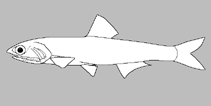 No image available for this species;
drawing shows typical species in Engraulidae.
Google image
drawing shows typical species in Engraulidae.
Classification / Names Common names | Synonyms | Catalog of Fishes(genus, species) | ITIS | CoL | WoRMS | Cloffa
Teleostei (teleosts) > Clupeiformes (Herrings) > Engraulidae (Anchovies) > Coiliinae
Etymology: mystica: Name 'mystica' from the Latin adjective meaning 'mystic', in allusion to the new species having been previously hidden under T. hamiltonii.
Etymology: mystica: Name 'mystica' from the Latin adjective meaning 'mystic', in allusion to the new species having been previously hidden under T. hamiltonii.
Environment: milieu / climate zone / depth range / distribution range Ecology
Marine; pelagic-neritic. Tropical
Distribution Territories | FAO areas | Ecosystems | Occurrences | Point map | Introductions | Faunafri
Indian Ocean: Kuwait, Pakistan, India, and Sri Lanka.
Size / Weight / Age
Short description Identification keys | Morphology | Morphometrics
Dorsal soft rays (total): 13 - 17; Anal soft rays: 37 - 44; Vertebrae: 44 - 46. This species is distinguished from its congeners by the following set of characters: maxilla moderate, its posterior tip slightly beyond posterior margin of opercle, but not reaching pectoral-fin insertion; teeth on both jaws small, not caniniform; first supramaxilla small, oval (sometimes absent); tip of snout above level of eye center; paired dark lines along dorsum from occipital area to caudal-fin base at least in preserved specimens; distinct black blotch behind upper part of gill opening; absence of saddle-like blotch on nape; anal fin with 4 (rarely 3) unbranched and 36-40 (modally 37; rarely 34 or 35) branched rays; transverse scales 11 or 12 (modally 11); scale rows in longitudinal series usually 39-41 (modally 40; rarely 38 or 42); 1UGR 9-11 (modally 10), 1LGR 13-16 (modally 15), 1TGR 23-26 (modally 24; rarely 22); 2UGR 8-10 (modally 9), 2LGR 14-16 (modally 15), 2TGR 22-26 (modally 24); 3UGR 6-8 (modally 7), 3LGR 8-10 (modally 9), 3TGR 15-18 (modally 16); 4UGR 5-9 (modally 7), 4LGR 8-10 (modally 9), 4TGR 13-17 (modally 16); gill rakers 2-6 (modally 4) on posterior face of third gill arch; abdomen covered with 16-20 (modally 17) + 9-11 (modally 10; rarely 12) = 26-30 (modally 28) keeled scutes; vertebrae mostly 45 (rarely 44 or 46); melanophores scattered on pectoral-fin rays of most individuals >110 mm SL; pelvic fin short, 7.4-8.7% (mean 8.0%) of SL; pre-dorsal-fin length short, 51.0-53.6% (52.3%) of SL; body elongate, depth 26.1-30.0% (27.7%) of SL; and anal-fin base long, 32.5-36.2% (34.2%) of SL (Ref. 138125).
Body shape (shape guide): elongated; Cross section: compressed.
Body shape (shape guide): elongated; Cross section: compressed.
Life cycle and mating behavior Maturity | Reproduction | Spawning | Eggs | Fecundity | Larvae
Main reference
Upload your references | References | Coordinator | Collaborators
Hata, H., S. Lavoué, P.N. Psomadakis, H.B. Osmany and H. Motomura, 2025. Thrissina mystica sp. nov., a new thryssa (Teleostei: Clupeiformes: Engraulidae: Coiliinae) from the northern Indian Ocean. Ichthyol. Res. 1-13. (Ref. 138125)
CITES
Not Evaluated
Threat to humans
Harmless
Human uses
Fisheries: of no interest
FAO - Publication: search | FishSource |
More information
Trophic ecology
Food items (preys)
Diet composition
Food consumption
Food rations
Predators
Food items (preys)
Diet composition
Food consumption
Food rations
Predators
Ecology
Ecology
Ecology
Population dynamics
Growth parameters
Max. ages / sizes
Length-weight rel.
Length-length rel.
Length-frequencies
Mass conversion
Recruitment
Abundance
Growth parameters
Max. ages / sizes
Length-weight rel.
Length-length rel.
Length-frequencies
Mass conversion
Recruitment
Abundance
Life cycle
Reproduction
Maturity
Maturity/Gills rel.
Fecundity
Spawning
Spawning aggregations
Eggs
Egg development
Larvae
Larval dynamics
Reproduction
Maturity
Maturity/Gills rel.
Fecundity
Spawning
Spawning aggregations
Eggs
Egg development
Larvae
Larval dynamics
Anatomy
Gill area
Brain
Otolith
Gill area
Brain
Otolith
Physiology
Body composition
Nutrients
Oxygen consumption
Swimming type
Swimming speed
Visual pigments
Fish sound
Diseases & Parasites
Toxicity (LC50s)
Body composition
Nutrients
Oxygen consumption
Swimming type
Swimming speed
Visual pigments
Fish sound
Diseases & Parasites
Toxicity (LC50s)
Genetics
Genome
Genetics
Heterozygosity
Heritability
Genetic Diversity
Genome
Genetics
Heterozygosity
Heritability
Genetic Diversity
Human related
Aquaculture systems
Aquaculture profiles
Strains
Ciguatera cases
Stamps, coins, misc.
Aquaculture systems
Aquaculture profiles
Strains
Ciguatera cases
Stamps, coins, misc.
Tools
Special reports
Download XML
Internet sources
AFORO (otoliths) | Aquatic Commons | BHL | Cloffa | Websites from users | Check FishWatcher | CISTI | Catalog of Fishes: genus, species | DiscoverLife | ECOTOX | FAO - Publication: search | Faunafri | Fishipedia | Fishtrace | GloBI | Google Books | Google Scholar | Google | IGFA World Record | OneZoom | Open Tree of Life | Otolith Atlas of Taiwan Fishes | PubMed | Reef Life Survey | Socotra Atlas | TreeBase | Tree of Life | Wikipedia: Go, Search |