



Upload your photos and videos
Google image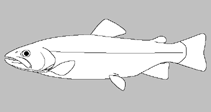 No image available for this species;
drawing shows typical species in Salmonidae.
Google image
drawing shows typical species in Salmonidae.
Classification / Names Common names | Synonyms | Catalog of Fishes(genus, species) | ITIS | CoL | WoRMS | Cloffa
Teleostei (teleosts) > Salmoniformes (Salmons) > Salmonidae (Salmonids) > Salmoninae
Etymology: Salvelinus: Old name for char; it is the same root of german "saibling" = little salmon (Ref. 45335).
More on author: Regan.
Etymology: Salvelinus: Old name for char; it is the same root of german "saibling" = little salmon (Ref. 45335).
More on author: Regan.
Environment: milieu / climate zone / depth range / distribution range Ecology
Freshwater; benthopelagic. Temperate; 60°N - 58°N, 4°W - 2°W
Distribution Territories | FAO areas | Ecosystems | Occurrences | Point map | Introductions | Faunafri
Europe: Orkney Islands (Heldale Water, Hoy Island), Scotland in UK (Loch Meallt, Isle of Skye). Considered extirpated on Orkney Islands since at least 1908, but no recent confirmation. This or a similar species has recently been found in Loch Meallt.
Size / Weight / Age
Short description Identification keys | Morphology | Morphometrics
Distinguished from congeners in British Isles by the following combination of characters: mouth subterminal, lower jaw shorter than upper; blunt snout; steel-grey flank, belly white to pinkish or bright orange; flank with numerous whitish spots, mainly in upper half of body; pectoral and anal fins orange-brown to orange-red, pelvic to cherry-red, with white anterior margin (weakly in pectorals); pectoral fin about 2/3 of head length (Ref. 59043).
Body shape (shape guide): fusiform / normal.
Body shape (shape guide): fusiform / normal.
Occurs in a small eutrophic lake with depth of up to 3 m. Feeds on sticklebacks, molluscs and insect larvae. Attains a maximum size of up to about 22 cm SL (Ref. 59043).
Life cycle and mating behavior Maturity | Reproduction | Spawning | Eggs | Fecundity | Larvae
Main reference
Upload your references | References | Coordinator | Collaborators
Kottelat, M. and J. Freyhof, 2007. Handbook of European freshwater fishes. Publications Kottelat, Cornol and Freyhof, Berlin. 646 pp. (Ref. 59043)
IUCN Red List Status (Ref. 130435: Version 2025-2 (Global))
Extinct (EX) ; Date assessed: 20 October 2023
CITES
Not Evaluated
Threat to humans
Harmless
Human uses
FAO - Publication: search | FishSource |
More information
Trophic ecology
Food items (preys)
Diet composition
Food consumption
Food rations
Predators
Food items (preys)
Diet composition
Food consumption
Food rations
Predators
Ecology
Ecology
Ecology
Population dynamics
Growth parameters
Max. ages / sizes
Length-weight rel.
Length-length rel.
Length-frequencies
Mass conversion
Recruitment
Abundance
Growth parameters
Max. ages / sizes
Length-weight rel.
Length-length rel.
Length-frequencies
Mass conversion
Recruitment
Abundance
Life cycle
Reproduction
Maturity
Maturity/Gills rel.
Fecundity
Spawning
Spawning aggregations
Eggs
Egg development
Larvae
Larval dynamics
Reproduction
Maturity
Maturity/Gills rel.
Fecundity
Spawning
Spawning aggregations
Eggs
Egg development
Larvae
Larval dynamics
Anatomy
Gill area
Brain
Otolith
Gill area
Brain
Otolith
Physiology
Body composition
Nutrients
Oxygen consumption
Swimming type
Swimming speed
Visual pigments
Fish sound
Diseases & Parasites
Toxicity (LC50s)
Body composition
Nutrients
Oxygen consumption
Swimming type
Swimming speed
Visual pigments
Fish sound
Diseases & Parasites
Toxicity (LC50s)
Genetics
Genome
Genetics
Heterozygosity
Heritability
Genetic Diversity
Genome
Genetics
Heterozygosity
Heritability
Genetic Diversity
Human related
Aquaculture systems
Aquaculture profiles
Strains
Ciguatera cases
Stamps, coins, misc.
Aquaculture systems
Aquaculture profiles
Strains
Ciguatera cases
Stamps, coins, misc.
Tools
Special reports
Download XML
Internet sources
AFORO (otoliths) | Aquatic Commons | BHL | Cloffa | Websites from users | Check FishWatcher | CISTI | Catalog of Fishes: genus, species | DiscoverLife | ECOTOX | FAO - Publication: search | Faunafri | Fishipedia | Fishtrace | GloBI | Google Books | Google Scholar | Google | IGFA World Record | OneZoom | Open Tree of Life | Otolith Atlas of Taiwan Fishes | PubMed | Reef Life Survey | Socotra Atlas | TreeBase | Tree of Life | Wikipedia: Go, Search | | Zoobank | Zoological Record
Estimates based on models
|
Phylogenetic diversity index (Ref. 82804) |
PD50 = 0.5000 [Uniqueness, from 0.5 = low to 2.0 = high]. |
| Bayesian length-weight | a=0.00977 (0.00473 - 0.02021), b=3.04 (2.87 - 3.21), in cm total length, based on LWR estimates for this (Sub)family-body shape (Ref. 93245). |
|
Trophic level (Ref. 69278) |
3.6 ±0.5 se; based on size and trophs of closest relatives |
|
Resilience (Ref. 120179) |
Medium, minimum population doubling time 1.4 - 4.4 years (Preliminary K or Fecundity.). |
|
Fishing Vulnerability (Ref. 59153) |
Moderate vulnerability (35 of 100). 🛈 |