This website uses cookies to enhance your browsing experience and ensure the functionality of our site. For more detailed information about the types of cookies we use and how we protect your privacy, please visit our Privacy Information page.
×
Cookie Settings
This website uses different types of cookies to enhance your experience. Please select your preferences below:
Teleostei (teleosts) > Perciformes/Percoidei (Perchs) > Percidae (Perches) > Etheostomatinae
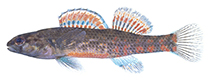
Etymology: Etheostoma:Greek, etheo = to strain + Greek, stoma = mouth; Rafinesque said "various mouths", but Jordan and Evermann suggest the name might have been intended as "Heterostoma (Ref. 45335); swaini:Named after an active ichthyologist in the late 1800s, J. S. Swain (Ref. 10294). Eponymy: Joseph Swain (1857–1927) was Professor of Mathematics and Biology at Indiana University (1883–1891) and a student of the author, David Starr Jordan, whom he followed (1891) to Stanford University and taught there as a professor of mathematics. (Ref. 128868), visit book page. More on author: Jordan.
Environment: milieu / climate zone / depth range / distribution range Ecology
North America: Gulf drainages from Ochlockonee River in Georgia and Florida to Mississippi River in Louisiana, and north on Former Mississippi Embayment (east of Mississippi River only) to Kentucky in the USA; in Bear Creek in northwestern Alabama and northeastern Mississippi, USA.
Size / Weight / Age
Maturity: Lm? range ? - ? cm Max length : 7.8 cm TL male/unsexed; (Ref. 5723); common length : 5.3 cm TL male/unsexed; (Ref. 12193)
Occurs in shallow rocky riffles, current-swept vegetation in headwaters, creeks and small to medium rivers (Ref. 5723); also found in streams (Ref. 10294). Feeds on midge larvae, with isopods and immature blackflies, mayflies, hydroptilid and hydropsychid caddisflies, and dragonflies (Ref. 10294).
Life cycle and mating behavior Maturity | Reproduction | Spawning | Eggs | Fecundity | Larvae
Page, L.M. and B.M. Burr, 1991. A field guide to freshwater fishes of North America north of Mexico. Houghton Mifflin Company, Boston. 432 p. (Ref. 5723)
IUCN Red List Status (Ref. 130435: Version 2025-2 (Global))