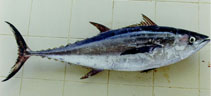
Thunnus tonggol, Longtail tuna : fisheries, gamefish

You can sponsor this page

Thunnus tonggol (Bleeker, 1851)

Longtail tuna
Lägg till din observation i Fish Watcher
Native range | All suitable habitat | Point map | Year 2050
This map was computer-generated and has not yet been reviewed.
Thunnus tonggol   AquaMaps   Data sources: GBIF OBIS
Ladda upp din foton och Videor
Bilder | Google image
Image of Thunnus tonggol (Longtail tuna)
Thunnus tonggol
Bild av Hermosa, Jr., G.V.

Common names from other countries

Klassificering / Namn Populärnamn | synonymer | Catalog of Fishes(Släkte, Arter) | ITIS | CoL | WoRMS | Cloffa

> Scombriformes (Mackerels) > Scombridae (Mackerels, tunas, bonitos) > Scombrinae
Etymology: Thunnus: Greek, thynnos = tunna (Ref. 45335).
More on author: Bleeker.

Miljö: miljö / Klimatzon / djupintervall / distributionsområde Ekologi

marina pelagic-neritic; havsvandrande (Ref. 51243); djupintervall 10 - ? m. Tropical; 47°N - 31°S, 34°E - 154°E (Ref. 54923)

Utbredning Territorier | FAO områden | Ekosystem | Förekomster | Prickkarta | Utplanteringar | Faunafri

Indo-West Pacific: Red Sea and East Africa to New Guinea, north to Japan, south to Australia. Reported in New Zealand (Ref. 89192).

Längd vid första mognad / Storlek / Vikt / Ålder

Könsmognad: Lm 60.7  range ? - ? cm
Max length : 145 cm FL hane/ej könsbestämd; (Ref. 40637); common length : 70.0 cm FL hane/ej könsbestämd; (Ref. 168); publicerad maxvikt: 35.9 kg (Ref. 168); rapporterad maxålder: 19 år (Ref. 97108)

Kort beskrivning Bestämningsnycklar | Morfologi | Morfometri

Ryggkotor: 39. A small species, deepest near the middle of the first dorsal fin base. The second dorsal fin is higher than the first dorsal fin; the pectoral fins are short to moderately long; swim bladder is absent or rudimentary. Lower sides and belly silvery white with colorless elongate oval spots arranged in horizontally oriented rows. The dorsal, pectoral and pelvic fins are blackish; the tip of the second dorsal and anal fins are washed with yellow; the anal fin is silvery; the dorsal and anal finlets are yellow with grayish margins; the caudal fin is blackish, with streaks of yellow green.
Body shape (shape guide): fusiform / normal; Cross section: oval.

Biologi     Ordlista (t.ex. epibenthic)

Predominantly neritic species avoiding very turbid waters and areas with reduced salinity such as estuaries. May form schools of varying size. Feeds on a variety of fishes, cephalopods, and crustaceans, particularly stomatopod larvae and prawns (Ref. 9684). Marketed mainly fresh and dried salted (Ref. 9684), but also smoked, canned and frozen (Ref. 9987).

Livscykel och parningsbeteende Könsmognad | Reproduktion | Lek | Ägg | Fekunditet | Larver

Huvudreferens Ladda upp dina referenser | referenser | Koordinator : Collette, Bruce B. | Medarbetare

Collette, B.B. and C.E. Nauen, 1983. FAO Species Catalogue. Vol. 2. Scombrids of the world. An annotated and illustrated catalogue of tunas, mackerels, bonitos and related species known to date. Rome: FAO. FAO Fish. Synop. 125(2):137 p. (Ref. 168)

Status på IUCN:s rödlista (Ref. 130435: Version 2025-2 (Global))

  Data deficient (DD) ; Date assessed: 01 July 2021

CITES

Not Evaluated

CMS (Ref. 116361)

Not Evaluated

Hot mot människor

  Harmless


Mänskliga användningsområden

Fiskeri: kommersiellt viktig; sportfisk: ja
FAO - fiskeri: landningar, artprofil; Publication: search | FIRMS - Stock assessments | FishSource | Havet omkring oss

Ytterligare information

Trofisk ekologi
Livsmedelsartiklar (preys)
Födosammansättning
Födointag
Matransoner
Predatorer
Ekologi
Ekologi
Home ranges
Populationsdynamik
Tillväxtparametrar
Max. åldrar / storlekar
Längd-vikt rel.
Längd-längd rel.
Längd-frekvenser
Massakonvertering
Rekrytering
Abundans
Livscykel
Reproduktion
Könsmognad
Mognad/Gills rel.
Fekunditet
Lek
Lekande aggregat
Ägg
Utveckling av ägg
Larver
Larvdynamik
Anatomi
Gälyta
Hjärna
Otolit
Fysiologi
Kroppssammansättning
Näringsämnen
Syreförbrukning
Typ av simning
Simhastighet
Visuella pigment
Ljud från fisk
Sjukdomar & Parasiter
Toxicitet (LC50)
Genetik
Genom
Genetik
Heterozygositet
Ärftlighet
Människorelaterad
Vattenbrukssystem
Vattenbruksprofiler
Avelslinjer
Ciguatera-fall
Frimärken, mynt, diverse.
Uppsökande verksamhet
Medarbetare
referenser
referenser

Verktyg

Särskilda rapporter

Ladda ner XML

Internet-källor

AFORO (otoliths) | Aquatic Commons | BHL | Cloffa | Websites from users | Check FishWatcher | CISTI | Catalog of Fishes: Släkte, Arter | DiscoverLife | ECOTOX | FAO - fiskeri: landningar, artprofil; Publication: search | Faunafri | Fishipedia | Fishtrace | GloBI | Google Books | Google Scholar | Google | IGFA World Record | Nationella databaser | OneZoom | Open Tree of Life | Otolith Atlas of Taiwan Fishes | PubMed | Reef Life Survey | Socotra Atlas | TreeBase | Tree of Life | Wikipedia: Go, sök | World Records Freshwater Fishing | Zoologiskt register

Uppskattningar baserade på modeller

Önskad temperatur (Ref. 123201): 13 - 28.4, mean 26.5 °C (based on 1398 cells).
Index för fylogenetisk mångfald (Ref. 82804):  PD50 = 0.5039   [Uniqueness, from 0.5 = low to 2.0 = high].
Bayesian length-weight: a=0.01413 (0.00818 - 0.02439), b=3.00 (2.86 - 3.14), in cm total length, based on LWR estimates for this species & Genus-body shape (Ref. 93245).
Trofisk nivå (Ref. 69278):  4.5   ±0.6 se; based on diet studies.
Resiliens (Ref. 120179):  Mellan, lägsta populationsfördubblingstid 1,4-4,4 år (K=0.36; assumed tm>2; tmax=19).
Prior r = 0.79, 95% CL = 0.52 - 1.18, Based on 2 full stock assessments.
Sårbarhet i fisket (Ref. 59153):  Moderate vulnerability (44 of 100). 🛈
Sårbarhet för klimatet (Ref. 125649):  High to very high vulnerability (75 of 100). 🛈
Priskategori (Ref. 80766):   Very high.
Näringsämnen (Ref. 124155):  Calcium = 48.2 [25.8, 117.5] mg/100g; Iron = 3.01 [1.19, 7.29] mg/100g; Protein = 23.2 [21.8, 24.6] %; Omega3 = 0.316 [0.191, 0.535] g/100g; Selenium = 101 [27, 327] μg/100g; VitaminA = 44 [6, 332] μg/100g; Zinc = 0.489 [0.265, 0.931] mg/100g (wet weight);