Thunnus maccoyii, Southern bluefin tuna : fisheries, aquaculture, gamefish

You can sponsor this page

Thunnus maccoyii (Castelnau, 1872)

Southern bluefin tuna
Adicionar sua observação em Fish Watcher
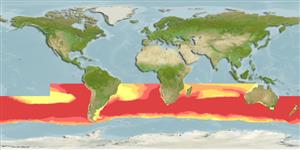
Native range | All suitable habitat | Point map | Year 2050
This map was computer-generated and has not yet been reviewed.
Thunnus maccoyii   AquaMaps   Data sources: GBIF OBIS
Carregue seu(sua) Fotos e vídeos
Fotos | Imagem do Google
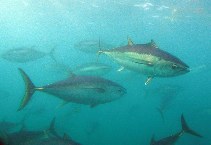
Image of Thunnus maccoyii (Southern bluefin tuna)
Thunnus maccoyii
Foto de Fritsches, K.

Common names from other countries

Classificação / Nomes Nomes comuns | Sinônimos | Catalog of Fishes(Gênero, Espécies) | ITIS | CoL | WoRMS | Cloffa

> Scombriformes (Mackerels) > Scombridae (Mackerels, tunas, bonitos) > Scombrinae
Etymology: Thunnus: Greek, thynnos = tunna (Ref. 45335).
Eponymy: Sir Frederick McCoy (1817–1899) was an Irish paleontologist and naturalist. [...] (Ref. 128868), visit book page.
More on author: Castelnau.

Meio ambiente: milieu / Zona climática / intervalo de profundidade / faixa de distribuição Ecologia

marinhas pelagic-oceanic; oceanódromo (Ref. 71039); intervalo de profundidade 0 - 2743 m (Ref. 57178). Temperate; 5°C - 20°C (Ref. 168); 10°S - 60°S, 180°W - 180°E (Ref. 54921)

Distribuição Territórios | Áreas da FAO | Ecossistemas | Ocorrências | Mapa de pontos | Introduções | Faunafri

Atlantic, Indian and Pacific: temperate and cold seas, mainly between 30°S and 50°S, to nearly 60°S. During spawning, large fish migrate to tropical seas, off the west coast of Australia, up to 10°S. Highly migratory species. If the current exploitation continues, the population will be below 500 mature individuals in 100 years (Ref. 27905).

Comprimento de primeira maturação / Tamanho / Peso / Idade

Maturidade: Lm 122.0, range 120 - 130 cm
Max length : 245 cm FL macho/indeterminado; (Ref. 5203); common length : 160 cm FL macho/indeterminado; (Ref. 9684); peso máx. publicado: 260.0 kg (Ref. 5203); idade máx. registrada: 20 anos (Ref. 168)

Descrição suscinta Chaves de identificação | Morfologia | Morfometria

Vértebras: 39. A very large species, deepest near the middle of the first dorsal fin base. Swim bladder present. Lower sides and belly silvery white with colorless transverse lines alternating with rows of colorless dots. The first dorsal fin is yellow or bluish; the anal fin and finlets are dusky yellow edged with black; the median caudal keel is yellow in adults.
Body shape (shape guide): fusiform / normal; Cross section: oval.

Biologia     Glossário (p.ex. epibenthic)

By maturity, most southern bluefin tuna lead an oceanic, pelagic existence (Ref. 6390). Spawning fish and larvae are encountered in waters with surface temperatures between 20° and 30°C. An opportunistic feeder, preying on a wide variety of fishes, crustaceans, cephalopods, salps, and other marine animals. Mostly canned (Ref. 9684). A specialized fishery for sashimi-quality has been developed recently by New Zealand fishers. In Japan, it is highly prized for the sashimi markets.

Ciclo de vida ou comportamento de acasalamento Maturidade | Reprodução | Desova | Ovos | Fecundidade | Larvas

It is not known whether all mature fish spawn each year, every few years, or even only once in their lifetime (Ref. 30320).

Referência principal Carregar suas referências | Referências | Coordenador : Collette, Bruce B. | Colaboradores

Collette, B.B. and C.E. Nauen, 1983. FAO Species Catalogue. Vol. 2. Scombrids of the world. An annotated and illustrated catalogue of tunas, mackerels, bonitos and related species known to date. Rome: FAO. FAO Fish. Synop. 125(2):137 p. (Ref. 168)

Status na Lista Vermelha da UICN (Ref. 130435: Version 2025-2 (Global))

  Em perigo (EN) (A1bd); Date assessed: 15 January 2021

CITES

Not Evaluated

CMS (Ref. 116361)

Not Evaluated

Ameaça para os humanos

  Harmless


Uso pelos humanos

Pescarias: espécies comerciais; Aquacultura: espécies comerciais; peixe esportivo: sim
FAO - Sistemas de aquicultura: produção; pescarias: desembarques, perfil da espécie; Publication: search | FIRMS - Stock assessments | FishSource | Sea Around Us

Mais informação

Ecologia Trófica
Itens alimentares (presas)
Composição da dieta
Consumo alimentar
Rações alimentares
Predadores
Ecologia
Ecologia
Home ranges
Ciclo de vida
Reprodução
Maturidade
Maturidade/Rel. das guelras
Fecundidade
Desova
Agregações de desova
Ovos
Desenvolvimento dos ovos
Larvas
Dinâmica larval
Anatomia
Área branquial
Cérebro
Otólito
Fisiologia
Composição corporal
Nutrientes
Consumo de oxigênio
Tipo de natação
Velocidade de natação
Pigmentos visuais
Som de peixe
Doenças e Parasitas
Toxicidade (LC50s)
Genética
genoma
Genética
Heterozigosidade
Hereditariedade
Relacionado a humanos
Sistemas de aquicultura
Perfis para aquacultura
Estirpes
Casos de Ciguatera
Selos, moedas, diversos.
Divulgação
Colaboradores
Referências
Referências

Ferramentas

Relatórios especiais

Baixar XML

Fontes da internet

AFORO (otoliths) | Aquatic Commons | BHL | Cloffa | Websites from users | Checar Observador de Peixes (FishWatcher) | CISTI | Catalog of Fishes: Gênero, Espécies | DiscoverLife | ECOTOX | FAO - Sistemas de aquicultura: produção; pescarias: desembarques, perfil da espécie; Publication: search | Faunafri | Fishipedia | Fishtrace | GloBI | Google Books | Google Scholar | Google | IGFA World Record | Bases de dados nacionais | OneZoom | Open Tree of Life | Otolith Atlas of Taiwan Fishes | PubMed | Reef Life Survey | Socotra Atlas | TreeBase | Árvore da vida | Wikipedia: Ir para, procura | World Records Freshwater Fishing | Registro zoológico

Estimativas baseadas em modelos

Temperatura preferida (Ref. 123201): 2.5 - 7.9, mean 5 °C (based on 439 cells).
Índice de diversidade filogenética (Ref. 82804):  PD50 = 0.5039   [Uniqueness, from 0.5 = low to 2.0 = high].
Bayesian length-weight: a=0.01288 (0.01070 - 0.01552), b=3.03 (3.00 - 3.06), in cm total length, based on LWR estimates for this species (Ref. 93245).
Nível Trófico (Ref. 69278):  3.9   ±0.53 se; based on food items.
Resiliência (Ref. 120179):  Baixo, tempo mínimo de duplicação da população 4,5 - 14 anos (K=0.14-0.15; tm=8-9; tmax=20; Fec=14 million).
Prior r = 0.27, 95% CL = 0.18 - 0.41, Based on 1 full stock assessment.
Vulnerabilidade da pesca (Ref. 59153):  High to very high vulnerability (67 of 100). 🛈
Vulnerabilidade climática (Ref. 125649):  Moderate vulnerability (38 of 100). 🛈
Categoria de preço (Ref. 80766):   Very high.
Nutrientes (Ref. 124155):  Calcium = 9.89 [5.80, 19.12] mg/100g; Iron = 0.922 [0.355, 2.441] mg/100g; Protein = 23.2 [21.7, 24.6] %; Omega3 = 0.74 [0.44, 1.24] g/100g; Selenium = 31.2 [8.4, 97.4] μg/100g; VitaminA = 22 [3, 199] μg/100g; Zinc = 0.245 [0.131, 0.490] mg/100g (wet weight);