Sarda sarda, Atlantic bonito : fisheries, gamefish

You can sponsor this page

Sarda sarda (Bloch, 1793)

Atlantic bonito
Aggiungete la vostra osservazione in Fish Watcher
Native range | All suitable habitat | Point map | Year 2050
This map was computer-generated and has not yet been reviewed.
Sarda sarda   AquaMaps   Data sources: GBIF OBIS
Carica il tuo foto e Video
Immagini | Francobolli, monete, materiale vario. | Google image
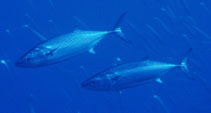
Image of Sarda sarda (Atlantic bonito)
Sarda sarda
Immagine di Wirtz, P.

Common names from other countries

Classificazione / Nomi Nomi Comuni | Sinonimi | Catalog of Fishes(Genere, Specie) | ITIS | CoL | WoRMS | Cloffa

> Scombriformes (Mackerels) > Scombridae (Mackerels, tunas, bonitos) > Scombrinae
Etymology: Sarda: Latin and Greek, sarda = sardine; name related to the island of Sardinia (Ref. 45335).
More on author: Bloch.

Ambiente: milieu / zona climatica / distribuzione batimetrica / gamma di distribuzione Ecologia

marino; salmastro pelagic-neritic; oceanodromo (Ref. 51243); distribuzione batimetrica 80 - 200 m (Ref. 5377). Subtropical; 12°C - 27°C (Ref. 168); 62°N - 40°S, 98°W - 42°E (Ref. 54865)

Distribuzione Territories | Aree FAO | Ecosistemi | Presenze | Mappa dei ritrovamenti | Introduzioni | Faunafri

Eastern Atlantic: Oslo, Norway to Port Elizabeth, South Africa. Also known from the Mediterranean and Black Sea. Western Atlantic: Nova Scotia, Canada to Florida, USA and northern Gulf of Mexico; then from Colombia, Venezuela, and south of the Amazon River to northern Argentina; apparently absent from most of the Caribbean Sea.

Lunghezza alla prima maturità / Dimensione / Peso / Età

Maturità: Lm 37.8, range 41 - ? cm
Max length : 91.4 cm FL maschio/sesso non determinato; (Ref. 168); common length : 50.0 cm FL maschio/sesso non determinato; (Ref. 168); peso massimo pubblicato: 11.0 kg (Ref. 40637); Età massima riportata: 5 anni (Ref. 29114)

Breve descrizione Chiavi di identificazione | Morfologia | Morfometria

Spine dorsali (totale) : 20 - 23; Raggi dorsali molli (totale) : 15 - 18; Spine anali: 0; Raggi anali molli: 14 - 17; Vertebre: 50 - 55. Mouth moderately large. Laminae of olfactory rosette 21-39. Interpelvic process small and bifid. Body completely covered with very small scales posterior to the corselet. Swim bladder absent. Spleen large. Liver with elongate left and right lobe and short middle lobe. Oblique dorsal stripes with a greater angle than in other species of Sarda.
Body shape (shape guide): fusiform / normal; Cross section: oval.

Biologia     Glossario (es. epibenthic)

Epipelagic, neritic and schooling species that may enter estuaries. Known to be cannibalistic, adults prey on small schooling fishes, invertebrates like squid and shrimps and can swallow relatively large prey. Eggs and larvae pelagic (Ref. 6769). Utilized fresh, dried or salted, smoked, canned and frozen (Ref. 9987). Able to adapt to different temperatures 12° to 27°C and salinities 14 to 39 (Ref. 36731).

Ciclo vitale e comportamento di accoppiamento Maturità | Riproduzione | Deposizione | Uova | Fecondità | Larve

Riferimento principale Caricare le referenze | Bibliografia | Coordinatore : Collette, Bruce B. | Collaboratori

Collette, B.B. and C.E. Nauen, 1983. FAO Species Catalogue. Vol. 2. Scombrids of the world. An annotated and illustrated catalogue of tunas, mackerels, bonitos and related species known to date. Rome: FAO. FAO Fish. Synop. 125(2):137 p. (Ref. 168)

Stato della Lista Rossa IUCN (Ref. 130435: Version 2025-2 (Global))

  Least Concern (LC) ; Date assessed: 15 November 2021

CITES

Not Evaluated

CMS (Ref. 116361)

Not Evaluated

Minaccia per l'uomo

  Reports of ciguatera poisoning (Ref. 30303)


Usi umani

Pesca: elevato interesse commerciale; Pesce da pesca sportiva: si
FAO - pesca: sbarchi, profilo della specie; Publication: search | FishSource | Sea Around Us

Informazioni ulteriori

Ecologia trofica
Articoli alimentari (prede)
Alimentazione
Consumo di cibo
Razioni alimentari
Predatori
Ecologia
Ecologia
Home ranges
Ciclo di vita
Riproduzione
Maturità
Maturità/Gli occhielli sono relativi.
Fecondità
Deposizione
Aggregazioni riproduttive
Uova
Sviluppo delle uova
Larve
Dinamica popolazioni larvali
Distribuzione
Territories
Aree FAO
Ecosistemi
Presenze
Introduzioni
BRUVS - Video
Anatomia
Area branchiale
Cervello
Otolite
Fisiologia
Composizione corporea
Nutrienti
Consumo di ossigeno
Tipo di nuoto
Velocità di nuoto
Pigmenti visivi
Suono del pesce
Malattie e parassiti
Tossicità (LC50)
Genetica
Genome
Genetica
Eterozigosi
Ereditarietà
Legato all'uomo
Sistemi di acquacoltura
Profili di acquacoltura
Varietà
Casi di Ciguatera
Francobolli, monete, materiale vario.
Raggiungimento
Collaboratori
Bibliografia
Bibliografia

Strumenti

Rapporti speciali

Scarica XML

Fonti Internet

Stime basate su modelli

Temperatura preferita (Fonte Biblio. 123201): 7 - 23.4, mean 10.7 °C (based on 346 cells).
Indice di diversità filogenetica (Fonte Biblio. 82804):  PD50 = 0.5312   [Uniqueness, from 0.5 = low to 2.0 = high].
Bayesian length-weight: a=0.00871 (0.00764 - 0.00993), b=3.06 (3.02 - 3.10), in cm total length, based on LWR estimates for this species (Ref. 93245).
Livello trofico (Fonte Biblio. 69278):  4.5   ±0.0 se; based on diet studies.
Generation time: 2.5 (1.4 - 3.1) years. Estimated as median ln(3)/K based on 14 growth studies.
Resilienza (Fonte Biblio. 120179):  Medio, tempo minimo di raddoppiamento della popolazione 1.4 - 4.4 anni (K=0.46; tm>1; tmax=5).
Prior r = 0.57, 95% CL = 0.37 - 0.85, Based on 9 data-limited stock assessments.
Vulnerabilità della pesca (Ref. 59153):  Low to moderate vulnerability (33 of 100). 🛈
Vulnerabilità climatica (Ref. 125649):  Moderate to high vulnerability (48 of 100). 🛈
Categoria di prezzo (Ref. 80766):   High.
Nutrienti (Ref. 124155):  Calcium = 48.6 [29.8, 70.5] mg/100g; Iron = 3.05 [1.93, 4.90] mg/100g; Protein = 21.2 [20.2, 22.1] %; Omega3 = 0.438 [0.198, 0.939] g/100g; Selenium = 34.7 [24.6, 48.6] μg/100g; VitaminA = 9.6 [3.1, 34.2] μg/100g; Zinc = 0.505 [0.409, 0.700] mg/100g (wet weight); based on nutrient studies.