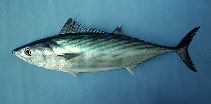
Common names from other countries
>
Scombriformes (Mackerels) >
Scombridae (Mackerels, tunas, bonitos) > Scombrinae
Etymology: Sarda: Latin and Greek, sarda = sardine; name related to the island of Sardinia (Ref. 45335); chiliensis: Named after Chile, South America (Ref. 6885).
More on author: Cuvier.
Taxonomic Remarks
Issue on validity of subspecies: subspecies considered as valid in FB, elevated to species rank as Sarda chiliensis (Cuvier, 1832) in Eschmeyer (CofF ver. May 2011: Ref. 86870).
محیط زیست: محیط زیست / منطقه آب و هوایی / تغييرات عمق / محدوده توزیع
بوم شناسي
دريايي pelagic-neritic; اقیانوس رو (Ref. 51243); تغييرات عمق 0 - 100 m. Subtropical; 60°N - 37°S, 149°W - 70°W (Ref. 168)
Southeast Pacific: northern Peru to Talcahuano, Chile (Ref. 9340). The northern subspecies Sarda chiliensis lineolata occurs from off the coast of Alaska, southward to Cabo San Lucas at the tip of Baja California, and in the Revillagigedo Islands.
طول در اولین بلوغ / اندازه / وزن / سن
بلوغ: Lm 47.0 range ? - ? cm
Max length : 102 cm TL جنس نر / بدون خواص جنسي; (Ref. 9015); بيشينه وزن گزارش شده: 11.3 kg (Ref. 168)
خارهاي باله پشتي (کل) : 17 - 19; شعاع نرم باله مخرجي: 12 - 15; مهره ها: 42 - 46. Mouth moderately large. Laminae of olfactory rosette 21 to 39. Interpelvic process small and bifid. Swim bladder absent. Spleen large and prominent in ventral view. Liver with elongate left and right lobes and a short middle lobe. Body completely covered with very small scales posterior to the corselet.
Body shape (shape guide): fusiform / normal; Cross section: oval.
A coastal species that reaches sexual maturity at two years of age (Ref. 9340). Older individuals are encountered farther from the coast as compared to the juveniles (Ref. 9340). Spawning is discontinuous and a female of 3 kg may produce millions of eggs per season (Ref. 9340). Forms schools by size. Feeds on a variety of small schooling fishes, squids and shrimps. This species is important to the recreational hook and line fishery operating from private and party boats, piers and jetties, and from the shore. Also caught with encircling nets (Ref. 9340). Utilized fresh, canned and frozen; eaten broiled and baked (Ref. 9988).
چرخه زندگی و رفتار جفتگیری
بلوغ | تولید مثل | تخم ریزی | تخم ها | باروری | توزاد ( لارو)
Collette, B.B. and C.E. Nauen, 1983. FAO Species Catalogue. Vol. 2. Scombrids of the world. An annotated and illustrated catalogue of tunas, mackerels, bonitos and related species known to date. Rome: FAO. FAO Fish. Synop. 125(2):137 p. (Ref. 168)
وضعيت در فهرست قرمز IUCN (Ref. 130435: Version 2025-2 (Global))
خطر برای انسان ها
Harmless
استفاده انسانی
ماهي گيري – شيلات: با ارزش تجاري بالا; ماهي ها ي سرگرم كننده: بله
ابزارها
گزارش های ويژه
بارگيری XML
منابع اينترنتي
تخمینها بر اساس مدلها
دمای ترجیحی (مرجع
123201): 14.6 - 23.1, mean 18.5 °C (based on 30 cells).
شاخص تنوع فیلوژنتیکی (مرجع
82804): PD
50 = 0.5312 [Uniqueness, from 0.5 = low to 2.0 = high].
Bayesian length-weight: a=0.00955 (0.00836 - 0.01090), b=3.06 (3.02 - 3.10), in cm total length, based on LWR estimates for this species (Ref.
93245).
سطح تروفیک (مرجع
69278): 4.5 ±0.3 se; based on diet studies.
Generation time: 7.1 ( na - na) years. Estimated as median ln(3)/K based on 2
growth studies.
جهندگی (مرجع
120179): متوسط, كمينه زمان لازم براي دو برابر شدن جمعيت 4/1 – 4/4 سال (K=0.15; tm=2).
Prior r = 0.51, 95% CL = 0.33 - 0.76, Based on 1 data-limited stock assessment.
آسیبپذیری ماهیگیری (Ref.
59153): Moderate vulnerability (36 of 100).
🛈
آسیبپذیری اقلیمی (Ref.
125649): High to very high vulnerability (71 of 100).
🛈
مواد مغذی (Ref.
124155): Calcium = 43 [25, 69] mg/100g; Iron = 2.8 [1.6, 4.8] mg/100g; Protein = 20.9 [19.8, 22.0] %; Omega3 = 0.363 [0.167, 0.758] g/100g; Selenium = 30.3 [17.5, 50.6] μg/100g; VitaminA = 12.1 [4.4, 36.7] μg/100g; Zinc = 0.427 [0.325, 0.634] mg/100g (wet weight);