Auxis thazard, Frigate tuna : fisheries, gamefish

You can sponsor this page

Auxis thazard (Lacepède, 1800)

Frigate tuna
Adicionar as suas observações no Fish Watcher
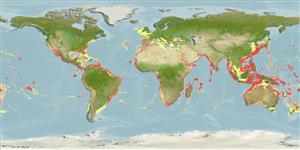
Native range | All suitable habitat | Point map | Year 2050
This map was computer-generated and has not yet been reviewed.
Auxis thazard   AquaMaps   Data sources: GBIF OBIS
Adicionar o seu Fotografias e vídeos
Fotografias | Selos, moedas, diversos. | Imagem do Google

Common names from other countries

Classificação / Nomes Nomes comuns | Sinónimos | Catalog of Fishes(Género, Espécies) | ITIS | CoL | WoRMS | Cloffa

> Scombriformes (Mackerels) > Scombridae (Mackerels, tunas, bonitos) > Scombrinae
Etymology: Auxis: Greek, auxis = a variety of tunna (Ref. 45335).
More on author: Lacepède.

Ambiente: milieu / zona climática / intervalo de profundidade / gama de distribuição Ecologia

marinhas pelagic-neritic; oceanódromo (Ref. 71039); intervalo de profundidade 50 - ? m (Ref. 9340). Subtropical; 27°C - 28°C; 61°N - 51°S, 180°W - 180°E

Distribuição Territórios | Áreas FAO | Ecossistemas | Ocorrências | Mapa dos pontos | Introduções | Faunafri

Atlantic,Mediterranean, Indian and Pacific (Western Central). Eastern Pacific population recognized as subspecies Auxis thazard brachydorax (Ref. 32349). Many authors have used the name Auxis thazard as including Auxis rochei in the belief that there was only a single worldwide species of Auxis. Highly migratory species.

Comprimento na primeira maturidade / Tamanho / Peso / Idade

Maturidade: Lm 29.5, range 29 - ? cm
Max length : 65.0 cm FL macho/indeterminado; (Ref. 29114); common length : 60.0 cm TL macho/indeterminado; (Ref. 47377); peso máx. Publicado: 1.7 kg (Ref. 40637); Idade máx. registada: 5 anos (Ref. 29114)

Descrição breve Chaves de identificação | Morfologia | Morfometria

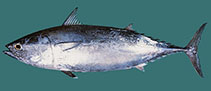
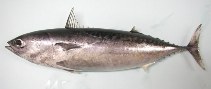
Espinhos dorsais (total) : 10 - 12; Raios dorsais moles (total) : 10 - 13; Espinhos anais: 0; Raios anais moles: 10 - 14. This species is distinguished by the following characters: a robust body, elongated and rounded; teeth small and conical, in a single series; total gill rakers on first gill arch 36-42; dorsal fins 2, D1 X-XII, separated from the second by a large interspace (at least equal to length of first dorsal-fin base), second dorsal fin followed by 8 finlets; anal fin followed by 7 finlets; pectoral fins short, but reaching past vertical line from anterior margin of scaleless area above corselet; a large single-pointed flap (interpelvic process) between pelvic fins; body naked except for the corselet, which is well developed and narrow in its posterior part (no more than 5 scales wide under second dorsal-fin origin); a strong central keel on each side of caudal-fin base between 2 smaller keels. Colour of back bluish, turning to deep purple or almost black on the head; a pattern of 15 or more narrow, oblique to nearly horizontal, dark wavy lines in scaleless area above lateral line; belly white; pectoral and pelvic fins purple, inner sides black (Ref 9684).
Body shape (shape guide): fusiform / normal; Cross section: oval.

Biologia     Glossário (ex. epibenthic)

Adults are epipelagic in neritic and oceanic waters (Ref. 9340). They feed on small fish, squids, planktonic crustaceans (megalops), and stomatopod larvae (Ref. 5213). Because of their abundance, they are considered an important element of the food web, particularly as forage for other species of commercial interest. They are preyed upon by larger fishes, including other tunas (Ref. 9987). Marketed fresh and frozen (Ref. 9340) and also utilized dried or salted, smoked and canned (Ref. 9987).

Ciclo de vida e comportamento de acasalamento Maturidade | Reprodução | Desova | Ovos | Fecundidade | Larvas

In correlation with temperature and other environmental changes, the spawning season varies with areas, but in some places it may even extend throughout the year.

Referência principal Carregar as suas referências | Referências | Coordenador : Collette, Bruce B. | Colaboradores

Collette, B.B. and C.R. Aadland, 1996. Revision of the frigate tunas (Scombridae, Auxis), with descriptions of two new subspecies from the eastern Pacific. Fish. Bull. 94(3):423-441. (Ref. 32349)

Categoria na Lista Vermelha da IUCN (Ref. 130435: Version 2025-2 (Global))

  Preocupação menor (LC) ; Date assessed: 01 March 2022

CITES

Not Evaluated

CMS (Ref. 116361)

Not Evaluated

Ameaça para o homem

  Harmless


Utilização humana

Pescarias: altamente comercial; peixe desportivo: sim
FAO - pescarias: desembarques, perfil da espécie; Publication: search | FIRMS - Stock assessments | FishSource | Sea Around Us

Mais informação

Ecologia Trófica
Produtos alimentares (presas)
Composição da dieta
Consumo alimentar
Rações alimentares
Predadores
Ecologia
Ecologia
Home ranges
Ciclo de vida
Reprodução
Maturidade
Maturidade/Rel. das guelras
Fecundidade
Desova
Agregações de desova
Ovos
Desenvolvimento dos ovos
Larvas
Dinâmica larvar
Anatomia
Área branquial
Cérebro
Otólitos
Fisiologia
Composição corporal
Nutrientes
Consumo de oxigénio
Tipo de natação
Velocidade de natação
Pigmentos visuais
Som de peixe
Doenças e Parasitas
Toxicidade (LC50s)
Genética
genoma
Genética
Heterozigotia
Hereditariedade
Relacionado com o ser humano
Sistemas de aquacultura
Perfis para aquacultura
Estirpes
Casos de Ciguatera
Selos, moedas, diversos.
Divulgação
Colaboradores
Referências
Referências

Ferramentas

Relatórios especiais

Descarregue XML

Fontes da internet

AFORO (otoliths) | Aquatic Commons | BHL | Cloffa | Websites from users | Consultar FishWatcher | CISTI | Catalog of Fishes: Género, Espécies | DiscoverLife | ECOTOX | FAO - pescarias: desembarques, perfil da espécie; Publication: search | Faunafri | Fishipedia | Fishtrace | GloBI | Google Books | Google Scholar | Google | IGFA World Record | Bases de dados nacionais | OneZoom | Open Tree of Life | Otolith Atlas of Taiwan Fishes | PubMed | Reef Life Survey | Socotra Atlas | TreeBase | Árvore da vida | Wikipedia: ir para, procurar | World Records Freshwater Fishing | Registo zoológico

Estimativas baseadas em modelos

Temperatura preferida (Ref. 123201): 13.8 - 27.1, mean 22 °C (based on 986 cells).
Índice de diversidade filogenética (Ref. 82804):  PD50 = 0.5625   [Uniqueness, from 0.5 = low to 2.0 = high].
Bayesian length-weight: a=0.00977 (0.00850 - 0.01124), b=3.07 (3.03 - 3.11), in cm total length, based on LWR estimates for this species (Ref. 93245).
Nível Trófico (Ref. 69278):  4.4   ±0.4 se; based on diet studies.
Generation time: 1.5 (1.3 - 1.9) years. Estimated as median ln(3)/K based on 18 growth studies.
Resiliência (Ref. 120179):  Médio, tempo mínimo de duplicação da população 1,4 - 4,4 anos (K=0.71; tm).
Prior r = 0.57, 95% CL = 0.37 - 0.85, Based on 4 data-limited stock assessments.
Vulnerabilidade da pesca (Ref. 59153):  Low to moderate vulnerability (28 of 100). 🛈
Vulnerabilidade climática (Ref. 125649):  Low to moderate vulnerability (28 of 100). 🛈
Categoria de preço (Ref. 80766):   Very high.
Nutrientes (Ref. 124155):  Calcium = 200 [57, 445] mg/100g; Iron = 2.61 [0.96, 6.35] mg/100g; Protein = 21.6 [19.6, 23.5] %; Omega3 = 0.324 [0.153, 0.683] g/100g; Selenium = 65.1 [25.8, 204.4] μg/100g; VitaminA = 21.9 [4.9, 83.8] μg/100g; Zinc = 1.2 [0.4, 2.2] mg/100g (wet weight); based on nutrient studies.