Common names from other countries
>
Cypriniformes (Carps) >
Tincidae (Tenches)
Etymology: Tinca: Latin, timica; realted to a predatory fish = timi, but the etymology of tench does not conform with this meaning (Ref. 45335); tinca: tinca which is the latin name for tench (Ref. 1998).
More on author: Linnaeus.
Meio ambiente: milieu / Zona climática / intervalo de profundidade / faixa de distribuição
Ecologia
; Água doce; estuarina demersal; potamódromo (Ref. 126106); intervalo de profundidade 1 - ? m (Ref. 26368). Temperate; 4°C - 24°C (Ref. 13614); 64°N - 36°N, 10°W - 104°E
Eurasia: hypothesized as native in most Europe, naturally absent only in Ireland, Scandinavia north of 61°30'N, eastern Adriatic basin and western and southern Greece where it is now introduced. In Asia, native eastward to western Yenisei drainage south of 60° N. Introduced elsewhere.
Comprimento de primeira maturação / Tamanho / Peso / Idade
Maturidade: Lm ?, range 20 - ? cm
Max length : 70.0 cm SL macho/indeterminado; (Ref. 44894); common length : 20.0 cm TL macho/indeterminado; (Ref. 556); peso máx. publicado: 7.5 kg (Ref. 556)
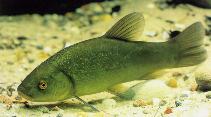
Espinhos dorsais (total) : 4; Raios dorsais (total) : 8 - 9; Espinhos anais: 3 - 4; Raios anais : 6 - 8; Vértebras: 39 - 41. Body thickset, heavy, and laterally compressed, the caudal peduncle characteristically deep and short. Skin thickened, slimy; the scales small, embedded. Overall coloration olive-green, at times dark green or almost black, with golden reflections on ventral surface. Head triangular, eye orange-red, small; snout relatively long; interorbital broad; mouth terminal, small in size with thick lips and a pair of well-developed barbels, one at each corner of the mouth. Caudal fin with 19 rays (Ref. 2196). Diagnosed from other cyprinid species in Europe by the following characters: body golden greenish brown; one pair of barbel (maxillary); lateral line with 96-115 scales, small and deeply embedded; dorsal fin with 8-9½ branched rays; and anal fin with 6-9½ branched rays (Ref. 59043).
Body shape (shape guide): fusiform / normal.
Typically found in shallow, densely vegetated lakes and backwaters. They often overwinter buried in mud. Larvae and juveniles confined to dense vegetation (Ref. 59043). Adults inhabit warm lakes and pools with weed and mud bottom. Tolerates low oxygen saturations (Ref. 30578, 44894). Feeds on detritus, benthic animals and plant materials. Adult often prey mainly on molluscs. They spawn among dense vegetation in still water (Ref. 59043). Used as a fodder fish for bass (Ref. 7248). Utilized fresh and frozen; eaten pan-fried, broiled, and baked (Ref. 9988). Popular with amateur sport fishers. Flesh is highly esteemed (Ref. 30578). Locally under threat due to river engineering (Ref. 59043). Reported to reach a maximum length of 84 cm TL (Ref. 5723).
Males reproduce at 2-3 years and females at 3-7 years. Spawning happens, depending on latitude, between May and September, at temperatures of 19 20°C. Lays numerous sticky green eggs on plants or on the botton every 1 5 days for 2 months. Incubation at 20°C lasts 3 days. Larvae remain attached to the plants for several days until the vitellus is used up. Egg size 0.8-1.0 mm, larval length at hatching 4-5 mm.
Kottelat, M. and J. Freyhof, 2007. Handbook of European freshwater fishes. Publications Kottelat, Cornol and Freyhof, Berlin. 646 pp. (Ref. 59043)
Status na Lista Vermelha da UICN (Ref. 130435: Version 2025-2 (Global))
Ameaça para os humanos
Harmless
Uso pelos humanos
Pescarias: espécies comerciais; Aquacultura: espécies comerciais; peixe esportivo: sim; Aquário: Aquários públicos
Ferramentas
Relatórios especiais
Baixar XML
Fontes da internet
Estimativas baseadas em modelos
Índice de diversidade filogenética (Ref.
82804): PD
50 = 1.5000 [Uniqueness, from 0.5 = low to 2.0 = high].
Bayesian length-weight: a=0.01122 (0.00809 - 0.01557), b=3.02 (2.93 - 3.11), in cm total length, based on LWR estimates for this species (Ref.
93245).
Nível Trófico (Ref.
69278): 3.7 ±0.0 se; based on diet studies.
Generation time: 8.9 ( na - na) years. Estimated as median ln(3)/K based on 2
growth studies.
Resiliência (Ref.
120179): médio(a), tempo mínimo de duplicação da população 1,4 - 4,4 anos (tm=2; tmax=10; Fec=120,000-800,000).
Vulnerabilidade da pesca (Ref.
59153): High vulnerability (58 of 100).
🛈
Nutrientes (Ref.
124155): Calcium = 63.1 [30.7, 116.5] mg/100g; Iron = 0.745 [0.348, 1.410] mg/100g; Protein = 18.7 [16.8, 20.5] %; Omega3 = 0.696 [0.352, 1.429] g/100g; Selenium = 10.2 [5.2, 20.9] μg/100g; VitaminA = 16.9 [5.5, 52.5] μg/100g; Zinc = 0.948 [0.429, 1.762] mg/100g (wet weight); based on
nutrient studies.