Epinephelus marginatus, Dusky grouper : fisheries, gamefish

You can sponsor this page

Epinephelus marginatus (Lowe, 1834)

Dusky grouper
Lägg till din observation i Fish Watcher
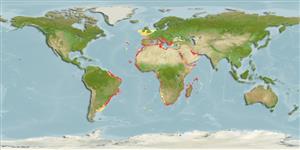
Native range | All suitable habitat | Point map | Year 2050
This map was computer-generated and has not yet been reviewed.
Epinephelus marginatus   AquaMaps   Data sources: GBIF OBIS
Ladda upp din foton och Videor
Bilder | Videor | Frimärken, mynt, diverse. | Google image
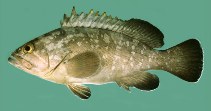
Image of Epinephelus marginatus (Dusky grouper)
Epinephelus marginatus
Bild av Randall, J.E.


Türkiye territory information

Common names: Orfoz, Orfoz balığı, Sarıhani balığı
Occurrence: native
Salinity: marine
Abundance: | Ref:
Importance: | Ref:
Aquaculture: | Ref:
Regulations: | Ref:
Uses: no uses
Comments: First record in Black Sea (Ref. 128440). Also Ref. 5222. Status of threat: Endangered (Ref. 58342).
National Checklist:
Territory Information: https://www.cia.gov/library/publications/resources/the-world-factbook/geos/tu.html
National Fisheries Authority:
Occurrences: Occurrences Point map
Main Ref: Bilecenoğlu, M., Taskavak E., S. Mater and M. Kaya, 2002
National Database: CLOMFOT

Common names from other countries

Klassificering / Namn Populärnamn | synonymer | Catalog of Fishes(Släkte, Arter) | ITIS | CoL | WoRMS | Cloffa

> Perciformes/Serranoidei (Groupers) > Epinephelidae (Groupers)
Etymology: Epinephelus: Greek, epinephelos = cloudy (Ref. 45335).
More on author: Lowe.

Miljö: miljö / Klimatzon / djupintervall / distributionsområde Ekologi

marina revassocierade; djupintervall 8 - 300 m (Ref. 27000), usually ? - 50 m (Ref. 5222). Subtropical; 54°N - 43°S, 65°W - 58°E (Ref. 5222)

Utbredning Territorier | FAO områden | Ekosystem | Förekomster | Prickkarta | Utplanteringar | Faunafri

East and Southwest Atlantic and Western Indian Ocean: East Atlantic: throughout the Mediterranean Sea, and from the southern Bay of Biscay to southern tip of Africa. Stray specimens reported from the British Isles, and eastern English Channel (Normandy, France; Ref. 92236). Southwest Atlantic: southeastern Brazil, Uruguay, and Argentina. Western Indian Ocean: from tip of Africa to southern Mozambique and southern Madagascar. Reported from Oman and La Reunion I.

Längd vid första mognad / Storlek / Vikt / Ålder

Könsmognad: Lm 49.2, range 37 - 54 cm
Max length : 150 cm TL hane/ej könsbestämd; (Ref. 12382); publicerad maxvikt: 60.0 kg (Ref. 5222); rapporterad maxålder: 60 år (Ref. 94520)

Kort beskrivning Bestämningsnycklar | Morfologi | Morfometri

Taggstrålar i ryggfenan (totalt) : 11; Mjukstrålar i ryggfenan (totalt) : 14 - 16; Taggstrålar i analfenan: 3; Mjukstrålar i analfenan: 8 - 9. Diagnosis: head and body dark reddish brown or greyish dorsally, usually yellowish gold ventrally; irregular white, pale greenish yellow or silvery grey blotches usually visible on the body and head and mostly arranged in vertical series; more or less distinct black maxillary streak; dark brown median fins; distal edge of anal and caudal fins, often also pectoral fins, narrowly white; pelvic fins blackish distally; pectoral fins dark reddish brown or grey; margin of spinous dorsal fin and basal part of the paired fins often golden yellow; head length 2.3-2.5 in SL; convex interorbital area; rounded preopercle, finely serrate, serrae at angle slightly enlarged; smooth subopercle and interopercle; eye diameter greater than or subequal to interorbital width in fish 10-30 cm SL, less than interorbital in fish over 40 cm SL; posterior and anterior nostrils subequal or posterior nostril slightly larger; maxilla naked, reaching to or slightly past vertical at rear edge of eye; 2-4 rows of subequal teeth on midlateral part of lower jaw (Ref. 89707).
Body shape (shape guide): fusiform / normal; Cross section: compressed.

Biologi     Ordlista (t.ex. epibenthic)

Adults prefer rocky bottoms (Ref. 5222), are solitary and territorial (Ref. 12382). Juveniles are found closer to shore (Ref. 48605) in rocky tidal pools (Ref. 48609). Enters brackish environments (Ref. 57293). Mainly feed on crabs and octopi; larger individuals feed on a greater proportion of fishes, the majority of which are reef-associated species (Ref. 6842). A protogynous hermaphrodite (Ref. 55367). Mature individuals form spawning aggregations (Ref. 55367). Utilized as a food fish (Ref. 171). Readily caught by anglers (Ref. 5222). Not adapted well in an aquarium (Ref. 12382).

Livscykel och parningsbeteende Könsmognad | Reproduktion | Lek | Ägg | Fekunditet | Larver

A monandric species (Ref. 55367). In Europe, sex reversal occurs when females are about 14-17 years of age and between 80 to 90 cm TL (Ref. 51466). From another study, sex change occurs at 88 cm TL and 12 years of age (Ref. 55367), between 52-77 cm TL and 7-17 years (Ref. 94520). Protogynous hermaphrodite species, reaching its first sexual maturity as female at 5 years and becoming male after 10 years (some females remain so for some more years). Spawning happens during summer.

Huvudreferens Ladda upp dina referenser | referenser | Koordinator | Medarbetare

Heemstra, P.C. and J.E. Randall, 1993. FAO Species Catalogue. Vol. 16. Groupers of the world (family Serranidae, subfamily Epinephelinae). An annotated and illustrated catalogue of the grouper, rockcod, hind, coral grouper and lyretail species known to date. Rome: FAO. FAO Fish. Synop. 125(16):382 p. (Ref. 5222)

Status på IUCN:s rödlista (Ref. 130435: Version 2025-2 (Global))


CITES

Not Evaluated

CMS (Ref. 116361)

Not Evaluated

Hot mot människor

  Harmless


Mänskliga användningsområden

Fiskeri: kommersiellt viktig; sportfisk: ja
FAO - fiskeri: landningar; Publication: search | FishSource | Havet omkring oss

Ytterligare information

Trofisk ekologi
Livsmedelsartiklar (preys)
Födosammansättning
Födointag
Matransoner
Predatorer
Ekologi
Ekologi
Home ranges
Populationsdynamik
Tillväxtparametrar
Max. åldrar / storlekar
Längd-vikt rel.
Längd-längd rel.
Längd-frekvenser
Massakonvertering
Rekrytering
Abundans
Livscykel
Reproduktion
Könsmognad
Mognad/Gills rel.
Fekunditet
Lek
Lekande aggregat
Ägg
Utveckling av ägg
Larver
Larvdynamik
Utbredning
Territorier
FAO områden
Ekosystem
Förekomster
Utplanteringar
BRUVS - Videor
Anatomi
Gälyta
Hjärna
Otolit
Fysiologi
Kroppssammansättning
Näringsämnen
Syreförbrukning
Typ av simning
Simhastighet
Visuella pigment
Ljud från fisk
Sjukdomar & Parasiter
Toxicitet (LC50)
Genetik
Genom
Genetik
Heterozygositet
Ärftlighet
Människorelaterad
Vattenbrukssystem
Vattenbruksprofiler
Avelslinjer
Ciguatera-fall
Frimärken, mynt, diverse.
Uppsökande verksamhet
Medarbetare
referenser
referenser

Verktyg

Särskilda rapporter

Ladda ner XML

Internet-källor

Uppskattningar baserade på modeller

Önskad temperatur (Ref. 123201): 13.3 - 25.8, mean 19 °C (based on 33 cells).
Index för fylogenetisk mångfald (Ref. 82804):  PD50 = 0.5000   [Uniqueness, from 0.5 = low to 2.0 = high].
Bayesian length-weight: a=0.01023 (0.00664 - 0.01576), b=3.07 (2.95 - 3.19), in cm total length, based on LWR estimates for this species & Genus-body shape (Ref. 93245).
Trofisk nivå (Ref. 69278):  4.4   ±0.0 se; based on diet studies.
Resiliens (Ref. 120179):  Låg, lägsta populationsfördubblingstid 4,5-14 år (K=0.03-0.09; tmax=50; tm=7).
Prior r = 0.36, 95% CL = 0.24 - 0.55, Based on 5 data-limited stock assessments.
Sårbarhet i fisket (Ref. 59153):  High vulnerability (64 of 100). 🛈
Sårbarhet för klimatet (Ref. 125649):  Moderate vulnerability (38 of 100). 🛈
Priskategori (Ref. 80766):   Very high.
Näringsämnen (Ref. 124155):  Calcium = 8.45 [3.09, 17.95] mg/100g; Iron = 0.361 [0.182, 0.786] mg/100g; Protein = 19.5 [17.9, 21.0] %; Omega3 = 0.187 [0.101, 0.362] g/100g; Selenium = 29.3 [13.7, 60.8] μg/100g; VitaminA = 72 [16, 292] μg/100g; Zinc = 0.596 [0.397, 0.903] mg/100g (wet weight); based on nutrient studies.