Galeocerdo cuvier, Tiger shark : fisheries, gamefish

You can sponsor this page

Galeocerdo cuvier (Péron & Lesueur, 1822)

Tiger shark
Thêm quan sát của bạn vào Fish Watcher
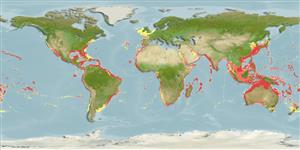
Native range | All suitable habitat | Point map | Year 2050
This map was computer-generated and has not yet been reviewed.
Galeocerdo cuvier   AquaMaps   Data sources: GBIF OBIS
Tải lên của bạn hình ảnh Và Video
Các tranh (Ảnh) | Video | Tem, tiền xu, v.v. | Google image


Trinidad and Tobago territory information

Common names: [No common name]
Occurrence: native
Salinity: brackish
Abundance: | Ref:
Importance: | Ref:
Aquaculture: | Ref:
Regulations: | Ref:
Uses: no uses
Comments:
National Checklist:
Territory Information: https://www.cia.gov/library/publications/resources/the-world-factbook/geos/td.html
National Fisheries Authority: http://www.cep.unep.org/trini_tbgo/fisheries/index.htm
Occurrences: Occurrences Point map
Main Ref: Compagno, L.J.V., 1984
National Database:

Common names from other countries

Phân loại / Tên Tên thường gặp | Các synonym ( Các tên trùng) | Catalog of Fishes(Giống, Các loài) | ITIS | CoL | WoRMS | Cloffa

Lớp phụ Cá sụn (cá mập và cá đuối) (sharks and rays) > Carcharhiniformes (Ground sharks) > Galeocerdonidae (Tiger sharks)
Etymology: Galeocerdo: galeos, a small shark or dogfish according to Aristotle and others (but perhaps used here as a generic term for shark); kerdo, Greek for fox, allusion not explained, perhaps referring to a cunning ability to steal bait from the line (see Alopias, Alopiidae) (See ETYFish)cuvier: Patronym not identified but almost certainly in honor of French naturalist Georges Cuvier (1769-1832), then most famous for his Le Règne Animal (1816), a survey of the animal kingdom based on comparative anatomy [presumably a noun in apposition, without the patronymic “i”] (See ETYFish).
Eponymy: Georges Léopold Chrétien Frédéric Dagobert Baron Cuvier (1769–1832), better known by his pen name Georges Cuvier, was a French naturalist and one of the scientific giants of his age. [...] (Ref. 128868), visit book page.
More on authors: Péron & Lesueur.

Taxonomic Remarks
Same spelling in Ref. 3814.

Môi trường: môi trường / vùng khí hậu / Mức độ sâu / phạm vi phân phối Sinh thái học

biển; thuộc về nước lợ sống nổi và đáy; Ở đại duơng, biển (Ref. 51243); mức độ sâu 0 - 800 m (Ref. 96339), usually 0 - 140 m (Ref. 26938). Subtropical; 62°N - 44°S, 180°W - 180°E

Sự phân bố Lãnh thổ | Các khu vực của FAO | Các hệ sinh thái | Những lần xuất hiện | Bản đồ điểm | Những chỉ dẫn | Faunafri

Circumglobal in tropical and temperate seas. Western Atlantic: Massachusetts, USA to Uruguay, including Gulf of Mexico and the Caribbean. Eastern Atlantic: Iceland to Angola. Indo-Pacific: Persian Gulf (Ref. 68964), Red Sea and East Africa to Hawaii and Tahiti, north to southern Japan, south to New Zealand. Eastern Pacific: southern California, USA to Peru, including the Revillagigedo, Cocos, and Galapagos islands. Highly migratory species.

Chiều dài lúc trưởng thành đầu tiên / Bộ gần gũi / Khối lượng (Trọng lượng) / Tuổi

Chín muồi sinh dục: Lm 300.0, range 210 - 350 cm
Max length : 750 cm TL con đực/không giới tính; (Ref. 58784); common length : 500 cm TL con đực/không giới tính; (Ref. 2683); Khối lượng cực đại được công bố: 807.4 kg (Ref. 4699); Tuổi cực đại được báo cáo: 50 các năm (Ref. 4827)

Mô tả ngắn gọn Khóa để định loại | Hình thái học | Sinh trắc học

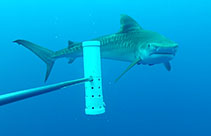
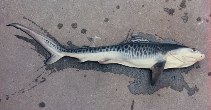
Các tia vây lưng cứng (tổng cộng) : 0; Tia cứng vây hậu môn: 0. This species is a huge, vertical tiger-striped shark with a very short or broad, bluntly rounded snout (its length much less than width of mouth), long upper labial furrows (about as long as snout, reaching front of eyes), a big mouth with large, saw-edged, cockscomb-shaped teeth (coarsely serrated with outer edges deeply notched and tips directed obliquely outward); spiracles small, slit-like, but easily visible, caudal keels low. Colour of back dark grey or greyish brown with vertical dark grey to black bars and rectangular spots often forming bars on sides and fins, but fading with growth (Ref. 5578, 9997).
Body shape (shape guide): fusiform / normal; Cross section: angular.

Sinh học     Tự điển (thí dụ epibenthic)

Usually found near surface to depths of 140 m (Ref. 26938); in Tahiti from 0-350 m (Ref. 89972). Occurs on or adjacent to continental and insular shelves, frequenting river estuaries, off wharves and jetties in harbors, and in coral atolls and lagoons (Ref. 244). Bottom-associated, sometimes pelagic (Ref. 58302). Also off oceanic islands far from other islands and continental land masses (Ref. 244). Makes excursions in the open ocean, but is not a truly oceanic species (Ref. 244). Nocturnal feeder on other sharks, rays, bony fishes, marine mammals, tortoises, seabirds, sea snakes, squids, gastropods, crustaceans, detritus (Ref. 9997), also including toxic or armored fish species such as Lactoria cornuta or Diodon hystrix, porpoises, whales, sea turtles, cephalopods, domestic animals and humans (Ref. 37816). It also feeds on carrion and garbage, including cans, pieces of metal and burlap bags (Ref. 26938). Second only to Carcharodon carcharias in recorded attacks on humans with at least 27 documented attacks sourced to it . One specimen, reportedly taken off Indo-China, weighed 3,110 kg and measured 740 cm (Ref. 9987). May be kept in an aquaria, but does not last for more than a few months (Ref. 244). Ovoviviparous (Ref. 50449). Up to 80 young of 51 to 104 cm are born per litter (Ref. 1602). Valued for its meat, fins, hide and liver oil (Ref. 9997) and also for its jaws and cartilage (Ref. 58048). Often used for fishmeal (Ref. 9997). Utilized fresh, dried-salted, smoked and frozen (Ref. 9987). Species from the Persian Gulf and Oman Sea has a max size of 750 cm TL (Ref. 47613).

Vòng đời và hành vi giao phối Chín muồi sinh dục | Sự tái sinh sản | Đẻ trứng | Các trứng | Sự sinh sản | Ấu trùng

Ovoviviparous (Ref. 4805, 6871) with 10-82 in a litter (Ref. 26346). Mating takes place even before gravid females have given birth (Ref. 244). Distinct pairing with embrace (Ref. 205). Gestation period: 13-16 months. Size at birth between 51 (Ref. 244) and 104 (Ref. 9997) cm TL; born at about 51-76 cm TL (Ref. 58048).

Tài liệu tham khảo chính Tải lên tài liệu tham khảo của bạn | Các tài liệu tham khảo | Người điều phối | Người cộng tác

Compagno, L.J.V., 1984. FAO Species Catalogue. Vol. 4. Sharks of the world. An annotated and illustrated catalogue of shark species known to date. Part 2 - Carcharhiniformes. FAO Fish. Synop. 125(4/2):251-655. Rome: FAO. (Ref. 244)

Tình trạng Sách đỏ IUCN (Ref. 130435: Version 2025-2 (Global))

  Near Threatened (NT) (A2bd+3d); Date assessed: 10 August 2018

CITES

Not Evaluated

CMS (Ref. 116361)

Not Evaluated

Mối đe dọa đối với con người

  Traumatogenic (Ref. 244)


Sử dụng của con người

Các nghề cá: tính thương mại; cá để chơi: đúng
FAO - Các nghề cá: hạ cánh; Publication: search | FishSource | Biển chung quanh ta

Thêm thông tin

Sinh thái dinh dưỡng
Thức ăn (con mồi)
Thành phần thức ăn
Thành phần thức ăn
Khẩu phần ăn
Các động vật ăn mồi
Sinh thái học
Sinh thái học
Home ranges
Vòng đời
Sự tái sinh sản
Chín muồi sinh dục
Độ trưởng thành/Mang liên quan
Sự sinh sản
Đẻ trứng
Tập hợp sinh sản
Các trứng
Sự phát triển của trứng
Ấu trùng
Sự biến động ấu trùng
Giải phẫu
Vùng mang
Não
sỏi tai
Sinh lý học
Thành phần cơ thể
Chất dinh dưỡng
Thành phần ô-xy
Kiểu bơi
Tốc độ bơi
Sắc tố thị giác
Tiếng cá
Bệnh tật & Ký sinh trùng
Độc tính (LC50)
Di truyền
Bộ gen
Di truyền
Sự dị hợp tử
Di sản
Liên quan đến con người
Hệ thống nuôi trồng thủy sản
Các tổng quan nuôi trồng thủy sản
Các giống
Các trường hợp ngộ độc Ciguatera
Tem, tiền xu, v.v.
Tiếp cận
Người cộng tác
Các tài liệu tham khảo

Các công cụ

Báo cáo đặc biệt

Tải xuống XML

Các nguồn internet

Ước tính dựa trên mô hình

Nhiệt độ ưa thích (Tài liệu tham khảo 123201): 15.8 - 28.9, mean 26.4 °C (based on 6872 cells).
Chỉ số đa dạng phát sinh loài (Tài liệu tham khảo 82804):  PD50 = 1.5000   [Uniqueness, from 0.5 = low to 2.0 = high].
Bayesian length-weight: a=0.00724 (0.00282 - 0.01861), b=3.09 (2.87 - 3.31), in cm total length, based on LWR estimates for this (Sub)family-body shape (Ref. 93245).
Mức dinh dưỡng (Tài liệu tham khảo 69278):  4.5   ±0.0 se; based on diet studies.
Generation time: 10.3 ( na - na) years. Estimated as median ln(3)/K based on 2 growth studies.
Thích nghi nhanh (Tài liệu tham khảo 120179):  thấp, thời gian nhân đôi của chủng quần tối thiểu là 4.5 - 14 năm (tm=4-11; tmax=50; K=0.18-0.6; Fec=10).
Prior r = 0.27, 95% CL = 0.18 - 0.41, Based on 1 data-limited stock assessment.
Sự dễ bị tổn thương của nghề đánh cá (Ref. 59153):  High vulnerability (64 of 100). 🛈
Sự dễ bị tổn thương của khí hậu (Ref. 125649):  High vulnerability (57 of 100). 🛈
Loại giá (Ref. 80766):   Medium.
Chất dinh dưỡng (Ref. 124155):  Calcium = 4.57 [0.66, 26.59] mg/100g; Iron = 0.455 [0.113, 1.474] mg/100g; Protein = 21.6 [19.3, 23.7] %; Omega3 = 0.287 [0.118, 0.709] g/100g; Selenium = 52.8 [14.6, 163.1] μg/100g; VitaminA = 4.47 [1.34, 14.90] μg/100g; Zinc = 0.278 [0.132, 0.539] mg/100g (wet weight);