Common names from other countries
>
Gadiformes (Cods) >
Merlucciidae (Merluccid hakes)
Etymology: Merluccius: Latin, mar, maris = the sea + Latin, lucius = pike (Ref. 45335).
Umwelt: Milieu / Klimazone / Tiefenbereich / Verbreitungsgebiet
Ökologie
seewasser demersal; ozeanodrom (Ref. 51243); tiefenbereich 15 - 1248 m (Ref. 58452), usually 100 - 600 m (Ref. 58452). Tropical; 33°N - 12°N, 19°W - 8°W (Ref. 58452)
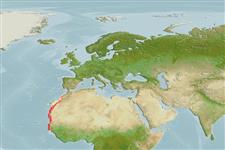
Eastern Atlantic: western North Africa from Cape Cantin to Cape Roxo.
Länge bei der ersten Reifung / Größe / Gewicht / Alter
Geschlechtsreife: Lm 40.9 range ? - ? cm
Max length : 81.0 cm TL Männchen/unbestimmt; (Ref. 1371); common length : 42.0 cm TL Männchen/unbestimmt; (Ref. 1371)
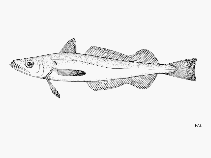
Rückenflossenstacheln (insgesamt) : 1; Rückenflossenweichstrahlen (insgesamt) : 47 - 51. Head rather long. Pectoral fin tips usually reaching origin of anal fin. Caudal fin usually truncate, progressively becoming concave with growth. Color is steel gray to blackish on back, silvery white on sides and belly.
Body shape (shape guide): elongated; Cross section: oval.
Feeds mainly on small fishes, and to a lesser extent on crustaceans and cephalopods. Undergoes seasonal latitudinal migrations (Ref. 9709). Spawning takes place in northern areas from January to March (Doutre, 1960), and from October to March (López Abellán and Ariz Telleía, 1993). Marketed fresh or frozen (Ref. 58452). Minimum depth reported from Ref. 26999.
Lebenszyklus und Paarungsverhalten
Geschlechtsreife | Fortpflanzung | Ablaichen | Eier | Fruchtbarkeit | Larven
Cohen, D.M., T. Inada, T. Iwamoto and N. Scialabba, 1990. FAO species catalogue. Vol. 10. Gadiform fishes of the world (Order Gadiformes). An annotated and illustrated catalogue of cods, hakes, grenadiers and other gadiform fishes known to date. FAO Fish. Synop. 125(10). Rome: FAO. 442 p. (Ref. 1371)
IUCN Rote Liste Status (Ref. 130435: Version 2025-2 (Global))
Bedrohung für Menschen
Harmless
Nutzung durch Menschen
Fischereien: hoch kommerziell
Tools
Zusatzinformationen
Download XML
Internet Quellen
Schätzungen auf der Grundlage von Modellen
Bevorzugte Temperatur (Ref.
123201): 10.2 - 16.8, mean 14.1 °C (based on 28 cells).
Phylogenetischer Diversitätsindex (Ref.
82804): PD
50 = 0.5000 [Uniqueness, from 0.5 = low to 2.0 = high].
Bayesian length-weight: a=0.00513 (0.00253 - 0.01042), b=3.09 (2.92 - 3.26), in cm total length, based on LWR estimates for this species & Genus-body shape (Ref.
93245).
Trophische Ebene (Ref.
69278): 4.5 ±0.80 se; based on food items.
Widerstandsfähigkeit (Ref.
120179): niedrig, Verdopplung der Population dauert 4,5 - 14 Jahre. (K=0.07-0.17).
Anfälligkeit der Fischerei (Ref.
59153): High vulnerability (57 of 100).
🛈
Klimaanfälligkeit (Ref.
125649): High to very high vulnerability (75 of 100).
🛈
Nährstoffe (Ref.
124155): Calcium = 35 [17, 113] mg/100g; Iron = 0.674 [0.260, 1.661] mg/100g; Protein = 17.4 [16.2, 18.6] %; Omega3 = 0.102 [0.057, 0.183] g/100g; Selenium = 126 [54, 283] μg/100g; VitaminA = 26 [8, 86] μg/100g; Zinc = 0.568 [0.371, 0.874] mg/100g (wet weight);