Thunnus albacares, Yellowfin tuna : fisheries, aquaculture, gamefish

You can sponsor this page

Thunnus albacares (Bonnaterre, 1788)

Yellowfin tuna
Masukkan pemerhatian anda di Fish Watcher
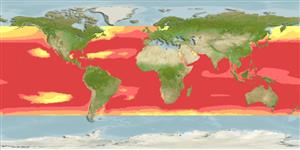
Native range | All suitable habitat | Point map | Year 2050
This map was computer-generated and has not yet been reviewed.
Thunnus albacares   AquaMaps   Data sources: GBIF OBIS
muatnaik fotos/gambar dan video
Gambar | video | Perangko, koin, dll. | imej Google
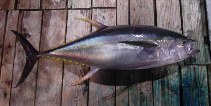
Image of Thunnus albacares (Yellowfin tuna)
Thunnus albacares
foto/gambar oleh Archambault, C.


São Tomé and Príncipe territory information

Common names: Atum oledê
Occurrence: native
Salinity: marine
Abundance: | Ref:
Importance: | Ref:
Aquaculture: | Ref:
Regulations: | Ref:
Uses: no uses
Comments: Recorded from São Tomé Island based on specimen caught by local fishers and identified by Jean Worms (Ref. 34088). Also Ref. 34508, 34626.
National Checklist:
Territory Information: https://www.cia.gov/library/publications/resources/the-world-factbook/geos/tp.html
National Fisheries Authority:
Occurrences: Occurrences Point map
Main Ref: Collette, B.B. and C.E. Nauen, 1983
National Database:

Common names from other countries

klasifikasi / Nama Nama-nama umum | Sinonim (persamaan) | Catalog of Fishes(Marga, Jenis) | ITIS | CoL | WoRMS | Cloffa

> Scombriformes (Mackerels) > Scombridae (Mackerels, tunas, bonitos) > Scombrinae
Etymology: Thunnus: Greek, thynnos = tunna (Ref. 45335).
More on author: Bonnaterre.

Lingkungan: lingkungan / zona iklim / kisaran kedalaman / jangkauan distribusi Ekologi

laut; payau pelagic-oceanic; oceanodromus (Ref. 71039); kisaran kedalaman 1 - 1602 m, usually 1 - 250 m (Ref. 6390). Tropical; 15°C - 31°C (Ref. 168); 50°N - 50°S, 180°W - 180°E

Penyebaran Wilayah | Daerah-daerah FAO | Ekosistem | Kemunculan | peta titik | Introduksi | Faunafri

Worldwide in tropical and subtropical seas, but absent from the Mediterranean Sea. Highly migratory species.

Panjang pada saat jatuh tempo pertama / Ukuran / Berat / umur

Kematangan: Lm 103.3, range 78 - 158 cm
Max length : 239 cm FL jantan/; (Ref. 40637); common length : 150 cm FL jantan/; (Ref. 168); Berat maksimum terpublikasi: 200.0 kg (Ref. 26550); Umur maksimum dilaporkan: 18 Tahun (Ref. 137697)

deskripsi pendek Kunci identifiaksi (pengenalan) | Morfologi | Morfometrik

Duri punggung (Keseluruhan (total)) : 11 - 14; duri punggung lunak (Keseluruhan (total)) : 12 - 16; Duri dubur: 0; Sirip dubur lunak: 11 - 16; vertebrata, bertulang belakang: 39. This large species is distinguished by the following characters: elongate, fusiform body, slightly compressed laterally; total gill rakers on first gill arch 26-34; dorsal fins 2 and separated only by a narrow interspace, the second followed by 8-10 finlets; anal fin followed by 7 to 10 finlets; large specimens may have very long second dorsal and anal fins, becoming well over 20% of fork length; pectoral fins moderately long, usually reaching beyond second dorsal-fin origin but not beyond end of its base, usually 22-31% of FL; 2 flaps (interpelvic process) between pelvic fins; body with very small scales; corselet of larger scales developed but not very distinct; caudal peduncle very slender, bearing on each side a strong lateral keel between 2 smaller keels; no striations on ventral surface of liver; swimbladder present. Colour of back metallic dark blue changing through yellow to silver on belly; belly frequently crossed by about 20 broken, nearly vertical lines; dorsal and anal fins, and dorsal and anal finlets bright yellow, the finlets with a narrow black border (Ref. 9684).
Body shape (shape guide): fusiform / normal; Cross section: oval.

Biologi     Daftar kata (contoh epibenthic)

An oceanic species occurring above and below the thermoclines. Pelagic in open water , but rarely seen near reefs (Ref. 48637). They school primarily by size, either in monospecific or multi-species groups. Larger fish frequently school with porpoises, also associated with floating debris and other objects. Feed on fishes, crustaceans and squids. It is sensitive to low concentrations of oxygen and therefore is not usually caught below 250 m in the tropics (Ref. 28952, 30329). Peak spawning occurs during the summer, in batches (Ref. 9684, 51846). Eggs and larvae are pelagic (Ref. 6769). Encircling nets are employed to catch schools near the surface (Ref. 9340). Caught mainly with longlines and purse seines. Marketed mainly fresh, frozen, canned (Ref. 9684), but also smoked (Ref. 9987). Highly valued for sashimi (Ref. 26938).

Siklus hidup dan perilaku kawin Kematangan | Reproduksi, perkembang biakan | Pemijahan | telur-telur | Fekunditas | Larva

Spawn throughout the tropical and equatorial waters of the major oceans (Ref. 6390). At higher latitudes, spawning is seasonal, with peaks in summer; may continue throughout the year at lower latitudes (Ref. 6390). Yellowfin tuna are multiple spawners, ie they spawn every few days over the spawning period (Ref. 6390). Eggs and sperm are released into the water for fertilisation (Ref. 6390).

rujukan utama Unggah referensi Anda | Acuan | Koordinator : Collette, Bruce B. | mitra

Collette, B.B. and C.E. Nauen, 1983. FAO Species Catalogue. Vol. 2. Scombrids of the world. An annotated and illustrated catalogue of tunas, mackerels, bonitos and related species known to date. Rome: FAO. FAO Fish. Synop. 125(2):137 p. (Ref. 168)

Status IUCN Red List (Ref. 130435: Version 2025-2 (Global))

  kurang bimbang (LC) ; Date assessed: 15 January 2021

CITES

Not Evaluated

CMS (Ref. 116361)

Not Evaluated

ancaman kepada manusia

  Harmless


penggunaan manusia

Perikanan: bernilai komersial tinggi; Budidaya air: percobaan; Ikan buruan: ya
FAO - Sistem akuakultur: produksi; Perikanan: pendaratan, profail spesis; Publication: search | FIRMS - Stock assessments | FishSource | Laut di Sekitar Kita

informasi lanjut

Fisiologi
Komposisi tubuh
Nutrisi
Konsumsi oksigen
Jenis renang
Kecepatan berenang
Pigmen visual
Suara ikan
Penyakit & Parasit
Toksisitas (LC50)
Genetika
genom
Genetika
Heterozigositas
Diturunkan
Yang berhubungan dengan manusia
Sistem akuakultur
profil budidaya air
Strain
Kasus Ciguatera
Perangko, koin, dll.
Penjangkauan
mitra
Acuan
Acuan

Alat, peralatan

laporan khas

muat turun XML

Sumber internet

Estimasi berdasarkan model

Suhu yang disukai (Acuan 123201): 16.5 - 28.9, mean 26.7 °C (based on 6382 cells).
Indeks keanekaragaman filogenetik (Acuan 82804):  PD50 = 0.5039   [Uniqueness, from 0.5 = low to 2.0 = high].
Bayesian length-weight: a=0.01445 (0.01205 - 0.01735), b=3.03 (3.00 - 3.06), in cm total length, based on LWR estimates for this species (Ref. 93245).
Tingkat Trofik (Acuan 69278):  4.4   ±0.4 se; based on diet studies.
Generation time: 2.8 (2.3 - 3.5) years. Estimated as median ln(3)/K based on 46 growth studies.
Daya lenting (Acuan 120179):  sedang, Waktu penggandaan populasi minimum 1.4 - 4.4 tahun (K=0.13-0.42; tm=2-5; tmax=8; Fec=200,000).
Prior r = 0.36, 95% CL = 0.24 - 0.54, Based on 9 full stock assessments.
Kerentanan Penangkapan Ikan (Ref. 59153):  Moderate to high vulnerability (46 of 100). 🛈
Kerentanan Iklim (Ref. 125649):  Moderate vulnerability (42 of 100). 🛈
kategori harga (Ref. 80766):   High.
Nutrisi (Ref. 124155):  Calcium = 41 [22, 86] mg/100g; Iron = 2.84 [1.17, 6.68] mg/100g; Protein = 23.7 [22.2, 25.1] %; Omega3 = 0.274 [0.166, 0.457] g/100g; Selenium = 82.4 [21.0, 256.4] μg/100g; VitaminA = 29.6 [3.7, 227.6] μg/100g; Zinc = 0.524 [0.292, 0.972] mg/100g (wet weight); based on nutrient studies.