Platichthys flesus, European flounder : fisheries, aquaculture, gamefish

You can sponsor this page

Platichthys flesus (Linnaeus, 1758)

European flounder
Lägg till din observation i Fish Watcher
Native range | All suitable habitat | Point map | Year 2050
This map was computer-generated and has not yet been reviewed.
Platichthys flesus   AquaMaps   Data sources: GBIF OBIS
Ladda upp din foton och Videor
Bilder | Videor | Frimärken, mynt, diverse. | Google image
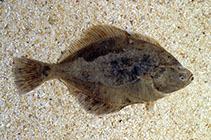
Image of Platichthys flesus (European flounder)
Platichthys flesus
Bild av Muséum-Aquarium de Nancy/D. Terver


Russia / Russian Federation territory information

Common names: Baltic flounder, Baltiiskaya rechnaya kambala, European flounder
Occurrence: native
Salinity: freshwater
Abundance: common (usually seen) | Ref: Winkler, H.M., K. Skora, R. Repecka, M. Ploks, A. Neelov, L. Urho, A. Gushin and H. Jespersen, 2000
Importance: | Ref:
Aquaculture: | Ref:
Regulations: | Ref:
Uses: no uses
Comments: Known from the Black Sea and Sea of Azov and enters estuaries with low salinity and river mouths (the Kuban); transferred into the Caspian Sea; Baltic Sea, enters the Vistula and reaches the mouths of the Neva and Luga; White Sea and enters the Varzuga, northern Dvian and Mezen rivers; and Murmam Coast of the Bay of Pechora, entering the Tuloma River and rivers of Cheshskaya Bay (Ref. 26334). This has been translocated to areas within the country for stocking in open waters however, it failed to establish self-sustaining populations (Ref. 45022). Also Ref. 4645, 36252. EurRus
National Checklist:
Territory Information: https://www.cia.gov/library/publications/resources/the-world-factbook/geos/rs.html
National Fisheries Authority:
Occurrences: Occurrences Point map
Main Ref: Reshetnikov, Y.S., N.G. Bogutskaya, E.D. Vasil'eva, E.A. Dorofeeva, A.M. Naseka, O.A. Popova, K.A. Savvaitova, V.G. Sideleva and L.I. Sokolov, 1997
National Database:

Common names from other countries

Klassificering / Namn Populärnamn | synonymer | Catalog of Fishes(Släkte, Arter) | ITIS | CoL | WoRMS | Cloffa

> Pleuronectiformes (Flatfishes) > Pleuronectidae (Righteye flounders) > Pleuronectinae
Etymology: Platichthys: Greek, platys = flat + Greek, ichthys = fish (Ref. 45335).
More on author: Linnaeus.

Miljö: miljö / Klimatzon / djupintervall / distributionsområde Ekologi

marina; sötvatten; brackvatten bottenlevande; pH range: 7.5 - 8.2; katadrom (Ref. 138126); djupintervall 1 - 100 m (Ref. 35388). Temperate; 5°C - 25°C (Ref. 13614); 72°N - 30°N, 32°W - 45°E (Ref. 54704)

Utbredning Territorier | FAO områden | Ekosystem | Förekomster | Prickkarta | Utplanteringar | Faunafri

Eastern Atlantic: coastal and brackish waters of western Europe and from the White Sea to the Mediterranean and the Black Sea (Ref. 4705, Ref. 51442). Introduced into the USA and Canada accidentally through transport in ballast water (Ref. 1739). Asia: Iran (Ref. 39702).

Längd vid första mognad / Storlek / Vikt / Ålder

Könsmognad: Lm 22.4, range 14 - 30 cm
Max length : 60.0 cm TL hane/ej könsbestämd; (Ref. 35388); common length : 50.0 cm TL hane/ej könsbestämd; (Ref. 30578); publicerad maxvikt: 2.9 kg (Ref. 104349); rapporterad maxålder: 15 år (Ref. 3944)

Kort beskrivning Bestämningsnycklar | Morfologi | Morfometri

Taggstrålar i ryggfenan (totalt) : 0; Mjukstrålar i ryggfenan (totalt) : 53 - 62; Taggstrålar i analfenan: 0; Mjukstrålar i analfenan: 37 - 46. Flatfish, its disc width less than half its length (Ref. 3137). Small mouth (Ref. 3137, Ref. 51442). Eyes mostly (70%) on right side (Ref. 3137, 51442), 79% of dextrally oriented flounder (n = 1076) in Bos, 2000 (Ref. 57574). Rough skin, especially along the lateral line and the basis of the dorsal and anal fin (Ref. 3137). Lateral line straight, slightly rounded over pectorals (Ref. 3137). Green-olive colored (Ref. 51442), the bottom side white (Ref. 3137). Irregular reddish spots on the eye side (Ref. 35388).
Body shape (shape guide): short and / or deep; Cross section: compressed.

Biologi     Ordlista (t.ex. epibenthic)

Migratory fish, which is most of the year found in estuaries (Ref. 51442). Adults occur on mud and sand bottom in shallow water, at sea and brackish; often entering freshwaters (Ref. 59043). During winter, adults retreat to deeper, warmer waters, where they spawn in spring (Ref. 30193). The growing larvae are moving to the coast (Ref. 51442). Larvae and early juveniles use selective tidal transport to migrate upstream rivers (Ref. 57575) using a range of triggers such as salinity, prey density and water temperature (Ref. 57573, 57574). Juveniles live in shallow coastal waters and estuaries (Ref. 57574), which are also the summer feeding grounds for the adults (Ref. 30193). Juveniles of less than a year old feed on plankton and larvae of insects, juveniles of more than a year and adults feed on benthic fauna (Ref. 51442), including small fishes and invertebrates (Ref. 30193). Nocturnal and burrowing (Ref. 30193). Marketed fresh and frozen; can be steamed, fried, boiled, microwaved and baked (Ref. 9988). Worms and mollusks are excellent baits for line fishing (Ref. 30578).

Livscykel och parningsbeteende Könsmognad | Reproduktion | Lek | Ägg | Fekunditet | Larver

Spawns in the water column (Ref. 7471). Produces 400,000 to 2,000,000 eggs for each female (Ref. 51442).

Huvudreferens Ladda upp dina referenser | referenser | Koordinator : Amaoka, Kunio | Medarbetare

Vinnikov, K.A., R.C. Thomson and T.A. Munroe, 2018. Revised classification of the righteye flounders (Teleostei: Pleuronectidae) based on multilocus phylogeny with complete taxon sampling. Molecular phylogenetics and evolution, 125:147-162. (Ref. 122998)

Status på IUCN:s rödlista (Ref. 130435: Version 2025-2 (Global))

  Least Concern (LC) ; Date assessed: 25 August 2022

CITES

Not Evaluated

CMS (Ref. 116361)

Not Evaluated

Hot mot människor

  Harmless


Mänskliga användningsområden

Fiskeri: kommersiell; Vattenbruk: experimentell; sportfisk: ja
FAO - Vattenbrukssystem: produktion; fiskeri: landningar, artprofil; Publication: search | FIRMS - Stock assessments | FishSource | Havet omkring oss

Ytterligare information

Livscykel
Reproduktion
Könsmognad
Mognad/Gills rel.
Fekunditet
Lek
Lekande aggregat
Ägg
Utveckling av ägg
Larver
Larvdynamik
Anatomi
Gälyta
Hjärna
Otolit
Genetik
Genom
Genetik
Heterozygositet
Ärftlighet
Människorelaterad
Vattenbrukssystem
Vattenbruksprofiler
Avelslinjer
Ciguatera-fall
Frimärken, mynt, diverse.
Uppsökande verksamhet
Medarbetare
referenser
referenser

Verktyg

Särskilda rapporter

Ladda ner XML

Internet-källor

AFORO (otoliths) | Alien/Invasive Species database | Aquatic Commons | BHL | Cloffa | Websites from users | Check FishWatcher | CISTI | Catalog of Fishes: Släkte, Arter | DiscoverLife | DORIS | ECOTOX | FAO - Vattenbrukssystem: produktion; fiskeri: landningar, artprofil; Publication: search | Faunafri | Fishipedia | Fishtrace | GloBI | Google Books | Google Scholar | Google | IGFA World Record | Nationella databaser | OneZoom | Open Tree of Life | Otolith Atlas of Taiwan Fishes | Offentliga akvarier | PubMed | Reef Life Survey | Socotra Atlas | TreeBase | Tree of Life | Wikipedia: Go, sök | World Records Freshwater Fishing | Zoologiskt register

Uppskattningar baserade på modeller

Önskad temperatur (Ref. 123201): 7.2 - 14.2, mean 10.2 °C (based on 862 cells).
Index för fylogenetisk mångfald (Ref. 82804):  PD50 = 0.5625   [Uniqueness, from 0.5 = low to 2.0 = high].
Bayesian length-weight: a=0.00759 (0.00671 - 0.00858), b=3.07 (3.03 - 3.11), in cm total length, based on LWR estimates for this species (Ref. 93245).
Trofisk nivå (Ref. 69278):  3.3   ±0.2 se; based on diet studies.
Generation time: 4.4 (3.1 - 5.5) years. Estimated as median ln(3)/K based on 13 growth studies.
Resiliens (Ref. 120179):  Låg, lägsta populationsfördubblingstid 4,5-14 år (K=0.22-0.3; tm=2-5; tmax=15; Fec= 2 million).
Prior r = 0.56, 95% CL = 0.37 - 0.83, Based on 5 full stock assessments.
Sårbarhet i fisket (Ref. 59153):  Moderate to high vulnerability (49 of 100). 🛈
Sårbarhet för klimatet (Ref. 125649):  Moderate vulnerability (36 of 100). 🛈
Priskategori (Ref. 80766):   Very high.
Näringsämnen (Ref. 124155):  Calcium = 33.1 [14.0, 58.0] mg/100g; Iron = 0.26 [0.13, 0.49] mg/100g; Protein = 17.8 [15.6, 19.8] %; Omega3 = 0.322 [0.161, 0.627] g/100g; Selenium = 14.7 [7.4, 32.3] μg/100g; VitaminA = 6.9 [1.9, 26.1] μg/100g; Zinc = 0.509 [0.347, 0.750] mg/100g (wet weight); based on nutrient studies.