Prionace glauca, Blue shark : fisheries, gamefish

You can sponsor this page

Prionace glauca (Linnaeus, 1758)

Blue shark
Aggiungete la vostra osservazione in Fish Watcher
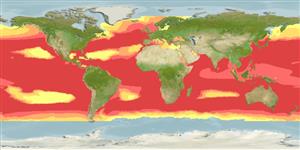
Native range | All suitable habitat | Point map | Year 2050
This map was computer-generated and has not yet been reviewed.
Prionace glauca   AquaMaps   Data sources: GBIF OBIS
Carica il tuo foto e Video
Immagini | Video | Francobolli, monete, materiale vario. | Google image


Portugal territory information

Common names: Guelha, Pas modrulj, Tintureira
Occurrence: native
Salinity: marine
Abundance: | Ref:
Importance: | Ref:
Aquaculture: | Ref:
Regulations: | Ref:
Uses: no uses
Comments:
National Checklist: Portugal
Territory Information: https://www.cia.gov/library/publications/resources/the-world-factbook/geos/po.html
National Fisheries Authority:
Occurrences: Occurrences Point map
Main Ref: Compagno, L.J.V., 1984
National Database: Portuguese Freshwater Fishes

Common names from other countries

Classificazione / Nomi Nomi Comuni | Sinonimi | Catalog of Fishes(Genere, Specie) | ITIS | CoL | WoRMS | Cloffa

Elasmobranchi (squali e razze) (sharks and rays) > Carcharhiniformes (Ground sharks) > Carcharhinidae (Requiem sharks)
Etymology: Prionace: prion (Gr.), saw; akis (Gr.), point or barb, referring to serrated (saw-like) cusps on teeth of upper jaw (See ETYFish)glauca: Latin for bluish green or gray (i.e., sea-colored), referring to its color (blue above, whitish below) (See ETYFish).
More on author: Linnaeus.

Ambiente: milieu / zona climatica / distribuzione batimetrica / gamma di distribuzione Ecologia

marino; salmastro pelagic-oceanic; oceanodromo (Ref. 87829); distribuzione batimetrica 0 - 1082 m (Ref. 89422), usually 1 - 220 m (Ref. 55193). Subtropical; 7°C - 21°C (Ref. 244); 70°N - 55°S, 180°W - 180°E

Distribuzione Territories | Aree FAO | Ecosistemi | Presenze | Mappa dei ritrovamenti | Introduzioni | Faunafri

Circumglobal in temperate and tropical waters. Western Atlantic: Newfoundland, Canada to Argentina. Central Atlantic. Eastern Atlantic: Norway to South Africa, including the Mediterranean. Indo-West Pacific: East Africa to Indonesia, Japan, Australia, New Caledonia, and New Zealand. Eastern Pacific: Gulf of Alaska to Chile. Probably the widest ranging chondrichthyian. Highly migratory species.

Lunghezza alla prima maturità / Dimensione / Peso / Età

Maturità: Lm 199.1, range 170 - 221 cm
Max length : 400 cm TL maschio/sesso non determinato; (Ref. 35388); common length : 335 cm TL maschio/sesso non determinato; (Ref. 5217); peso massimo pubblicato: 205.9 kg (Ref. 40637); Età massima riportata: 20 anni (Ref. 27347)

Breve descrizione Chiavi di identificazione | Morfologia | Morfometria

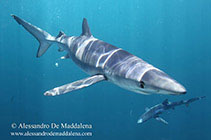
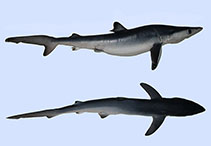
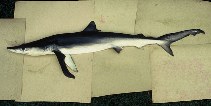
Spine dorsali (totale) : 0; Spine anali: 0. A slim, graceful blue shark with a long, conical snout, large eyes, and curved triangular upper teeth with saw edges; pectorals long and narrow; no interdorsal ridge (Ref. 5578). Dark blue dorsally, bright blue on the sides, white ventrally (Ref. 5578). Tips of pectoral fins and anal fin dusky (Ref. 9997). The first case of diprosopus tetrophthalmus (cranofacial duplication) in a foetus of this species was reported from South Atlantic (Ref. 119190).
Body shape (shape guide): fusiform / normal.

Biologia     Glossario (es. epibenthic)

Oceanic, but may be found close inshore where the continental shelf is narrow (Ref. 6871, 58302). Usually found to at least 150 m (Ref. 26938). Maximum size from Ref. 128029. Reported from estuaries (Ref. 26340). Epipelagic, occasionally occurs in littoral areas (Ref. 58302). Feeds on fishes (herring, silver hake, white hake, red hake, cod, haddock, pollock, mackerel, butterfish, sea raven and flounders (Ref. 5951)), small sharks, squids, pelagic red crabs, cetacean carrion, occasional sea birds and garbage (Ref. 5578). Viviparous (Ref. 50449). Sexual dimorphism occurs in skin thickness of maturing and adult females (Ref. 49562). May travel considerable distances (one specimen tagged in New Zealand was recaptured 1,200 km off the coast of Chile) (Ref. 26346). Potentially dangerous to humans (Ref. 6871, 13513). Marketed fresh, dried or salted, and frozen; meat utilized for consumption, hides for leather and fins for soup (Ref. 9987). Sexually mature at 250 cm long and 4-5 years old. The female gives birth up to 80 young measuring 40 cm long, gestation lasts almost a year (Ref. 35388). Produces from 4 to 135 young a litter (Ref. 26938). Minimum depth from Ref. 125614.

Ciclo vitale e comportamento di accoppiamento Maturità | Riproduzione | Deposizione | Uova | Fecondità | Larve

Distinct pairing with embrace (Ref. 205). Viviparous (Ref. 26281), placental (Ref. 50449); 4-63 young in a litter (Ref. 9997); 4-135 (usually 15-30) pups (Ref.58048), about 35-44 cm at birth. Gestation period ranges from 9 to 12 months (Ref. 244). Sexual dimorphism is evident in skin thickness of maturing and adult females (Ref. 49562). Females have thicker skin layer than males of the same size (Ref. 49562).

Riferimento principale Caricare le referenze | Bibliografia | Coordinatore : Compagno, Leonard J.V. | Collaboratori

Compagno, L.J.V., 1984. FAO Species Catalogue. Vol. 4. Sharks of the world. An annotated and illustrated catalogue of shark species known to date. Part 2 - Carcharhiniformes. FAO Fish. Synop. 125(4/2):251-655. Rome: FAO. (Ref. 244)

Stato della Lista Rossa IUCN (Ref. 130435: Version 2025-2 (Global))

  Near Threatened (NT) (A2bd); Date assessed: 06 November 2018

CITES


Minaccia per l'uomo

  Traumatogenic (Ref. 4690)


Usi umani

Pesca: scarso interesse commerciale; Pesce da pesca sportiva: si
FAO - pesca: sbarchi, profilo della specie; Publication: search | FIRMS - Stock assessments | FishSource | Sea Around Us

Informazioni ulteriori

Ciclo di vita
Riproduzione
Maturità
Maturità/Gli occhielli sono relativi.
Fecondità
Deposizione
Aggregazioni riproduttive
Uova
Sviluppo delle uova
Larve
Dinamica popolazioni larvali
Anatomia
Area branchiale
Cervello
Otolite
Fisiologia
Composizione corporea
Nutrienti
Consumo di ossigeno
Tipo di nuoto
Velocità di nuoto
Pigmenti visivi
Suono del pesce
Malattie e parassiti
Tossicità (LC50)
Genetica
Genome
Genetica
Eterozigosi
Ereditarietà
Legato all'uomo
Sistemi di acquacoltura
Profili di acquacoltura
Varietà
Casi di Ciguatera
Francobolli, monete, materiale vario.
Raggiungimento
Collaboratori
Bibliografia
Bibliografia

Strumenti

Rapporti speciali

Scarica XML

Fonti Internet

AFORO (otoliths) | Aquatic Commons | BHL | Cloffa | Websites from users | Check FishWatcher | CISTI | Catalog of Fishes: Genere, Specie | DiscoverLife | DORIS | ECOTOX | FAO - pesca: sbarchi, profilo della specie; Publication: search | Faunafri | Fishipedia | Fishtrace | GloBI | Google Books | Google Scholar | Google | IGFA World Record | Database Nazionali | OneZoom | Open Tree of Life | Otolith Atlas of Taiwan Fishes | PubMed | Reef Life Survey | Socotra Atlas | TreeBase | Tree of Life | Wikipedia: Go, ricerca | World Records Freshwater Fishing | Record zoologico

Stime basate su modelli

Temperatura preferita (Fonte Biblio. 123201): 5.9 - 25.2, mean 14.8 °C (based on 1945 cells).
Indice di diversità filogenetica (Fonte Biblio. 82804):  PD50 = 1.0000   [Uniqueness, from 0.5 = low to 2.0 = high].
Bayesian length-weight: a=0.00457 (0.00380 - 0.00549), b=3.09 (3.04 - 3.14), in cm total length, based on LWR estimates for this species (Ref. 93245).
Livello trofico (Fonte Biblio. 69278):  4.4   ±0.2 se; based on diet studies.
Generation time: 8.5 (7.3 - 9.2) years. Estimated as median ln(3)/K based on 25 growth studies.
Resilienza (Fonte Biblio. 120179):  Basso, tempo minimo di raddoppiamento della popolazione 4.5 - 14 anni (rm=0.031; K=0.16; tm=6; tmax=20; Fec=4-135).
Prior r = 0.19, 95% CL = 0.12 - 0.28, Based on 9 full stock assessments.
Vulnerabilità della pesca (Ref. 59153):  High to very high vulnerability (73 of 100). 🛈
Vulnerabilità climatica (Ref. 125649):  High vulnerability (57 of 100). 🛈
Categoria di prezzo (Ref. 80766):   Medium.
Nutrienti (Ref. 124155):  Calcium = 7.26 [1.20, 39.50] mg/100g; Iron = 0.69 [0.17, 2.12] mg/100g; Protein = 22.1 [19.8, 24.2] %; Omega3 = 0.337 [0.134, 0.841] g/100g; Selenium = 15.4 [5.5, 45.8] μg/100g; VitaminA = 6.1 [1.9, 18.9] μg/100g; Zinc = 0.232 [0.129, 0.610] mg/100g (wet weight); based on nutrient studies.