Common names from other countries
>
Clupeiformes (Herrings) >
Clupeidae (Herrings, shads, sardines, menhadens)
Etymology: Clupea: Latin, clupea = sardine, derived from Clupeus = shield; doubtless a reference to the scales covering the body of the fish + Greek, odous = teeth (Ref. 45335); pallasii: Named after Petrus Simon Pallas, great Russian naturalist and explorer (Ref. 6885).
Eponymy: Peter Simon Pallas (1741–1811) was a German-born Russian (1767) explorer, zoologist and one of greatest 18th century naturalists. [...] (Ref. 128868), visit book page.
More on author: Valenciennes.
محیط زیست: محیط زیست / منطقه آب و هوایی / تغييرات عمق / محدوده توزیع
بوم شناسي
دريايي; آب شيرين; لب شور pelagic-neritic; غير مهاجر; تغييرات عمق 0 - 475 m (Ref. 117245). Temperate; 77°N - 33°N, 34°E - 119°W (Ref. 54336)
Arctic: White Sea eastward to Ob inlet. Western Pacific: Anadyr Bay, eastern coasts of Kamchatka, possibly the Aleutian Islands southward to Japan and west coast of Korea. Eastern Pacific: Kent Peninsula at 107°W and Beaufort Sea southward to northern Baja California, Mexico.
طول در اولین بلوغ / اندازه / وزن / سن
بلوغ: Lm 21.4 range ? - ? cm
Max length : 46.0 cm TL جنس نر / بدون خواص جنسي; (Ref. 27436); common length : 25.0 cm SL جنس نر / بدون خواص جنسي; (Ref. 188); بيشينه سن گزارش شده: 19 سال ها (Ref. 27547)
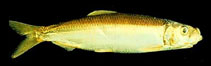
خارهاي باله پشتي (کل) : 0; شعاع نرم باله پشتي (کل) : 13 - 21; خارهاي باله مخرجي: 0; شعاع نرم باله مخرجي: 12 - 23; مهره ها: 46 - 58. Without prominent keel; no median notch in upper jaw. Gill cover without radiating bony striae. No distinctive dark spots on body or fins. Overlaps C. harengus in White Sea, but distinguished by fewer vertebrae (usually 52 to 55; cf. usually 55 to 57) and fewer post-pelvic scutes (10 to 14; cf. 12 to 16). Dark blue to olivaceous above, shading to silver below (Ref. 27547). Precaudal vertebrae: 29-31-32; caudal vertebrae: 19-22-22 (Ref. 265).
Body shape (shape guide): fusiform / normal; Cross section: compressed.
Neritic species (Ref. 11230). A coastal and schooling species (Ref. 188). Landlocked populations exist. Mature adults migrate inshore, entering estuaries to breed. During the summer of their first year, young form schools in shallow bays, inlets and channels that appear at the surface; these schools disappear in the fall and remain in deep water for the next 2-3 years (Ref. 6885, 27547). Young feed mainly on crustaceans, but also take decapod and mollusk larvae; adults prey mainly on large crustaceans and small fishes (Ref. 6885, 27547). Because it does not undertake extensive coastal migrations, the mixing of local populations is relatively rare (Ref. 27547). In the eastern Pacific, the fish is mainly caught for roe markets in Asia (Ref. 9988). There is a fishery for eggs laid on kelp, which when salted, is called kazunoko-kombu, and is considered a delicacy in Japan (Ref. 27547). Used in Chinese medicine (Ref. 12166). Utilized fresh, dried or salted, smoked, canned, and frozen; eaten pan-fried, broiled, and baked (Ref. 9988). Possibly to 475 m depth (Ref. 6793).
Oviparous (Ref. 265). A female turns to her side, deposits her eggs on the bottom and resumes an upright posture. This procedure is repeated until all eggs have been laid, which may take several days (Ref. 11548). As eggs are being deposited, males are releasing milt, fertilizing the eggs (Ref. 27547). There is no observable pairing of the sexes; the whole spawning area is white with milt (Ref. 11558).
Whitehead, P.J.P., 1985. FAO Species Catalogue. Vol. 7. Clupeoid fishes of the world (suborder Clupeoidei). An annotated and illustrated catalogue of the herrings, sardines, pilchards, sprats, shads, anchovies and wolf-herrings. FAO Fish. Synop. 125(7/1):1-303. Rome: FAO. (Ref. 188)
وضعيت در فهرست قرمز IUCN (Ref. 130435: Version 2025-2 (Global))
خطر برای انسان ها
Harmless
استفاده انسانی
ماهي گيري – شيلات: با ارزش تجاري بالا; ماهي ها ي سرگرم كننده: بله; طعمه: usually
ابزارها
گزارش های ويژه
بارگيری XML
منابع اينترنتي
تخمینها بر اساس مدلها
دمای ترجیحی (مرجع
123201): 0.2 - 9.7, mean 2.8 °C (based on 966 cells).
شاخص تنوع فیلوژنتیکی (مرجع
82804): PD
50 = 0.6250 [Uniqueness, from 0.5 = low to 2.0 = high].
Bayesian length-weight: a=0.00617 (0.00494 - 0.00770), b=3.13 (3.07 - 3.19), in cm total length, based on LWR estimates for this species (Ref.
93245).
سطح تروفیک (مرجع
69278): 3.2 ±0.2 se; based on diet studies.
Generation time: 4.2 (2.3 - 5.9) years. Estimated as median ln(3)/K based on 13
growth studies.
جهندگی (مرجع
120179): متوسط, كمينه زمان لازم براي دو برابر شدن جمعيت 4/1 – 4/4 سال (Musick et al. 2000 (Ref.
36717)).
Prior r = 0.74, 95% CL = 0.49 - 1.11, Based on 4 full stock assessments.
آسیبپذیری ماهیگیری (Ref.
59153): Moderate to high vulnerability (49 of 100).
🛈
آسیبپذیری اقلیمی (Ref.
125649): Low vulnerability (22 of 100).
🛈
مواد مغذی (Ref.
124155): Calcium = 113 [31, 265] mg/100g; Iron = 0.652 [0.379, 1.109] mg/100g; Protein = 18.4 [16.4, 20.3] %; Omega3 = 1 [1, 2] g/100g; Selenium = 16 [5, 49] μg/100g; VitaminA = 15.1 [3.4, 67.2] μg/100g; Zinc = 1.18 [0.62, 2.02] mg/100g (wet weight); based on
nutrient studies.