Common names from other countries
>
Gadiformes (Cods) >
Merlucciidae (Merluccid hakes)
Etymology: Merluccius: Latin, mar, maris = the sea + Latin, lucius = pike (Ref. 45335).
Eponymy: Claude Gay (1800–1873) was a French botanist. [...] (Ref. 128868), visit book page.
More on author: Guichenot.
Taxonomic Remarks
A different species/subspecies is recognized on the Peruvian coasts Merluccius peruanus Ginsburg, 1954, that is recognized in FishBase as a provisionally valid species. More studies are needed to clearly differentiate it (March 2021).
Miljö: miljö / Klimatzon / djupintervall / distributionsområde
Ekologi
marina djupbottenlevande; havsvandrande; djupintervall 50 - 500 m (Ref. 1371). Deep-water; 5°S - 46°S, 81°W - 69°E (Ref. 54583)
Southeast Pacific: off the coast of Chile from Arica to Chiloé Island.
Längd vid första mognad / Storlek / Vikt / Ålder
Könsmognad: Lm ?, range 32 - ? cm
Max length : 87.0 cm TL hane/ej könsbestämd; (Ref. 1371); common length : 50.0 cm TL hane/ej könsbestämd; (Ref. 1371)
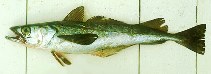
Taggstrålar i ryggfenan (totalt) : 1; Mjukstrålar i ryggfenan (totalt) : 45 - 54; Taggstrålar i analfenan: 0; Mjukstrålar i analfenan: 36 - 42; Ryggkotor: 49 - 53. Caudal fin margin usually concave. Color is silvery on back, silvery whitish on belly. M. gayi gayi and M. gayi peruanus differ by the total number of vertebrae, total number of gill rakers and relative length of head (Ref. 1371).
Body shape (shape guide): fusiform / normal; Cross section: oval.
Occurs from the shallow continental shelf to the upper continental slope (Ref. 1371). Sometimes found off the bottom or in midwater (Ref. 1371). Migrates vertically to midwater at night to feed on fishes, squids and euphausiids (Ref. 27363). Moves to southern coastal areas in summer and migrates to northern deeper waters (200-500 m depth) in winter and spring (Ref. 27363). Spawning occurs at the end of the winter and during the southern spring (Ref. 58452). Marketed fresh and frozen (Ref. 1371) and eaten steamed, fried, boiled and microwaved (Ref. 9988). Also utilized as fishmeal (Ref. 1371).
Livscykel och parningsbeteende
Könsmognad | Reproduktion | Lek | Ägg | Fekunditet | Larver
Cohen, D.M., T. Inada, T. Iwamoto and N. Scialabba, 1990. FAO species catalogue. Vol. 10. Gadiform fishes of the world (Order Gadiformes). An annotated and illustrated catalogue of cods, hakes, grenadiers and other gadiform fishes known to date. FAO Fish. Synop. 125(10). Rome: FAO. 442 p. (Ref. 1371)
Status på IUCN:s rödlista (Ref. 130435: Version 2025-2 (Global))
Hot mot människor
Harmless
Mänskliga användningsområden
Fiskeri: kommersiellt viktig
Verktyg
Särskilda rapporter
Ladda ner XML
Internet-källor
Uppskattningar baserade på modeller
Önskad temperatur (Ref.
123201): 9.3 - 14, mean 10.9 °C (based on 38 cells).
Index för fylogenetisk mångfald (Ref.
82804): PD
50 = 0.5000 [Uniqueness, from 0.5 = low to 2.0 = high].
Bayesian length-weight: a=0.01413 (0.00630 - 0.03168), b=3.05 (2.85 - 3.25), in cm total length, based on LWR estimates for this species & (Sub)family-body (Ref.
93245).
Trofisk nivå (Ref.
69278): 4.3 ±0.6 se; based on diet studies.
Resiliens (Ref.
120179): Mellan, lägsta populationsfördubblingstid 1,4-4,4 år (K=0.1-0.2; tm=2).
Prior r = 0.28, 95% CL = 0.18 - 0.42, Based on 3 full stock assessments.
Sårbarhet i fisket (Ref.
59153): High vulnerability (61 of 100).
🛈
Sårbarhet för klimatet (Ref.
125649): High vulnerability (62 of 100).
🛈
Näringsämnen (Ref.
124155): Calcium = 8.76 [3.94, 31.98] mg/100g; Iron = 0.342 [0.068, 0.925] mg/100g; Protein = 17.6 [16.3, 18.9] %; Omega3 = 0.216 [0.103, 0.404] g/100g; Selenium = 22 [10, 49] μg/100g; VitaminA = 11.9 [2.5, 54.2] μg/100g; Zinc = 0.223 [0.154, 0.356] mg/100g (wet weight); based on
nutrient studies.