Opisthonema libertate, Pacific thread herring : fisheries, bait

You can sponsor this page

Opisthonema libertate (Günther, 1867)

Pacific thread herring
Beobachtung melden im Fish Watcher
Native range | All suitable habitat | Point map | Year 2050
This map was computer-generated and has not yet been reviewed.
Opisthonema libertate   AquaMaps   Data sources: GBIF OBIS
Hochladen Photos und videos
Bilder | Google Bild
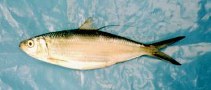
Image of Opisthonema libertate (Pacific thread herring)
Opisthonema libertate
Photo von Cotto Sánchez, A.J.


Panama territory information

Common names: Arenca, Arenque, Arenque de hebra
Occurrence: native
Salinity: marine
Abundance: | Ref:
Importance: highly commercial | Ref: Garcés, H., 2020
Aquaculture: | Ref:
Regulations: | Ref:
Uses: no uses
Comments:
National Checklist:
Territory Information: https://www.cia.gov/library/publications/resources/the-world-factbook/geos/pm.html
National Fisheries Authority:
Occurrences: Occurrences Point map
Main Ref: Whitehead, P.J.P., 1985
National Database:

Common names from other countries

Klassifizierung / Names Namen | Synonyme | Catalog of Fishes(Gattung, Arten) | ITIS | CoL | WoRMS | Cloffa

> Clupeiformes (Herrings) > Dorosomatidae (Gizzard shads and sardinellas)
Etymology: Opisthonema: Greek, opisthe = behind + Greek,nema = filament (Ref. 45335).
More on author: Günther.

Umwelt: Milieu / Klimazone / Tiefenbereich / Verbreitungsgebiet Ökologie

seewasser pelagic-neritic; tiefenbereich ? - 70 m (Ref. 96339), usually ? - 50 m (Ref. 11035). Tropical; 28°N - 3°S, 112°W - 78°W (Ref. 54686)

Verbreitung Territorien | FAO Gebiete | Ökosysteme | Vorkommen | Punkt Karte | Einführungen | Faunafri

Eastern Pacific: Santa Rosalita, Pacific coast of Baja, California, Mexico southward to Punta Sal and Punta Picos, Peru. (Earlier works probably combined data for Opisthonema bulleri and Opisthonema medirastre). Range is extended northwards to San Pedro, California (Ref. 35601). Rare on outer coast of Baja California Sur (Ref. 35601).

Größe / Gewicht / Alter

Geschlechtsreife: Lm ?  range ? - ? cm
Max length : 30.0 cm TL Männchen/unbestimmt; (Ref. 55763); common length : 22.0 cm SL Männchen/unbestimmt; (Ref. 9291); max. veröff. Gewicht: 261.36 g (Ref. 124487)

Kurzbeschreibung Bestimmungsschlüssel | Morphologie | Morphometrie

Rückenflossenstacheln (insgesamt) : 0; Rückenflossenweichstrahlen (insgesamt) : 13 - 21; Afterflossenstacheln: 0; Afterflossenweichstrahlen: 12 - 23. The filamentous last dorsal fin ray distinguishes it from members of any other eastern Pacific clupeoid genus. Separated from eastern Pacific Opisthonema species by having 63 to 110 lower gill rakers in fishes over 14 cm standard length.
Body shape (shape guide): elongated; Cross section: compressed.

Biologie     Fachlexikon (Englisch) (z.B. epibenthic)

Usually occur near the surface of coastal and offshore waters, down to over bottom of continental shelf (Ref. 11035). Form dense schools. Apparently the most abundant of the eastern Pacific species of Opisthonema. Feed on phytoplankton (dinoflagellates and diatoms). Oviparous, with planktonic eggs and larvae (Ref. 35601). Migratory behaviour is undetermined (Ref. 126106). It is reduced to fish meal (Ref. 9291). Oil may be extracted (Ref. 9291). May be canned (Ref. 9291).

Lebenszyklus und Paarungsverhalten Geschlechtsreife | Fortpflanzung | Ablaichen | Eier | Fruchtbarkeit | Larven

Oviparous (Ref. 35601).

Hauptreferenz Laden Sie Ihre Referenzen hoch | Referenzen | Koordinator | Partner

Whitehead, P.J.P., 1985. FAO Species Catalogue. Vol. 7. Clupeoid fishes of the world (suborder Clupeoidei). An annotated and illustrated catalogue of the herrings, sardines, pilchards, sprats, shads, anchovies and wolf-herrings. FAO Fish. Synop. 125(7/1):1-303. Rome: FAO. (Ref. 188)

IUCN Rote Liste Status (Ref. 130435: Version 2025-2 (Global))

  nicht bedroht (LC) ; Date assessed: 24 May 2007

CITES

Not Evaluated

CMS (Ref. 116361)

Not Evaluated

Bedrohung für Menschen

  Harmless


Nutzung durch Menschen

Fischereien: hoch kommerziell; Köder: occasionally
FAO - Fischereien: landungen, Artbeschreibung; Publication: search | FishSource | Das Meer um uns herum

Mehr Information

Trophische Ökologie
Lebensmittel (Beutetiere)
Nahrungszusammensetzung
Nahrungsaufnahme
Lebensmittelrationen
Räuber
Ökologie
Ökologie
Home ranges
Populationsdynamik
Wachstumsparameter
Max. Alter/Größen
Länge-Gewicht-Rel.
Länge-Länge-Verhältnis.
Längenhäufigkeiten
Massenkonvertierung
Rekrutierung
Dichte
Lebenszyklus
Fortpflanzung
Geschlechtsreife
Reifung/Kiemen rel.
Fruchtbarkeit
Ablaichen
Laichaggregationen
Eier
Eientwicklung
Larven
Larven Pop.Dyn.
Anatomie
Kiemenoberfläche
Gehirn
Otolith
Physiologie
Körperliche Zusammensetzung
Nährstoffe
Sauerstoffverbrauch
Schwimmart
Schwimmgeschwindigkeit
Visuelle Pigmente
Fischgeräusche
Krankheiten und Parasiten
Toxizität (LC50s)
Genetik
Genom
Genetik
Heterozygotie
Vererbbarkeit
Menschenbezogen
Aquakultur-Systeme
Aquakultur Profile
Zuchtlinien
Ciguatera-Fälle
Briefmarken, Münzen, Verschiedenes.
Aufsuchen
Partner
Referenzen
Referenzen

Tools

Zusatzinformationen

Download XML

Internet Quellen

AFORO (otoliths) | Alien/Invasive Species database | Aquatic Commons | BHL | Cloffa | Websites from users | FishWatcher Einträge suchen | CISTI | Catalog of Fishes: Gattung, Arten | DiscoverLife | ECOTOX | FAO - Fischereien: landungen, Artbeschreibung; Publication: search | Faunafri | Fishipedia | Fishtrace | GloBI | Google Books | Google Scholar | Google | IGFA World Record | OneZoom | Open Tree of Life | Otolith Atlas of Taiwan Fishes | PubMed | Reef Life Survey | Socotra Atlas | TreeBase | Tree of Life | Wikipedia: Gehe zu, Suchen | World Records Freshwater Fishing | Zoologischer Rekord

Schätzungen auf der Grundlage von Modellen

Bevorzugte Temperatur (Ref. 123201): 21.4 - 29, mean 27 °C (based on 86 cells).
Phylogenetischer Diversitätsindex (Ref. 82804):  PD50 = 0.5312   [Uniqueness, from 0.5 = low to 2.0 = high].
Bayesian length-weight: a=0.00676 (0.00401 - 0.01141), b=3.06 (2.91 - 3.21), in cm total length, based on LWR estimates for this species & (Sub)family-body (Ref. 93245).
Trophische Ebene (Ref. 69278):  2.9   ±0.28 se; based on food items.
Widerstandsfähigkeit (Ref. 120179):  hoch, Verdopplung der Population dauert weniger als 15 Monate. (K=0.22-0.5).
Prior r = 0.43, 95% CL = 0.28 - 0.64, Based on 2 full stock assessments.
Anfälligkeit der Fischerei (Ref. 59153):  Low vulnerability (25 of 100). 🛈
Klimaanfälligkeit (Ref. 125649):  Moderate vulnerability (37 of 100). 🛈
Preiskategorie (Ref. 80766):   Medium.
Nährstoffe (Ref. 124155):  Calcium = 199 [90, 362] mg/100g; Iron = 1.94 [1.10, 3.34] mg/100g; Protein = 18.6 [17.5, 19.7] %; Omega3 = 0.37 [0.21, 0.67] g/100g; Selenium = 48.5 [23.7, 99.5] μg/100g; VitaminA = 26.8 [9.3, 78.7] μg/100g; Zinc = 1.41 [0.97, 2.09] mg/100g (wet weight);