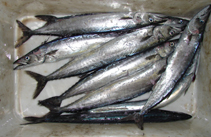
Thyrsites atun, Snoek : fisheries, gamefish

You can sponsor this page

Thyrsites atun (Euphrasen, 1791)

Snoek
Adicionar as suas observações no Fish Watcher
Native range | All suitable habitat | Point map | Year 2050
This map was computer-generated and has not yet been reviewed.
Thyrsites atun   AquaMaps   Data sources: GBIF OBIS
Adicionar o seu Fotografias e vídeos
Fotografias | Imagem do Google
Image of Thyrsites atun (Snoek)
Thyrsites atun
Fotografia de Le Noury, P.


New Zealand territory information

Common names: Barracouta, Mangaa, Snoek
Occurrence: native
Salinity: marine
Abundance: | Ref:
Importance: commercial | Ref: Nakamura, I. and N.V. Parin, 1993
Aquaculture: | Ref:
Regulations: | Ref:
Uses: gamefish: yes;
Comments: Widespread in coastal waters, abundant in some localities (Ref. 9258). Fishing grounds are located around the South Island, especially off Stewart Island, Canterbury Bight and the northwest coast. Recorded in the trawl survey in Chatham Islands (Ref. 45493). Voucher specimen(s) held at the NMNZ (Ref. 5755). Also Ref. 5530, 9072, 9988, 58461.
National Checklist:
Territory Information: https://www.cia.gov/library/publications/resources/the-world-factbook/geos/nz.html
National Fisheries Authority: http://www.fish.govt.nz/
Occurrences: Occurrences Point map
Main Ref: Nakamura, I. and N.V. Parin, 1993
National Database:

Common names from other countries

Classificação / Nomes Nomes comuns | Sinónimos | Catalog of Fishes(Género, Espécies) | ITIS | CoL | WoRMS | Cloffa

> Scombriformes (Mackerels) > Gempylidae (Snake mackerels)
Etymology: Thyrsites: Greek, thyrsites, -ou = stalk of a plant, an ornament like a pine cone borne by Bacchus (Ref. 45335).

Ambiente: milieu / zona climática / intervalo de profundidade / gama de distribuição Ecologia

marinhas; estuarina bentopelágico; oceanódromo; intervalo de profundidade 0 - 550 m (Ref. 6390), usually 100 - 500 m (Ref. 6181). Subtropical; 13°C - 18°C (Ref. 6181); 21°S - 56°S, 75°W - 177°E (Ref. 54924)

Distribuição Territórios | Áreas FAO | Ecossistemas | Ocorrências | Mapa dos pontos | Introduções | Faunafri

Southwest Atlantic: Uruguay, Argentina and Tierra del Fuego. Eastern Atlantic: Tristan da Cunha and South Africa. Western Indian Ocean: South Africa and the St. Paul and Amsterdam islands. Eastern Indian Ocean: Tasmania and southern coast of Australia. Southwest Pacific: New Zealand and southern coast of Australia. Southeast Pacific: southern Peru, Chile, and Tierra del Fuego.

Comprimento na primeira maturidade / Tamanho / Peso / Idade

Maturidade: Lm 55.0, range 50 - 60 cm
Max length : 200 cm SL macho/indeterminado; (Ref. 3630); common length : 75.0 cm SL macho/indeterminado; (Ref. 6181); peso máx. Publicado: 6.0 kg (Ref. 6181); Idade máx. registada: 10 anos (Ref. 28892)

Descrição breve Chaves de identificação | Morfologia | Morfometria

Espinhos dorsais (total) : 19 - 21; Raios dorsais moles (total) : 11 - 13; Espinhos anais: 1; Raios anais moles: 10 - 12; Vértebras: 35. Body elongate and strongly compressed. Lateral line single, running close to the upper contour of the body below most of the first dorsal-fin base then abruptly curving ventrally. Body is dark blue, slightly paler on belly; first dorsal fin membrane black (Ref. 6181).
Body shape (shape guide): elongated; Cross section: compressed.

Biologia     Glossário (ex. epibenthic)

Inhabit continental shelves or around islands. Feed on pelagic crustaceans (Euphausia, Nyctiphanes), cephalopods and fishes (Ref. 6181) like anchovy and pilchard (Ref. 36731). Form schools near the bottom or midwater; sometimes even at the surface at night (Ref. 6181). Prefers temperature between 13° and 18°C (Ref. 36731). Marketed fresh, smoked, canned and frozen; eaten fried, broiled, microwaved and baked (Ref. 9988). Good for fish and chips or smoking; also made into fillet or fish cake in Japan (Ref. 6181). Commonly called as Baracoutta and because it is a fast predator, several English vessels were named after it. In the UK during WW II, this canned fish was commonly eaten that many older people have an aversion to it (D. Parkyn, pers. comm. 05/2022).

Ciclo de vida e comportamento de acasalamento Maturidade | Reprodução | Desova | Ovos | Fecundidade | Larvas

Spawning patterns are complex, with different stock spawning at different times of the year (Ref. 6390).

Referência principal Carregar as suas referências | Referências | Coordenador : Parin, Nikolay V. | Colaboradores

Nakamura, I. and N.V. Parin, 1993. FAO Species Catalogue. Vol. 15. Snake mackerels and cutlassfishes of the world (families Gempylidae and Trichiuridae). An annotated and illustrated catalogue of the snake mackerels, snoeks, escolars, gemfishes, sackfishes, domine, oilfish, cutlassfishes,. scabbardfishes, hairtails, and frostfishes known to date. FAO Fish. Synop. 125(15):136 p. (Ref. 6181)

Categoria na Lista Vermelha da IUCN (Ref. 130435: Version 2025-2 (Global))


CITES

Not Evaluated

CMS (Ref. 116361)

Not Evaluated

Ameaça para o homem

  Harmless


Utilização humana

Pescarias: altamente comercial; peixe desportivo: sim
FAO - pescarias: desembarques, perfil da espécie; Publication: search | FishSource | Sea Around Us

Mais informação

Ecologia Trófica
Produtos alimentares (presas)
Composição da dieta
Consumo alimentar
Rações alimentares
Predadores
Ecologia
Ecologia
Home ranges
Ciclo de vida
Reprodução
Maturidade
Maturidade/Rel. das guelras
Fecundidade
Desova
Agregações de desova
Ovos
Desenvolvimento dos ovos
Larvas
Dinâmica larvar
Distribuição
Territórios
Áreas FAO
Ecossistemas
Ocorrências
Introduções
BRUVS - Vídeos
Anatomia
Área branquial
Cérebro
Otólitos
Fisiologia
Composição corporal
Nutrientes
Consumo de oxigénio
Tipo de natação
Velocidade de natação
Pigmentos visuais
Som de peixe
Doenças e Parasitas
Toxicidade (LC50s)
Genética
genoma
Genética
Heterozigotia
Hereditariedade
Relacionado com o ser humano
Sistemas de aquacultura
Perfis para aquacultura
Estirpes
Casos de Ciguatera
Selos, moedas, diversos.
Divulgação
Colaboradores
Referências
Referências

Ferramentas

Relatórios especiais

Descarregue XML

Fontes da internet

AFORO (otoliths) | Aquatic Commons | BHL | Cloffa | Websites from users | Consultar FishWatcher | CISTI | Catalog of Fishes: Género, Espécies | DiscoverLife | ECOTOX | FAO - pescarias: desembarques, perfil da espécie; Publication: search | Faunafri | Fishipedia | Fishtrace | GloBI | Google Books | Google Scholar | Google | IGFA World Record | Bases de dados nacionais | OneZoom | Open Tree of Life | Otolith Atlas of Taiwan Fishes | PubMed | Reef Life Survey | Socotra Atlas | TreeBase | Árvore da vida | Wikipedia: ir para, procurar | World Records Freshwater Fishing | Registo zoológico

Estimativas baseadas em modelos

Temperatura preferida (Ref. 123201): 6.2 - 16, mean 11.2 °C (based on 285 cells).
Índice de diversidade filogenética (Ref. 82804):  PD50 = 1.0000   [Uniqueness, from 0.5 = low to 2.0 = high].
Bayesian length-weight: a=0.00427 (0.00237 - 0.00767), b=3.08 (2.92 - 3.24), in cm total length, based on LWR estimates for this species & (Sub)family-body (Ref. 93245).
Nível Trófico (Ref. 69278):  3.6   ±0.3 se; based on diet studies.
Generation time: 3.7 ( na - na) years. Estimated as median ln(3)/K based on 1 growth studies.
Resiliência (Ref. 120179):  Médio, tempo mínimo de duplicação da população 1,4 - 4,4 anos (tm=2-4; tmax=10).
Prior r = 0.37, 95% CL = 0.25 - 0.56, Based on 1 full stock assessment.
Vulnerabilidade da pesca (Ref. 59153):  Moderate to high vulnerability (53 of 100). 🛈
Vulnerabilidade climática (Ref. 125649):  Moderate vulnerability (43 of 100). 🛈
Categoria de preço (Ref. 80766):   Very high.
Nutrientes (Ref. 124155):  Calcium = 27.5 [13.2, 49.7] mg/100g; Iron = 0.697 [0.342, 1.400] mg/100g; Protein = 17.9 [15.7, 19.9] %; Omega3 = 0.225 [0.130, 0.402] g/100g; Selenium = 67.6 [33.5, 135.3] μg/100g; VitaminA = 8.26 [2.93, 23.72] μg/100g; Zinc = 0.541 [0.382, 0.784] mg/100g (wet weight);