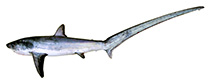
Alopias vulpinus, Thresher : fisheries, gamefish

You can sponsor this page

Alopias vulpinus (Bonnaterre, 1788)

Thresher
Добавить Ваши наблюдения в Fish Watcher
Native range | All suitable habitat | Point map | Year 2050
This map was computer-generated and has not yet been reviewed.
Alopias vulpinus   AquaMaps   Data sources: GBIF OBIS
Загрузить свой Фото и Видео
изображения | Видео | Изображение на Google
Image of Alopias vulpinus (Thresher)
Alopias vulpinus
Изображение сделано S. Iglesels et al


New Zealand territory information

Common names: Mangoo-ripi, Mango-ripi, Thresher shark
Occurrence: native
Salinity: marine
Abundance: | Ref:
Importance: | Ref:
Aquaculture: | Ref:
Regulations: | Ref:
Uses: gamefish: yes;
Comments: Ranges from Kermadec Islands to the Snares shelf (Ref. 89422). Possibly to the Auckland Islands (Ref. 89423). Voucher specimen(s) held at the NMNZ (Ref. 5755). Also Ref. 247, 43278.
National Checklist:
Territory Information: https://www.cia.gov/library/publications/resources/the-world-factbook/geos/nz.html
National Fisheries Authority: http://www.fish.govt.nz/
Occurrences: Occurrences Point map
Main Ref: Cox, G. and M. Francis, 1997
National Database:

Common names from other countries

Классификация / Имена народные названия | синонимы | Catalog of Fishes(род, виды) | ITIS | CoL | WoRMS | Cloffa

Пластиножаберные (акулы и скаты) (sharks and rays) > Lamniformes (Mackerel sharks) > Alopiidae (Thresher sharks)
Etymology: Alopias: From alopex, Greek for fox, referring to the ancient vernacular “fox shark,” from its supposed cunning (ancients believed that when it took a bait, it swallowed the hook until it got to the cord, which it bit off and so escaped) (See ETYFish)vulpinus: Latin for fox-like (as for genus) (See ETYFish).
More on author: Bonnaterre.

Окружающая среда: среда / климатическая зона / пределы глубины / диапазон распространения экология

морской pelagic-oceanic; мигрирует в океане (Ref. 87829); пределы глубины 0 - 650 m (Ref. 106604), usually 0 - 200 m (Ref. 55168). Subtropical; 74°N - 58°S, 180°W - 180°E (Ref. 54279)

распространение Территории | регионы FAO | Экосистемы | места находок | карта точек | интродукции | Faunafri

Cosmopolitan in temperate and tropical seas (Ref. 6871, 58085). Population considered reduced (R) in the US Atlantic waters; lower risk/conservation dependent (LR/CD) in US Pacific waters; data deficient (DD) in the rest of Atlantic and rest of Pacific (Ref. 12451). Highly migratory species.

Длина при первой зрелости / Размер / Вес / Возраст

половая зрелость: Lm 351.0, range 226 - 400 cm
Max length : 573 cm TL самец/пол неопределен; (Ref. 106604); 549.0 cm TL (female); common length : 450 cm TL самец/пол неопределен; (Ref. 5217); наибольший вес (опубликованные данные): 348.0 kg (Ref. 40637); наибольший возраст (опубликованны данные): 25 годы (Ref. 81241)

Краткое описание определительные ключи | морфология | морфометрия

колючие лучи спинного плавника (общее число) : 0; колючие лучи анального плавника: 0. A large thresher with relatively small eyes, curved, narrow-tipped pectoral fins, a narrow-tipped caudal fin, and a conspicuous white patch over the pectoral fin bases (Ref. 5578). Second dorsal origin well behind the rear tip of the pelvic fin (Ref. 559). Upper lobe of caudal fin very long and strap-like, about as long as or longer than length of rest of shark; lower lobe short but well developed (Ref. 13570). Brown, grey, blue-grey, or blackish on back and underside of snout, lighter on sides and abruptly white below; a white area extends from the abdomen over the pectoral-fin bases; pectoral-, pelvic-, and dorsal fins blackish, white dots sometimes present on pectoral-, pelvic-, and caudal- fin tips (Ref. 13570).
Body shape (shape guide): fusiform / normal; Cross section: circular.

биология     глоссарий (например epibenthic)

Coastal over continental and insular shelves and epipelagic far from land (Ref. 30573, 43278, 58302). Oceanic although most abundant near land, pelagic at 1-366 m (Ref. 58302). Young often close inshore and in shallow bays (Ref. 5578). Feeds on schooling fishes (including mackerels, bluefishes, clupeids, needlefishes, lancetfishes and lanternfishes), squid, octopi, pelagic crustaceans, and rarely seabirds (Ref. 247). Ovoviviparous, embryos feeding on yolk sac and other ova produced by the mother (Ref. 43278, 50449). Uses its long caudal fin to bunch up and stun prey (Ref. 2850). Spatial and depth segregation by sex in northwestern Indian Ocean populations (Ref. 247). A few attacks on boats are doubtfully attributed to this species, but it is otherwise apparently harmless to humans, though the size of adults of this species command respect (Ref. 247). May cause damage to fishing gear (Ref. 6885). Valued for its meat, liver, hide, and fins; utilized fresh, dried-salted, smoked, and frozen (Ref. 9987).

Жизненный цикл и брачное поведение половая зрелость | размножение | нерест | икра | Плодовитость | личинки

Ovoviviparous, embryos feed solely on the ova produced by the mother after the yolk sac is absorbed (oophagy) (Ref. 50449), 2 to 4 young in a litter (usually 2) (Ref. 247). Size at birth 114-150 cm (Ref. 247). Distinct pairing with embrace (Ref. 205).

Основная ссылка Загрузите свои рекомендации | ссылки | координатор : Compagno, Leonard J.V. | соавторы

Compagno, L.J.V., 1984. FAO Species Catalogue. Vol. 4. Sharks of the world. An annotated and illustrated catalogue of shark species known to date. Part 1 - Hexanchiformes to Lamniformes. FAO Fish. Synop. 125(4/1):1-249. Rome, FAO. (Ref. 247)

Статус Красного Списка МСОП (Ref. 130435: Version 2025-2 (Global))

  Уязвимые (VU) (A2bd); Date assessed: 06 November 2018

CITES


Угроза для людей

  Harmless (Ref. 247)


Использование человеком

рыболовство: коммерческий; объект спортивного рыболовства: да

дополнительная информация

Трофическая экология
Пищевые предметы (добыча)
состав пищи
потребление пищи
Продовольственные пайки
хищники
экология
экология
Home ranges
Динамика численности населения
Параметры роста
Макс. возраст / размер
Отношение длины к весу.
Отношение длины к длине.
Размерный состав
Преобразование массы
пополнение
численность
Жизненный цикл
размножение
половая зрелость
Зрелость/Жиры относительно.
Плодовитость
нерест
Нерестовые скопления
икра
Развитие икры
личинки
динамика численности личинок
распространение
Территории
регионы FAO
Экосистемы
места находок
интродукции
BRUVS - Видео
Анатомия
жаберная область
Мозг
Отолит
Физиология
Состав тела
Питательные вещества
Потребление кислорода
Тип плавания
Скорость плавания
Зрительные пигменты
Звук рыбы
Болезни и паразиты
Токсичность (LC50s)
генетика
Геном
генетика
Гетерозиготность
наследуемость
Связанные с человеком
Системы аквакультуры
особенности рыбоводства
степень растяжения
Случаи заболевания сигуатерой
Марки, монеты и прочее.
Информационно-просветительская работа
соавторы
ссылки
ссылки

инструменты

Специальные отчеты

Скачать в формате XML

ресурсы в Интернет

Оценки, основанные на моделях

Предпочтительная температура (ссылка 123201): 11.6 - 28.2, mean 23.3 °C (based on 8352 cells).
Индекс филогенетического разнообразия (ссылка 82804):  PD50 = 0.7500   [Uniqueness, from 0.5 = low to 2.0 = high].
Bayesian length-weight: a=0.00851 (0.00364 - 0.01988), b=2.86 (2.66 - 3.06), in cm total length, based on LWR estimates for this species & (Sub)family-body (Ref. 93245).
Трофический уровень (ссылка 69278):  4.5   ±0.0 se; based on diet studies.
Generation time: 11.0 ( na - na) years. Estimated as median ln(3)/K based on 2 growth studies.
устойчивость к внешним воздействиям (ссылка 120179):  низкий, минимальное время удвоения популяции 4.5-14 лет (K=0.1; tm=5-7; tmax=19; Fec=2-4).
Prior r = 0.05, 95% CL = 0.03 - 0.07, Based on 1 full stock assessment.
Уязвимость рыбной ловли (Ref. 59153):  Very high vulnerability (77 of 100). 🛈
Климатическая уязвимость (Ref. 125649):  High vulnerability (62 of 100). 🛈
Категория цены (Ref. 80766):   High.
Питательные вещества (Ref. 124155):  Calcium = 6.93 [1.98, 35.15] mg/100g; Iron = 0.726 [0.178, 2.143] mg/100g; Protein = 20.7 [18.3, 23.1] %; Omega3 = 0.379 [0.152, 0.923] g/100g; Selenium = 37.8 [10.7, 110.5] μg/100g; VitaminA = 4.78 [1.56, 14.81] μg/100g; Zinc = 0.28 [0.14, 0.52] mg/100g (wet weight);