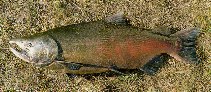
Oncorhynchus tshawytscha, Chinook salmon : fisheries, aquaculture, gamefish, aquarium

You can sponsor this page

Oncorhynchus tshawytscha (Walbaum, 1792)

Chinook salmon
Thêm quan sát của bạn vào Fish Watcher
Native range | All suitable habitat | Point map | Year 2050
This map was computer-generated and has not yet been reviewed.
Oncorhynchus tshawytscha   AquaMaps   Data sources: GBIF OBIS
Tải lên của bạn hình ảnh Và Video
Các tranh (Ảnh) | Video | Google image
Image of Oncorhynchus tshawytscha (Chinook salmon)
Oncorhynchus tshawytscha
Male Hình ảnh của McDowall, R.M.


New Zealand territory information

Common names: King salmon, Pacific salmon, Quinnat salmon
Occurrence: introduced
Salinity: freshwater
Abundance: abundant (always seen in some numbers) | Ref: McDowall, R.M., 1990
Importance: commercial | Ref:
Aquaculture: commercial | Ref:
Regulations: | Ref:
Uses: no uses
Comments: Known from the eastern South I., limited number in west of South I., and rare in North I. Range is expanding (Ref. 52336). In coastal waters, mainly east coast of South Island; migrates inshore and up rivers to spawn in late summer and autumn (Ref. 9258). Population in the South Island of New Zealand originated from Chinook eggs shipped between 1900 and 1906 from Battle Creek Hatchery in Sacramento River (Ref. 76986). Voucher specimen(s) held at the NMNZ (Ref. 5755). Also Ref. 1998, 6452, 6466, 7306, 27436, 43202, 58461.
National Checklist:
Territory Information: https://www.cia.gov/library/publications/resources/the-world-factbook/geos/nz.html
National Fisheries Authority: http://www.fish.govt.nz/
Occurrences: Occurrences Point map
Main Ref: Welcomme, R.L., 1988
National Database:

Common names from other countries

Phân loại / Tên Tên thường gặp | Các synonym ( Các tên trùng) | Catalog of Fishes(Giống, Các loài) | ITIS | CoL | WoRMS | Cloffa

> Salmoniformes (Salmons) > Salmonidae (Salmonids) > Salmoninae
Etymology: Oncorhynchus: Greek, onyx, -ychos = nail + Greek, rhyngchos = snout (Ref. 45335)tshawytscha: tshawytscha which is the vernacular name of this species in Kamchatka (Ref. 1998).
More on author: Walbaum.

Môi trường: môi trường / vùng khí hậu / Mức độ sâu / phạm vi phân phối Sinh thái học

biển; nước ngọt; thuộc về nước lợ sống nổi và đáy; di cư biển sông (để đẻ trứng) (Ref. 132363); mức độ sâu 0 - 375 m (Ref. 58426). Temperate; 0°C - 25°C (Ref. 35682); 71°N - 27°N, 136°E - 112°W (Ref. 54251)

Sự phân bố Lãnh thổ | Các khu vực của FAO | Các hệ sinh thái | Những lần xuất hiện | Bản đồ điểm | Những chỉ dẫn | Faunafri

Arctic, Northwest to Northeast Pacific: drainages from Point Hope, Alaska to San Joanquin and King rivers in California, USA (Ref. 86798). Also in Honshu, Japan (Ref. 6793), Sea of Japan (Ref. 1998), Bering Sea (Ref. 2850) and Sea of Okhotsk (Ref. 1998). Found in Coppermine River in the Arctic. Several countries report adverse ecological impact after introduction.

Chiều dài lúc trưởng thành đầu tiên / Bộ gần gũi / Khối lượng (Trọng lượng) / Tuổi

Chín muồi sinh dục: Lm 82.2  range ? - ? cm
Max length : 150 cm TL con đực/không giới tính; (Ref. 40637); common length : 70.0 cm TL con đực/không giới tính; (Ref. 9258); Khối lượng cực đại được công bố: 61.4 kg (Ref. 27547); Tuổi cực đại được báo cáo: 9 các năm (Ref. 12193)

Mô tả ngắn gọn Khóa để định loại | Hình thái học | Sinh trắc học

Các tia vây lưng cứng (tổng cộng) : 0; Các vây lưng mềm (tổng cộng) : 10 - 14; Tia cứng vây hậu môn: 0; Tia mềm vây hậu môn: 13 - 19; Động vật có xương sống: 67 - 75. Distinguished by the small black spots on the back and on the upper and lower lobes of the caudal fin, and the black gums of the lower jaw (Ref. 27547). Body fusiform, streamlined, noticeably laterally compressed in large adults, somewhat deeper than other species (Ref. 6885). Gill rakers wide-spaced and rough; pelvic fins with axillary process (Ref. 27547). Fish in the sea are dark greenish to blue black on top of head and back, silvery to white on the lower sides and belly; numerous small, dark spots along back and upper sides and on both lobes of caudal; gum line of lower jaw black (Ref. 27547). In fresh water, with the approach of the breeding condition, the fish change to olive brown, red or purplish, the color change being more marked in males than in females (Ref. 27547).
Body shape (shape guide): fusiform / normal; Cross section: compressed.

Sinh học     Tự điển (thí dụ epibenthic)

Adults return to natal streams from the sea to spawn (Ref. 27547). Fry may migrate to the sea after only 3 months in fresh water, some may stay for as long as 3 years, but generally most stay a year in the stream before migrating (Ref. 27547). Some individuals remain close inshore throughout their lives, but some make extensive migrations (Ref. 27547, 44894). Also found in lakes (Ref. 1998). Possibly up to 375 m depth (Ref. 6793). Epipelagic (Ref. 58426). Food in streams is mainly terrestrial insects and small crustaceans; in the sea, major food items include fishes, crustaceans, and other invertebrates (Ref. 27547). Young are preyed upon by fishes and birds (such as mergansers and kingfishers); adults are prey of large mammals and large birds (Ref. 1998). Highly regarded game fish (Ref. 27547). Flesh is usually red, but some are white; the red meat commands a higher price (Ref. 27547). Marketed fresh, smoked, frozen, and canned. Eaten steamed, fried, broiled, boiled, microwaved, and baked (Ref. 9988). Viscera said to contain high vitamin A content and used successfully as food for hatchery fish (Ref. 28971, 28977).

Vòng đời và hành vi giao phối Chín muồi sinh dục | Sự tái sinh sản | Đẻ trứng | Các trứng | Sự sinh sản | Ấu trùng

Adults migrate up to 4,827 km upstream to spawn (Ref. 6850). Migration from the sea begins in December so that the the first fish are near river mouths by spring (Ref. 27547). Once a female selects a spot, she begins to dig a nest, driving away other females during the period of nest building. The female is attended by a larger, dominant male and several smaller males who drive away other males. While the female digs the nest, the male courts her by coming to rest beside her and quivering; by swimming about over her, touching her dorsal fin with his body and fins; and occasionally nudging her side gently with his snout (Ref. 28978). Upon completion of the nest, the female drops into it and is immediately joined by the dominant male. The fish open their mouths, vibrate, and eggs and sperm are released. At this point smaller males may dart into the nest and release sperm. The female then quickly moves to the upstrem edge of the nest and begins to dig. The eggs are covered and a new nest is made. The whole process is repeated until the female releases all her eggs, which may take several days. The male then leaves the female and may mate with another female. The female guards the nest for as long as she can. Spent adults usually die a few days after spawning. (Ref. 1998, 27547). Reproductive strategy: synchronous ovarian organization, determinate fecundity (Ref. 51846).

Tài liệu tham khảo chính Tải lên tài liệu tham khảo của bạn | Các tài liệu tham khảo | Người điều phối | Người cộng tác

Page, L.M. and B.M. Burr, 2011. A field guide to freshwater fishes of North America north of Mexico. Boston : Houghton Mifflin Harcourt, 663p. (Ref. 86798)

Tình trạng Sách đỏ IUCN (Ref. 130435: Version 2025-2 (Global))

  Least Concern (LC) ; Date assessed: 18 September 2020

CITES

Not Evaluated

CMS (Ref. 116361)

Not Evaluated

Mối đe dọa đối với con người

  Potential pest (Ref. 12257)


Sử dụng của con người

Các nghề cá: tính thương mại cao; Nuôi trồng thủy sản: tính thương mại; cá để chơi: đúng; Bể nuôi cá: Bể cá công cộng
FAO - Hệ thống nuôi trồng thủy sản: sản xuất; Các nghề cá: hạ cánh, hồ sơ loài; Publication: search | FishSource | Biển chung quanh ta

Thêm thông tin

Sinh thái dinh dưỡng
Thức ăn (con mồi)
Thành phần thức ăn
Thành phần thức ăn
Khẩu phần ăn
Các động vật ăn mồi
Sinh thái học
Sinh thái học
Home ranges
Vòng đời
Sự tái sinh sản
Chín muồi sinh dục
Độ trưởng thành/Mang liên quan
Sự sinh sản
Đẻ trứng
Tập hợp sinh sản
Các trứng
Sự phát triển của trứng
Ấu trùng
Sự biến động ấu trùng
Giải phẫu
Vùng mang
Não
sỏi tai
Liên quan đến con người
Hệ thống nuôi trồng thủy sản
Các tổng quan nuôi trồng thủy sản
Các giống
Các trường hợp ngộ độc Ciguatera
Tem, tiền xu, v.v.
Tiếp cận
Người cộng tác
Các tài liệu tham khảo

Các công cụ

Báo cáo đặc biệt

Tải xuống XML

Các nguồn internet

Ước tính dựa trên mô hình

Nhiệt độ ưa thích (Tài liệu tham khảo 123201): 0.7 - 8, mean 3.5 °C (based on 561 cells).
Chỉ số đa dạng phát sinh loài (Tài liệu tham khảo 82804):  PD50 = 0.5000   [Uniqueness, from 0.5 = low to 2.0 = high].
Bayesian length-weight: a=0.01047 (0.00488 - 0.02245), b=3.04 (2.87 - 3.21), in cm total length, based on LWR estimates for this Genus-body shape (Ref. 93245).
Mức dinh dưỡng (Tài liệu tham khảo 69278):  4.4   ±0.7 se; based on diet studies.
Thích nghi nhanh (Tài liệu tham khảo 120179):  Trung bình, thời gian nhân đôi của chủng quần tối thiểu là 1.4 - 4.4 năm (tm=4; tmax=9; Fec=4,000).
Prior r = 0.32, 95% CL = 0.21 - 0.48, Based on 10 full stock assessments.
Sự dễ bị tổn thương của nghề đánh cá (Ref. 59153):  Very high vulnerability (90 of 100). 🛈
Sự dễ bị tổn thương của khí hậu (Ref. 125649):  Moderate to high vulnerability (52 of 100). 🛈
Loại giá (Ref. 80766):   Very high.
Chất dinh dưỡng (Ref. 124155):  Calcium = 18.6 [7.8, 45.2] mg/100g; Iron = 0.749 [0.406, 1.458] mg/100g; Protein = 19 [18, 20] %; Omega3 = 1 [0, 2] g/100g; Selenium = 261 [84, 762] μg/100g; VitaminA = 14.3 [4.2, 51.3] μg/100g; Zinc = 0.467 [0.323, 0.915] mg/100g (wet weight); based on nutrient studies.