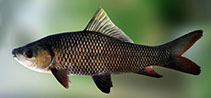
Labeo rohita, Roho labeo : fisheries, aquaculture, gamefish

You can sponsor this page

Labeo rohita (Hamilton, 1822)

Roho labeo
Envoyez vos Photos et vidéos
Images | Timbres, pièces de monnaie, divers | Images Google
Image of Labeo rohita (Roho labeo)
Labeo rohita
Photo de Ramani Shirantha


Nepal territory information

Common names: Rohu
Occurrence: native
Salinity: freshwater
Abundance: common (usually seen) | Ref: Shrestha, T.K., 2008
Importance: highly commercial | Ref:
Aquaculture: commercial | Ref:
Regulations: | Ref:
Uses: gamefish: yes;
Comments: Occurs naturally in the Kosi, Bagmati, Narayani, Lumbini and Bheri zones with an altitudinal range of 76-250 m. Cultured by artificial propagation in the rivers of the Terai zone. Sold for 65-70 Rs/kg at the Kathmandu market in March 1992. Also Ref. 4832, 41236, 43640.
National Checklist:
Territory Information: https://www.cia.gov/library/publications/resources/the-world-factbook/geos/np.html
National Fisheries Authority:
Occurrences: Occurrences Point map
Main Ref: Shrestha, J., 1994
National Database:

Common names from other countries

Classification / Noms Noms communs | Synonymes | Catalog of Fishes(Genre, Espèce) | ITIS | CoL | WoRMS | Cloffa

> Cypriniformes (Carps) > Cyprinidae (Minnows or carps) > Labeoninae
Etymology: Labeo: Latin, labeo = one who has large lips (Ref. 45335).
More on author: Hamilton.

Environnement : milieu / zone climatique / profondeur / gamme de distribution Écologie

; eau douce; saumâtre benthopélagique; potamodrome (Ref. 51243); profondeur 5 - ? m (Ref. 4832). Tropical; 32°N - 21°S

Distribution Territoires | Zones FAO | Écosystèmes | Occurrences | Carte par point | Introductions | Faunafri

Asia: Pakistan, India, Bangladesh, Myanmar and Nepal.

Longueur à la première maturité / Taille / Poids / Âge

Maturité: Lm 58.0  range ? - ? cm
Max length : 200 cm TL mâle / non sexé; (Ref. 9987); poids max. publié: 45.0 kg (Ref. 9987); âge max. reporté: 10 années (Ref. 56)

Description synthétique Clés d'identification | Morphologie | Morphométrie

Dorsal fin with 12-14 1/2 branched rays; lower profile of head conspicuously arched; short dorsal fin with anterior branched rays shorter than head; 12-16 predorsal scales ; snout without lateral lobe (Ref. 43281).
Body shape (shape guide): fusiform / normal; Cross section: oval.

Biologie     Glossaire (ex. epibenthic)

Adults inhabit rivers (Ref. 4832). A diurnal species and usually solitary. They burrow occasionally. Feed on plants. Spawning season generally coincides with the southwest monsoon. Spawning occurs in flooded rivers. Fecundity varies from 226,000 to 2,794,000 depending upon the length and weight of the fish and weight of the ovary. Widely introduced outside its native range for stocking reservoirs and aquaculture. Utilized fresh (Ref. 9987).

Cycle de vie et comportement reproducteur Maturité | Reproduction | Frai | Œufs | Fécondité | Larves

Spawns in middle reaches of rivers, where flood water spreads in more or less limpid shallows over fertile flats, well above tidal reaches; also in reservoirs and bundh-type tanks.

Référence principale Téléchargez vos références | Références | Coordinateur | Collaborateurs

Khan, H.A. and V.G. Jhingran, 1975. Synopsis of biological data on rohu Labeo rohita (Hamilton, 1822). FAO Fish. Synop. (111):100 p. (Ref. 56)

Statut dans la liste rouge de l'IUCN (Ref. 130435: Version 2025-2 (Global))

  Préoccupation mineure (LC) ; Date assessed: 20 March 2010

CITES

Not Evaluated

CMS (Ref. 116361)

Not Evaluated

Menace pour l'homme

  Harmless


Utilisations par l'homme

Pêcheries: hautement commercial; Aquaculture: commercial; pêche sportive: oui
FAO - Systèmes d'aquaculture: production, Résumé espèce; Publication: search | FishSource |

Plus d'informations

Écologie
Écologie
Home ranges
Dynamique des populations
Paramètres de croissance
Âges / tailles maximales
Longueur-poids rel.
Rel. longueur-longueur.
Fréquences de longueurs
Conversion de masse
Recrutement
Abondance
Cycle de vie
Reproduction
Maturité
Maturité/épines rel.
Fécondité
Frai
Agrégats de frai
Œufs
Développement de l'œuf
Larves
Dynamique des populations larvaires
Anatomie
Surface branchiale
Cerveau
Otolithe
Génétique
génôme
Génétique
Hétérozygotie
Héritabilité

Outils

Articles particuliers

Télécharger en XML

Sources Internet

AFORO (otoliths) | Alien/Invasive Species database | Aquatic Commons | BHL | Cloffa | Websites from users | FishWatcher | CISTI | Catalog of Fishes: Genre, Espèce | DiscoverLife | ECOTOX | FAO - Systèmes d'aquaculture: production, Résumé espèce; Publication: search | Faunafri | Fishipedia | Fishtrace | GloBI | Google Books | Google Scholar | Google | IGFA World Record | OneZoom | Open Tree of Life | Otolith Atlas of Taiwan Fishes | PubMed | Reef Life Survey | Socotra Atlas | TreeBase | Arbre de Vie | Wikipedia: aller à, chercher | World Records Freshwater Fishing | Zoological Record

Estimations basées sur des modèles

Indice de diversité phylogénétique (Réf. 82804):  PD50 = 0.5000   [Uniqueness, from 0.5 = low to 2.0 = high].
Bayesian length-weight: a=0.00813 (0.00699 - 0.00945), b=3.08 (3.05 - 3.11), in cm total length, based on LWR estimates for this species (Ref. 93245).
Niveau trophique (Réf. 69278):  2.2   ±0.12 se; based on food items.
Generation time: 4.0 ( na - na) years. Estimated as median ln(3)/K based on 1 growth studies.
Résilience (Réf. 120179):  Milieu, temps minimum de doublement de population : 1,4 à 4,4 années (tm=3; tmax=10).
Vulnérabilité de la pêche (Ref. 59153):  Moderate to high vulnerability (48 of 100). 🛈
Catégorie de prix (Ref. 80766):   Unknown.
Nutriments (Ref. 124155):  Calcium = 101 [25, 189] mg/100g; Iron = 0.621 [0.393, 1.023] mg/100g; Protein = 16.7 [15.9, 17.5] %; Omega3 = 0.188 [0.090, 0.389] g/100g; Selenium = 366 [130, 873] μg/100g; VitaminA = 3.39 [1.68, 7.88] μg/100g; Zinc = 0.912 [0.463, 1.596] mg/100g (wet weight); based on nutrient studies.