Isurus oxyrinchus, Shortfin mako : fisheries, gamefish

You can sponsor this page

Isurus oxyrinchus Rafinesque, 1810

Shortfin mako
अपना अवलोकन जोड़ें Fish Watcher
Native range | All suitable habitat | Point map | Year 2050
This map was computer-generated and has not yet been reviewed.
Isurus oxyrinchus   AquaMaps   Data sources: GBIF OBIS
अपना अपलोड करें तस्वीरें और वीडियो
तस्वीरे | वीडियो | टिकट, सिक्के, विविध. | Google image


Côte d'Ivoire / Ivory coast territory information

Common names: [No common name]
Occurrence: native
Salinity: marine
Abundance: | Ref:
Importance: | Ref:
Aquaculture: | Ref:
Regulations: | Ref:
Uses: no uses
Comments: Also Ref. 43278.
National Checklist:
Territory Information: https://www.cia.gov/library/publications/resources/the-world-factbook/geos/iv.html
National Fisheries Authority:
Occurrences: Occurrences Point map
Main Ref: Compagno, L.J.V., 1984
National Database:

Common names from other countries

वर्गीकरण / नाम आम नाम | उपशब्द | Catalog of Fishes(वर्ग, प्रजाति) | ITIS | CoL | WoRMS | Cloffa

इलाज़मौबरांकी (शारक और रेज़) (sharks and rays) > Lamniformes (Mackerel sharks) > Lamnidae (Mackerel sharks or white shark)
Etymology: Isurus: isos (Gr.), equal; oura (Gr.), tail, referring to caudal-fin lobes of I. oxyrinchus being equal in length (except that they are not; the upper is clearly longer) (See ETYFish)oxyrinchus: oxys (Gr.), sharp or pointed; rynchus (L.), snout, referring to its pointed snout (See ETYFish).
More on author: Rafinesque.

पर्यावरण: पर्यावरण / जलवायु क्षेत्र / गहराई सीमा / वितरण सीमा पारिस्थितिकी

समुद्री pelagic-oceanic; औशिनोड़िरोमस (Ref. 87829); गहराई सीमा 0 - 888 m (Ref. 106604), usually 100 - 150 m (Ref. 36731). Subtropical; 16°C - ? (Ref. 9988); 65°N - 54°S, 180°W - 180°E

वितरण प्रदेशों | ऐफ ऐ ओ क्षेत्र | पारिस्थितिकी प्रणालियों | संयोग | बिन्दु नक्शा | भूमिका | Faunafri

Cosmopolitan in temperate and tropical seas (Ref. 6871, 11230). Western Atlantic: Gulf of Maine to southern Brazil and Argentina (Ref. 58839), including the Gulf of Mexico and Caribbean. Eastern Atlantic: Norway to South Africa, including the Mediterranean. Indo-Pacific: East Africa to Hawaii, north to Primorskiy Kray (Russian Federation), south to Australia and New Zealand. Eastern Pacific: south of Aleutian Islands and from southern California, USA to Chile.

प्रथम परिपक्वता पर लंबाई / आकार / वज़न / आयु

परिपक्व अवधि: Lm 278.3, range 275 - 285 cm
Max length : 445 cm TL पुल्लिंग / अलिंग; (Ref. 106604); common length : 270 cm TL पुल्लिंग / अलिंग; (Ref. 5217); अधिकतम प्रकाशित वज़न: 505.8 kg (Ref. 4699); अधिकतम सूचित उम्र: 32 वर्षो (Ref. 86588)

संक्षिप्त वर्णन पहचान कुंजी | आकृति विज्ञान | मौरफोमैटरिक्स

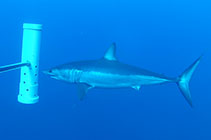
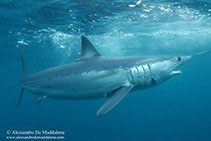
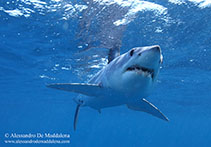
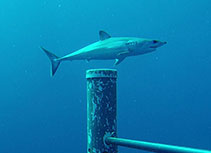
पृष्ठीय रीढ़ (सम्पूर्ण) : 0; गुदा कांटा: 0. A large, spindle-shaped shark with large black eyes, a sharp snout, and large, narrow, hooked teeth with smooth edges (Ref. 5578). Caudal fin lunate, lower lobe strongly developed (Ref. 13574). Dark blue above, white below (Ref. 6581). Tiny second dorsal and anal fins (Ref. 26938).
Body shape (shape guide): fusiform / normal.

जीवविज्ञान     शब्द संग्रह (उदाहरणार्थ epibenthic)

Oceanic, but sometimes found close inshore (Ref. 6871, 11230, 58302). Usually in surface waters (Ref. 30573), down to about 150 m (Ref. 26938, 11230). Coastal, epipelagic at 1->500 m (Ref. 58302). Isotope analysis has shown that shortfin mako is the highest level fish predator in oceanic waters off eastern Australia (Ref. 86961). Adults feed on bony fishes, other sharks (Ref. 5578), cephalopods; larger individuals may feed on larger prey such as billfish and small cetaceans (Ref. 6871, 58048). Ovoviviparous, embryos feeding on yolk sac and other ova produced by the mother (Ref. 43278, 50449). With 4-16 young of about 60-70 cm long (Ref. 35388, 26346). Gestation period lasts 15-18 months, spawning cycle is every 3 years. Some authors (Refs. 1661, 28081, 31395) have erroneously assumed that two age rings are deposited per year by this species, thus underestimating longevity, age at maturity, and resilience . These data have been removed and replaced by recent, verified estimates (Refs. 86586, 86587, 86588). Tagging in New Zealand indicates seasonal migrations (Ref. 26346). The presence of genetic differentiation in mitochondrial DNA across global populations (Ref. 36416) suggests dispersal may be male-biased, and that females may have natal site-fidelity. Shortfin mako has been shown to have a marked sexually segregated population structure (Ref. 86954). Shortfin mako is probably the fastest of all sharks and can leap out of the water when hooked (Ref. 6871). Potentially dangerous and responsible for unprovoked attacks on swimmers and boats (Ref. 13574). Utilized fresh, dried or salted, smoked and frozen; eaten broiled and baked (Ref. 9988). Valued for its fine quality meat as well as its fins and skin (Ref. 247). Oil is extracted for vitamins and fins for shark-fin soup (Ref. 13574). Jaws and teeth are also sold as ornaments and trophies (Ref. 9988). by Kabasakal & de Maddalena, 2011 reported a historical record of a larger specimen, caught in the Mediterranean Sea off Turkey, about 585 cm (TL estimated from photographs) (Ref. 106604). Maximum depth from Ref. 125614.

जीवन चक्र और संभोग व्यवहार परिपक्व अवधि | पुनरुत्पत्ति | मछलीऔ का अंडे देना | अंडे | उपजाऊपन | लार्वा

Exhibit ovoviparity (aplacental viviparity), with embryos feeding on other ova produced by the mother (oophagy) after the yolk sac is absorbed (Ref. 50449). With up to 18 young in a litter (Ref. 26346). Gives birth to litters of 4-25 (usually 10-18) pups after a gestation period of 15-18 months; reproduces every 3 years (Ref.58048). Size at birth between 60 and 70 cm (Ref. 247). Distinct pairing with embrace (Ref. 205).

मुख्य संदर्भ अपने संदर्भ अपलोड करें | संदर्भ | संयोजक : Compagno, Leonard J.V. | सहयोगीयो

Compagno, L.J.V., 1984. FAO Species Catalogue. Vol. 4. Sharks of the world. An annotated and illustrated catalogue of shark species known to date. Part 1 - Hexanchiformes to Lamniformes. FAO Fish. Synop. 125(4/1):1-249. Rome, FAO. (Ref. 247)

आईयूसीएन रेड लिस्ट स्थिति (Ref. 130435: Version 2025-2 (Global))

  Endangered (EN) (A2bd); Date assessed: 05 November 2018

CITES


मनुष्यों के लिए ख़तरा

  Traumatogenic (Ref. 247)


मानव उपयोग

मात्स्यिकी: लघु वाणिज्य; आखेट मत्स्य: हां

अधिक जानकारी

ट्रॉफिक पारिस्थितिकी
खाद्य पदार्थ (शिकार)
संघटक आहार
आहार खपत
खाद्यान्न राशन
परभक्षी
पारिस्थितिकी
पारिस्थितिकी
Home ranges
जीवन चक्र
पुनरुत्पत्ति
परिपक्व अवधि
परिपक्वता/गिल्स संबंध
उपजाऊपन
मछलीऔ का अंडे देना
स्पॉनिंग एकत्रीकरण
अंडे
अंडे का विकास
लार्वा
लारवल गतिकी
शरीर रचना
गिल क्षेत्र
दिमाग
ओटोलिथ
फिजियोलॉजी
शारीरिक संरचना
पोषक तत्व
प्राणवायु की खपत
तैराकी का प्रकार
तैराकी की गति
दृश्य वर्णक
मछली की आवाज
रोग एवं परजीवी
विषाक्तता (LC50s)
आनुवंशिकी
जीनोम
आनुवंशिकी
विषमयुग्मजी
हैरेटिबिलटी
मानव संबंधी
जलकृषि प्रणालियाँ
जलीयकृषि रूपरेखाऐ
खींच
सिगुएटेरा के मामले
टिकट, सिक्के, विविध.
आउटरीच
सहयोगीयो
संदर्भ
संदर्भ

साधन

विशेष रिपोर्ट

XML डाउनलोड करें

इंटरनेट स्रोत

मॉडल पर आधारित अनुमान

पसंदीदा तापमान (संदर्भ 123201): 9.7 - 24.4, mean 17.4 °C (based on 598 cells).
जातिवृति विविधता सूचकांक (संदर्भ 82804):  PD50 = 0.7813   [Uniqueness, from 0.5 = low to 2.0 = high].
Bayesian length-weight: a=0.00646 (0.00386 - 0.01080), b=3.02 (2.87 - 3.17), in cm total length, based on LWR estimates for this species & (Sub)family-body (Ref. 93245).
ट्रॉफिक स्तर (संदर्भ 69278):  4.5   ±0.0 se; based on diet studies.
लौटाव (संदर्भ 120179):  निम्न, न्यूनतम जनसंख्या दुगनी होने का समय 4.5 - 14 वर्ष। (rm=0.051; tm=8-20; tmax=32; Fec=4).
Prior r = 0.14, 95% CL = 0.09 - 0.21, Based on 3 full stock assessments.
मछली पकड़ने की भेद्यता (Ref. 59153):  Very high vulnerability (79 of 100). 🛈
जलवायु भेद्यता (Ref. 125649):  High vulnerability (62 of 100). 🛈
मूल्य श्रेणी (Ref. 80766):   Medium.
पोषक तत्व (Ref. 124155):  Calcium = 7.24 [2.04, 36.21] mg/100g; Iron = 0.713 [0.180, 2.070] mg/100g; Protein = 20.7 [18.3, 22.9] %; Omega3 = 0.383 [0.157, 0.916] g/100g; Selenium = 35.5 [11.1, 99.0] μg/100g; VitaminA = 6.35 [2.11, 19.61] μg/100g; Zinc = 0.32 [0.16, 0.59] mg/100g (wet weight); based on nutrient studies.