Sparus aurata, Gilthead seabream : fisheries, aquaculture, gamefish

You can sponsor this page

Sparus aurata Linnaeus, 1758

Gilthead seabream
Añada su observación en Fish Watcher
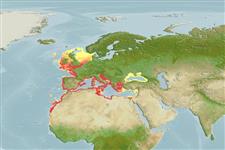
Native range | All suitable habitat | Point map | Year 2050
This map was computer-generated and has not yet been reviewed.
Sparus aurata   AquaMaps   Data sources: GBIF OBIS
Sube tu fotos y Vídeos
Imágenes | Vídeos | Sellos, monedas, varios | Google image
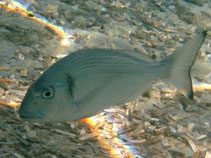
Image of Sparus aurata (Gilthead seabream)
Sparus aurata
Foto de Pillon, R.


Israel territory information

Common names: דניס
Occurrence: native
Salinity: brackish
Abundance: | Ref:
Importance: | Ref:
Aquaculture: commercial | Ref: FAO Fishery Information, Data and Statistics Service, 1993
Regulations: | Ref:
Uses: no uses
Comments:
National Checklist:
Territory Information: https://www.cia.gov/library/publications/resources/the-world-factbook/geos/is.html
National Fisheries Authority:
Occurrences: Occurrences Point map
Main Ref: Bauchot, M.-L., 1987
National Database:

Common names from other countries

Clasificación / Nombres Nombres comunes | Sinónimos | Catalog of Fishes(Género, Especie) | ITIS | CoL | WoRMS | Cloffa

> Eupercaria/misc (Various families in series Eupercaria) > Sparidae (Porgies)
Etymology: Sparus: Latin, sparus = a fish with a golden head (Ref. 45335).
More on author: Linnaeus.

Taxonomic Remarks
There has been much confusion in the past literature between the names Chrysophrys aurata/us, Pagrus aurata/us and Sparus aurata/us, that were used for two different species: Sparus aurata Linnaeus, 1758 from the Northeast and Central Atlantic, Pagrus auratus (Forster, 1801) from the West Pacific on one other side on the other side. Check the geographic origin of specimens when these names are used in the literature.

Entorno: milieu / zona climática / rango de profundidad / gama de distribución Ecología

marino; salobre demersal; rango de profundidad 1 - 150 m (Ref. 35388), usually 1 - 30 m (Ref. 54890). Subtropical; 62°N - 15°N, 17°W - 43°E (Ref. 54890)

Distribución Territorios | Áreas FAO | Ecosistemas | Ocurrencias, apariciones | Mapa de puntos | Introducciones | Faunafri

Eastern Atlantic: British Isles, Strait of Gibraltar to Cape Verde and around the Canary Islands; also in the Mediterranean (Ref. 3688). Reported from the Black Sea (Ref. 12781). Reports from New Zealand refer to Pagrus auratus (Foster 1801) (Ref. 5755, 9258).

Longitud en la primera madurez / Tamaño / Peso / Edad

Madurez: Lm 36.5, range 33 - 40 cm
Max length : 70.0 cm TL macho / no sexado; (Ref. 35388); common length : 35.0 cm SL macho / no sexado; (Ref. 4781); peso máximo publicado: 17.2 kg (Ref. 40637); edad máxima reportada: 14 años (Ref. 138174)

Descripción breve Claves de identificación | Morfología | Morfometría

Espinas dorsales (total) : 11; Radios blandos dorsales (total) : 13 - 14; Espinas anales: 3; Radios blandos anales: 11 - 12. Body tall, with large black spot on the gill cover. Snout more than twice as long as the eye diameter (Ref. 35388).
Body shape (shape guide): fusiform / normal.

Biología     Glosario (por ej. epibenthic)

Found in seagrass beds and sandy bottoms as well as in the surf zone commonly to depths of about 30 m, but adults may occur to 150 m depth. A sedentary fish, either solitary or in small aggregations. In spring, they often occur in brackish water coastal lagoons and estuaries. Mainly carnivorous, accessorily herbivorous (Ref. 3688). Feed on shellfish, including mussels and oysters. One of the most important fishes in saline and hypersaline aquaculture. Utilized fresh and eaten steamed, pan-fried, broiled, boiled, microwaved and baked (Ref. 9987).

Ciclo vital y comportamiento de apareamiento Madurez | Reproducción | Puesta | Huevos | Fecundidad | Larva

Males become females at about 3 years of age (Ref. 2715, 28504). Protandric hermaphrodite species, maturing first as male (during the first or second year of age) and after the second or third year of age, as female. Spawning happens generally from October to December, with sequenced spawning during the whole period. Incubation lasts about 2 days at 16-1 7°C. Larval stages last about 50 days at 1 7.5°C or about 43 days at 20°C. Egg size 0.9-1.1 mm, larval length at hatching 2.5-3.0 mm. Simultaneous hermaphroditism is suggested for this species (Ref. 103751).

Referencia principal Suba sus referencias | Referencias | Coordinador | Colaboradores

Bauchot, M.-L. and J.-C. Hureau, 1990. Sparidae. p. 790-812. In J.C. Quero, J.C. Hureau, C. Karrer, A. Post and L. Saldanha (eds.) Check-list of the fishes of the eastern tropical Atlantic (CLOFETA). JNICT, Lisbon; SEI, Paris; and UNESCO, Paris. Vol. 2. (Ref. 3688)

Situación en la Lista Roja de la UICN (Ref. 130435: Version 2025-2 (Global))

  Least Concern (LC) ; Date assessed: 19 August 2009

CITES

Not Evaluated

CMS (Ref. 116361)

Not Evaluated

Amenaza para el ser humano

  Harmless


Usos humanos

Pesquerías: comercial; Acuicultura: comercial; pesca deportiva: si
FAO - Sistemas de acuicultura: producción, perfil de la especie; pesquerías: desembarques, perfil de la especie; Publication: search | FIRMS - Stock assessments | FishSource | Sea Around Us

Más información

Anatomía
Superficie branquial
Cerebro
Otolito
Fisiología
Composición corporal
Nutrientes
Consumo del oxígeno
Tipo de natación
Velocidad de natación
Pigmentos visuales
Sonido de peces
Enfermedades y parásitos
Toxicidad (CL50)
Genética
Genoma
Genética
Heterocigosidad
heritabilidad
Relacionados con el ser humano
Sistemas de acuicultura
Perfiles de acuicultura
Razas
Ciguatera cases
Sellos, monedas, varios
Divulgación
Colaboradores
Referencias
Referencias

Herramientas

Informes especiales

Descargar XML

Fuentes de Internet

Estimaciones basadas en modelos

Temperatura preferida (Referencia 123201): 12.1 - 21, mean 17.8 °C (based on 258 cells).
Índice de diversidad filogenética (Referencia 82804):  PD50 = 1.0000   [Uniqueness, from 0.5 = low to 2.0 = high].
Bayesian length-weight: a=0.01202 (0.01089 - 0.01328), b=3.02 (2.99 - 3.05), in cm total length, based on LWR estimates for this species (Ref. 93245).
Nivel trófico (Referencia 69278):  3.7   ±0.0 se; based on diet studies.
Generation time: 4.2 (3.0 - 8.5) years. Estimated as median ln(3)/K based on 11 growth studies.
Resiliencia (Referencia 120179):  Medio, población duplicada en un tiempo mínimo de 1.4-4.4 años (K=0.28; tmax=11; tm=2-3).
Prior r = 0.57, 95% CL = 0.37 - 0.85, Based on 7 data-limited stock assessments.
Vulnerabilidad pesquera (Ref. 59153):  Low to moderate vulnerability (35 of 100). 🛈
Vulnerabilidad climática (Ref. 125649):  Moderate vulnerability (41 of 100). 🛈
Categoría de precios (Ref. 80766):   Very high.
Nutrientes (Ref. 124155):  Calcium = 63.3 [38.3, 117.5] mg/100g; Iron = 1.03 [0.59, 1.80] mg/100g; Protein = 20.2 [19.2, 21.3] %; Omega3 = 0.655 [0.431, 1.017] g/100g; Selenium = 2 [1, 6] μg/100g; VitaminA = 9.74 [2.44, 37.29] μg/100g; Zinc = 0.315 [0.167, 1.197] mg/100g (wet weight); based on nutrient studies.