Anguilla anguilla, European eel : fisheries, aquaculture, gamefish

You can sponsor this page

Anguilla anguilla (Linnaeus, 1758)

European eel
Aggiungete la vostra osservazione in Fish Watcher
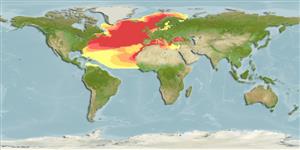
Native range | All suitable habitat | Point map | Year 2050
This map was computer-generated and has not yet been reviewed.
Anguilla anguilla   AquaMaps   Data sources: GBIF OBIS
Carica il tuo foto e Video
Immagini | Video | Francobolli, monete, materiale vario. | Google image
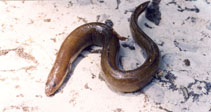
Image of Anguilla anguilla (European eel)
Anguilla anguilla
Immagine di V. Tachos & D. Bobori


Ireland territory information

Common names: An eascann, Eascann, Eel
Occurrence: native
Salinity: freshwater
Abundance: abundant (always seen in some numbers) | Ref: Went, A.E.J., 1957
Importance: | Ref:
Aquaculture: | Ref:
Regulations: | Ref:
Uses: no uses
Comments:
National Checklist:
Territory Information: https://www.cia.gov/library/publications/resources/the-world-factbook/geos/ei.html
National Fisheries Authority:
Occurrences: Occurrences Point map
Main Ref: Bauchot, M.-L., 1986
National Database:

Common names from other countries

Classificazione / Nomi Nomi Comuni | Sinonimi | Catalog of Fishes(Genere, Specie) | ITIS | CoL | WoRMS | Cloffa

> Anguilliformes (Eels and morays) > Anguillidae (Freshwater eels)
Etymology: Anguilla: Latin, anguilla, .-ae = eel (Ref. 45335).
More on author: Linnaeus.

Ambiente: milieu / zona climatica / distribuzione batimetrica / gamma di distribuzione Ecologia

marino; acqua dolce; salmastro demersale; catadromo (Ref. 30240); distribuzione batimetrica 0 - 700 m (Ref. 54218). Temperate; 4°C - 20°C (Ref. 2059); 75°N - 8°N, 82°W - 50°E (Ref. 42249)

Distribuzione Territories | Aree FAO | Ecosistemi | Presenze | Mappa dei ritrovamenti | Introduzioni | Faunafri

Atlantic Ocean: Atlantic coast from Scandinavia to Morocco; Baltic, Black and Mediterranean Seas; rivers of North Atlantic, Baltic and Mediterranean seas (Ref. 172, Ref. 51442). Continuous introductions to Asia and South and Central America. Spawning area in western Atlantic (Sargasso Sea). At least one country reports adverse ecological impact after introduction. Recent genomic DNA studies show that the European eel exhibits isolation by distance, implying that non-random mating and restricted gene flow among eels from different location exists (Ref. 43723). The existence of 3 genetically distinct sub-populations is suggested: a Northern European subpopulation (consisting mainly of the Icelandic stocks); a Western European subpopulation (including the Baltic, the Mediterranean and Black Sea); a Southern sub-population (including stocks of Morocco) (Ref. 43723, 89139).

Lunghezza alla prima maturità / Dimensione / Peso / Età

Maturità: Lm 55.0, range 45 - 65 cm
Max length : 122 cm TL maschio/sesso non determinato; (Ref. 88166); 133.0 cm TL (female); common length : 35.0 cm TL maschio/sesso non determinato; (Ref. 6125); common length :50 cm TL (female); peso massimo pubblicato: 6.6 kg (Ref. 39903); peso massimo pubblicato: 6.6 kg; Età massima riportata: 23 anni (Ref. 106807)

Breve descrizione Chiavi di identificazione | Morfologia | Morfometria

Spine dorsali (totale) : 0; Spine anali: 0; Vertebre: 110 - 120. Elongated, anguilliform body (Ref. 51442), cylindrical anteriorly, somewhat compressed posteriorly (Ref. 6125). Lower jaw slightly longer and projecting (Ref. 6125, Ref. 51442). Gill openings small and vertical, restricted to the sides (Ref. 6125). Elongated dorsal and anal fins, confluent with caudal fin (Ref. 6125, Ref. 51442), forming one unique fin from the anus to the middle of the back with minimum 500 soft rays (Ref. 40476). Dorsal fin origin far behind pectoral fins; anal fin origin slightly behind anus, well back from origin of dorsal fin (Ref. 6125). Pelvic fins absent (Ref. 2196, Ref. 51442). Greenbrown colored (Ref. 51442).
Body shape (shape guide): eel-like; Cross section: circular.

Biologia     Glossario (es. epibenthic)

Facultative air-breathing (Ref. 126274); Inhabits all types of benthic habitats from streams to shores of large rivers and lakes. Naturally found only in water bodies connected to the sea (Ref. 59043). Territorial and solitary species; 'schools' of young eels which are observed from time to time are a mass response to outward conditions and not of active assembling (Ref. 172). Amphihaline (Ref. 51442). Migrates to the depths of the Sargasso Sea to spawn (Ref. 172, 51442). Eel larvae (leptocephali) are transparent ribbon-like. They are brought to the coasts of Europe by the Gulf Stream in 7 to 11 months time (Ref. 51442) and can last for up to 3 years (Ref. 8994). They are transformed into glass eels (6-8 cm length, cylindrical in shape and transparent to slightly pigmented in colour). They enter the estuaries and colonize rivers and lakes (Ref. 11941, 51442); some individuals remain in estuaries and coastal waters to grow into adults (Ref. 88171). The glass eel stage is followed by a long feeding period (from the yellow to the silver eel stage) lasting 6-12 years in males (Ref. 6125) and 9-20 years in females (Ref. 6125). Yellow and silver eels are benthic, found under stones, buried in the mud or in crevices (Ref. 89138). Yellow eels eventually lose their pigmentation, becoming dark dorsally and silver ventrally (called silver eels). Silver eels are also characterized by a clear contrasting black lateral line and enlarged eyes (Ref. 6125). At the end of their growth period, they become sexually mature, migrate to the sea and cover great distances during their spawning migration (5,000-6,000 km); with extensive daily vertical migrations between 200 m at night and 600 m during day time, possibly for predator avoidance (Ref. 89140). Gametogenesis occurs entirely during spawning migration. Average life span is usually 15-20 years (Ref. 88171). Male eels can grow up to 50 cm TL (Ref. 39903). Occurs at temperatures ranging from 0-30°C (Ref. 172). Its food includes virtually the whole aquatic fauna (freshwater as well as marine) occurring in the eel's area, augmented with animals living out of water, e.g. worms (Ref. 172). Best temperature for making eels sexually mature is 20-25°C (Ref. 35388). Sensitive to weak magnetic fields (Ref. 89141, 89142). Their high fat content and benthic feeding habits in continental waters make them vulnerable to the bioaccumulation of pollutants, such as heavy metals and organic contaminants, that may result in organ damage and impaired migration capability (Ref. 82710) and lowered genetic variability (Ref. 82711). Review of information supports the view that the European eel population as a whole has declined in most areas, the stock is outside safe biological limits and current fisheries not sustainable (Ref. 82712). Obvious decreasing of the stocks for all the continental native distribution area (Ref. 40476). Utilized fresh, dried or salted, smoked and frozen; can be fried, boiled and baked (Ref. 9988).

Ciclo vitale e comportamento di accoppiamento Maturità | Riproduzione | Deposizione | Uova | Fecondità | Larve

Catadromous species. When sexual maturity is reached they leave the river. Spawning migrations occur mainly during the second half of the year but have been observed year-round, usually commencing during dark nights (Ref. 172). Maturity is obtained during the spawning migration (Ref. 88171). Actual spawning has never been observed but is believed to occur solely in the Sargasso Sea between March and June (Ref. 89144). After spawning (at 600 m depth) adults die. Sigmund Freud described the testicles of eel (Ref. 72449).

Riferimento principale Caricare le referenze | Bibliografia | Coordinatore | Collaboratori

Deelder, C.L., 1984. Synopsis of biological data on the eel, Anguilla anguilla (Linnaeus, 1758). FAO Fish. Synop. (80, Rev. 1):73 p. (Ref. 172)

Stato della Lista Rossa IUCN (Ref. 130435: Version 2025-2 (Global))

  Critically Endangered (CR) (A2bd+4bd); Date assessed: 07 November 2018

CITES


Minaccia per l'uomo

  Harmless


Usi umani

Pesca: commerciale; Acquacoltura: commerciale; Pesce da pesca sportiva: si
FAO - Sistemi di acquacoltura: produzione, profilo della specie; pesca: sbarchi, profilo della specie; Publication: search | FIRMS - Stock assessments | FishSource | Sea Around Us

Informazioni ulteriori

Ciclo di vita
Riproduzione
Maturità
Maturità/Gli occhielli sono relativi.
Fecondità
Deposizione
Aggregazioni riproduttive
Uova
Sviluppo delle uova
Larve
Dinamica popolazioni larvali
Distribuzione
Territories
Aree FAO
Ecosistemi
Presenze
Introduzioni
BRUVS - Video
Anatomia
Area branchiale
Cervello
Otolite
Genetica
Genome
Genetica
Eterozigosi
Ereditarietà
Legato all'uomo
Sistemi di acquacoltura
Profili di acquacoltura
Varietà
Casi di Ciguatera
Francobolli, monete, materiale vario.
Raggiungimento
Collaboratori
Bibliografia
Bibliografia

Strumenti

Rapporti speciali

Scarica XML

Fonti Internet

Stime basate su modelli

Temperatura preferita (Fonte Biblio. 123201): 3 - 14.5, mean 7.9 °C (based on 1203 cells).
Indice di diversità filogenetica (Fonte Biblio. 82804):  PD50 = 0.5000   [Uniqueness, from 0.5 = low to 2.0 = high].
Bayesian length-weight: a=0.00095 (0.00085 - 0.00108), b=3.17 (3.13 - 3.21), in cm total length, based on LWR estimates for this species (Ref. 93245).
Livello trofico (Fonte Biblio. 69278):  3.6   ±0.3 se; based on diet studies.
Generation time: 8.4 (7.5 - 12.6) years. Estimated as median ln(3)/K based on 25 growth studies.
Resilienza (Fonte Biblio. 120179):  Basso, tempo minimo di raddoppiamento della popolazione 4.5 - 14 anni (K=0.1; tm=6-30; tmax=23).
Prior r = 0.20, 95% CL = 0.13 - 0.29, Based on 2 full stock assessments.
Vulnerabilità della pesca (Ref. 59153):  High vulnerability (64 of 100). 🛈
Categoria di prezzo (Ref. 80766):   Unknown.
Nutrienti (Ref. 124155):  Calcium = 18.9 [11.6, 32.9] mg/100g; Iron = 0.267 [0.167, 0.425] mg/100g; Protein = 19 [17, 21] %; Omega3 = 0.664 [0.388, 1.169] g/100g; Selenium = 27.5 [14.5, 50.8] μg/100g; VitaminA = 10.3 [2.3, 48.5] μg/100g; Zinc = 0.507 [0.371, 0.705] mg/100g (wet weight); based on nutrient studies.