Common names from other countries
分類 / 名稱
俗名 | 同種異名 | Catalog of Fishes(屬, 種) | ITIS | CoL | WoRMS | Cloffa
Teleostei >
Scombriformes (Mackerels)
鱸形目 (Mackerels) >
Scombridae (Mackerels, tunas, bonitos)
鯖科 (Mackerels, tunas, bonitos) > Scombrinae
Etymology: Euthynnus: Greek, eu = good + Greek, thynnos = tunna (Ref. 45335).
環境: 環境 / 氣候帶 / 深度上下限 / 配送範圍
生態學
海洋 pelagic-neritic; 海洋洄游的 (Ref. 71039); 深度上下限 0 - 200 m (Ref. 54439). 熱帶; 18°C - 29°C (Ref. 168); 35°N - 38°S, 19°E - 137°W (Ref. 54439)
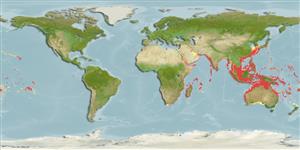
Indo-West Pacific: in warm waters including oceanic islands and archipelagos. A few stray specimens have been collected in the Eastern Central Pacific. Highly migratory.
印度-西太平洋: 在溫暖的水域包括大洋性島嶼與群島中。 一些迷途的標本曾經在中太平洋東部收集。 高度遷移的種,1982年海事法會議的附件一.(參考文獻 26139)
初熟時的長度 / 大小 / 重量 / 年齡
成熟度: Lm 42.3, range 40 - 65 cm
Max length : 100.0 cm FL 雄魚/尚未辨別雌雄; (Ref. 168); common length : 60.0 cm FL 雄魚/尚未辨別雌雄; (Ref. 168); 最大體重: 14.0 kg (Ref. 30874); 最大年齡: 6 年 (Ref. 121508)
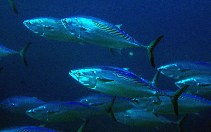
背棘 (總數) : 10 - 15; 背的軟條 (總數) : 11 - 15; 臀棘: 0; 臀鰭軟條: 11 - 15; 脊椎骨: 39. This species is distinguished by the following characters: medium-sized fish with a robust, elongate and fusiform body; teeth small and conical, in a single series; total gill rakers on first gill arch 29-34; D1 XI-XIV with both dorsal fins separated by only a narrow interspace (not wider than eye), anterior spines of first fin much higher than those midway, giving fin a strongly concave outline; D2 much lower than first and followed by 8-10 finlets; anal fin followed by 6-8 finlets; pectoral fins short, never reaching interspace between dorsal fins; 2 flaps (interpelvic process) between pelvic fins; very slender caudal peduncle with a prominent lateral keel between 2 small keels at base of caudal fin; body naked except for corselet and lateral line. Colour of back dark blue with a complicated striped pattern which does not extend forward beyond middle of first dorsal fin; lower sides and belly silvery white; several characteristic dark spots between pelvic and pectoral fins (but may not always be present) (Ref. 9684, 90102).
Body shape (shape guide): fusiform / normal; Cross section: oval.
泳鰾不存在。 椎骨突起的沒有痕跡。 第一背鰭的前面棘比那些中間者高許多。 腹鰭間的突起小而兩裂的。 身體裸露的除了甲胄與側線。 背部的在後部部分具有一個斷掉斜的斑紋的圖案。
Occurs in open waters but always remains close to the shoreline. The young may enter bays and harbors. Forms multi-species schools by size with other scombrid species comprising from 100 to over 5,000 individuals. A highly opportunistic predator feeding indiscriminately on small fishes, especially on clupeoids and atherinids; also on squids, crustaceans and zooplankton. Caught in multispecies fisheries, mainly by surface trolling; also with gill nets. Generally marketed canned and frozen; also utilized dried, salted, smoked and fresh (Ref. 9684).
出現於開放的水域但是總是逗留在接近海岸線。 幼魚可能進入海灣與港灣。 形成多魚種的依大小形成魚群從 100 到超過 5,000個個體包含的與其它的鯖魚種在一起。 不加選擇地捕食小魚的一個高度隨機的掠食者, 尤其吃鯡魚與銀漢魚; 也吃烏賊,甲殼動物與浮游動物.(參考文獻 9684) 通常在市場上銷售罐裝及冷凍; 也利用乾燥的﹐鹽醃的, 煙燻 (參考文獻 9684) 與生鮮地.(參考文獻 9987)
印度-西太平洋: 在溫暖的水域包括大洋性島嶼與群島中。 一些迷途的標本曾經在中太平洋東部收集。 高度遷移的種,1982年海事法會議的附件一.(參考文獻 26139)
Collette, B.B. and C.E. Nauen, 1983. FAO Species Catalogue. Vol. 2. Scombrids of the world. An annotated and illustrated catalogue of tunas, mackerels, bonitos and related species known to date. Rome: FAO. FAO Fish. Synop. 125(2):137 p. (Ref. 168)
IUCN 瀕危狀態 (Ref. 130435: Version 2025-2 (Global))
無危 (LC) ; Date assessed: 01 March 2022
人類使用
漁業: 高經濟性; 游釣魚種: 是的
工具
特別的報告
下載 XML
網路資源
基於模型的估計
首選溫度 (參考文獻
123201): 20.7 - 28.5, mean 26.9 °C (based on 1384 cells).
系統發育多樣性指數 (參考文獻
82804): PD
50 = 0.6250 [Uniqueness, from 0.5 = low to 2.0 = high].
Bayesian length-weight: a=0.00977 (0.00846 - 0.01129), b=3.05 (3.01 - 3.09), in cm total length, based on LWR estimates for this species (Ref.
93245).
營養階層 (參考文獻
69278): 4.5 ±0.0 se; based on diet studies.
Generation time: 1.6 (1.2 - 2.5) years. Estimated as median ln(3)/K based on 11
growth studies.
回復力 (參考文獻
120179): 中等的, 族群倍增時間最少 1.4 - 4.4年 (K=0.60; tm>2; tmax=6).
Prior r = 0.88, 95% CL = 0.58 - 1.32, Based on 5 full stock assessments.
釣魚的脆弱性 (Ref.
59153): Moderate vulnerability (36 of 100).
🛈
氣候脆弱性 (Ref.
125649): High to very high vulnerability (75 of 100).
🛈
營養素 (Ref.
124155): Calcium = 20.9 [9.6, 171.3] mg/100g; Iron = 2.28 [0.88, 5.97] mg/100g; Protein = 23.1 [21.1, 24.7] %; Omega3 = 0.235 [0.129, 0.428] g/100g; Selenium = 70.6 [35.4, 143.5] μg/100g; VitaminA = 20.2 [5.4, 77.8] μg/100g; Zinc = 0.408 [0.211, 1.643] mg/100g (wet weight); based on
nutrient studies.