Pagrus pagrus, Red porgy : fisheries, aquaculture, gamefish, aquarium

You can sponsor this page

Pagrus pagrus (Linnaeus, 1758)

Red porgy
Добавить Ваши наблюдения в Fish Watcher
Native range | All suitable habitat | Point map | Year 2050
This map was computer-generated and has not yet been reviewed.
Pagrus pagrus   AquaMaps   Data sources: GBIF OBIS
Загрузить свой Фото и Видео
изображения | Изображение на Google
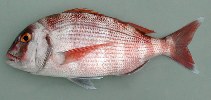
Image of Pagrus pagrus (Red porgy)
Pagrus pagrus
Изображение сделано Cambraia Duarte, P.M.N. (c)ImagDOP


Greece territory information

Common names: Fagri, Phágri Mertzáni, Μερτζάνι
Occurrence: native
Salinity: marine
Abundance: abundant (always seen in some numbers) | Ref: Tsimenides, N., G. Tserpes, A. Machias and A. Kallianiotis, 1991
Importance: commercial | Ref:
Aquaculture: commercial | Ref: FAO, 1997
Regulations: | Ref:
Uses: no uses
Comments: Found in Cretan shelf (Ref. 40188). Recorded from Strymonikos Gulf (Ref. 58475). Also Ref. 3397, 9987. Also Ref. 40188.
National Checklist:
Territory Information: https://www.cia.gov/library/publications/resources/the-world-factbook/geos/gr.html
National Fisheries Authority:
Occurrences: Occurrences Point map
Main Ref: Papaconstantinou, C., 2014
National Database:

Common names from other countries

Классификация / Имена народные названия | синонимы | Catalog of Fishes(род, виды) | ITIS | CoL | WoRMS | Cloffa

> Eupercaria/misc (Various families in series Eupercaria) > Sparidae (Porgies)
Etymology: Pagrus: Greek, pagros = a fish, Dentex, sp. (Ref. 45335).
More on author: Linnaeus.

Окружающая среда: среда / климатическая зона / пределы глубины / диапазон распространения экология

морской донно-пелагический; мигрирует в океане (Ref. 51243); пределы глубины 0 - 250 m (Ref. 3688), usually 10 - 80 m (Ref. 9626). Subtropical; 51°N - 43°S, 98°W - 36°E

распространение Территории | регионы FAO | Экосистемы | места находок | карта точек | интродукции | Faunafri

Eastern Atlantic: Strait of Gibraltar to 15°N (rare southward 20°N), including Madeira and the Canary Islands; Mediterranean and northward to the British Isles. Western Atlantic: New York, USA and northern Gulf of Mexico to Argentina (Ref. 7251), including the continental coast of the Caribbean Sea (Ref. 9626).

Длина при первой зрелости / Размер / Вес / Возраст

половая зрелость: Lm 26.6, range 19 - ? cm
Max length : 91.0 cm TL самец/пол неопределен; (Ref. 9710); common length : 35.0 cm SL самец/пол неопределен; (Ref. 4781); наибольший вес (опубликованные данные): 7.7 kg (Ref. 40637); наибольший возраст (опубликованны данные): 26 годы (Ref. 123644)

Краткое описание определительные ключи | морфология | морфометрия

This species is distinguished by the following characters: body oval, moderately deep. Head profile convex, slightly steeper in front of eye; 6 or 7 rows of scales on cheeks; preopercle scaleless; both jaws anteriorly with large canine-like teeth, 4 in upper and 6 in lower jaw, followed by smaller and blunter canine-like teeth that become progressively molar-like toward the posterior third of jaws; the 2 outer rows of strong teeth are flanked in the region anterior to the molars by several rows of very small teeth; gill rakers short, lower limb of first arch with 8 to 10, 6 to 8 on upper limb. Dorsal fin with 12 spines and 9 to 12 soft rays; anal fin with 3 spines and 8 or 9 soft rays. Scales along lateral line 52 to 60. Colour: pink with silvery reflections, lighter on belly; head dark from nape to angle of mouth; sometimes, fine blue dots present on upper sides, particularly conspicuous in young individuals; often a somewhat darker area at pectoral fin axils; caudal fin dark pink, with both tips white; other fins pinkish (Ref. 109259).
Body shape (shape guide): fusiform / normal; Cross section: compressed.

биология     глоссарий (например epibenthic)

Found over rock, rubble, or sand bottoms (young frequently found on seagrass beds and the continental shelf (Ref. 47377)) down to about 250 m depth, often above 150 m. In southwest Brazil found in 160 m depth (Ref. 47377). Feeds on crustaceans, fishes, and mollusks (Ref. 3688). Its toxic nature is uncertain (Ref. 4690). Marketed fresh and frozen (Ref. 9987). Reported weights of caught individuals were between 9 to 17 kgs (9-10 off the west coast of Greece) (Hans Bollnert, hassebollnert@yahoo.gr, pers.comm. 12/09). It is parasitised by the monogeneans Anoplodiscus longivaginatus and Anoplodiscus richiardii (species inquirenda) on the fins and body surface (Ref. 124057).

Жизненный цикл и брачное поведение половая зрелость | размножение | нерест | икра | Плодовитость | личинки

Protogynous hermaphrodite species. First sexual maturity occurs at 3 years of age (about 24 cm), first behaving as females and then as males. Spawning happens at 1 5-19° and it tends to be in spring, depending on the habitat (in the Canary Islands it can start in January). Also Ref. 28504, 41163.

Основная ссылка Загрузите свои рекомендации | ссылки | координатор | соавторы

Bauchot, M.-L. and J.-C. Hureau, 1990. Sparidae. p. 790-812. In J.C. Quero, J.C. Hureau, C. Karrer, A. Post and L. Saldanha (eds.) Check-list of the fishes of the eastern tropical Atlantic (CLOFETA). JNICT, Lisbon; SEI, Paris; and UNESCO, Paris. Vol. 2. (Ref. 3688)

Статус Красного Списка МСОП (Ref. 130435: Version 2025-2 (Global))

  Не вызывающий беспокойства (LC) ; Date assessed: 17 August 2009

CITES

Not Evaluated

CMS (Ref. 116361)

Not Evaluated

Угроза для людей

  Reports of ciguatera poisoning (Ref. 4690)


Использование человеком

рыболовство: коммерческий; аквакультура (рыбоводство): коммерческий; объект спортивного рыболовства: да; аквариум: общественные аквариумы
FAO - Системы аквакультуры: Производство; рыболовство: посадки; Publication: search | FishSource | Море вокруг нас

дополнительная информация

Жизненный цикл
размножение
половая зрелость
Зрелость/Жиры относительно.
Плодовитость
нерест
Нерестовые скопления
икра
Развитие икры
личинки
динамика численности личинок
распространение
Территории
регионы FAO
Экосистемы
места находок
интродукции
BRUVS - Видео
Анатомия
жаберная область
Мозг
Отолит
Физиология
Состав тела
Питательные вещества
Потребление кислорода
Тип плавания
Скорость плавания
Зрительные пигменты
Звук рыбы
Болезни и паразиты
Токсичность (LC50s)
генетика
Геном
генетика
Гетерозиготность
наследуемость
Связанные с человеком
Системы аквакультуры
особенности рыбоводства
степень растяжения
Случаи заболевания сигуатерой
Марки, монеты и прочее.
Информационно-просветительская работа
соавторы
ссылки
ссылки

инструменты

Специальные отчеты

Скачать в формате XML

ресурсы в Интернет

Оценки, основанные на моделях

Предпочтительная температура (ссылка 123201): 15.8 - 27.8, mean 24.1 °C (based on 1356 cells).
Индекс филогенетического разнообразия (ссылка 82804):  PD50 = 0.5156   [Uniqueness, from 0.5 = low to 2.0 = high].
Bayesian length-weight: a=0.01318 (0.01202 - 0.01445), b=3.02 (2.99 - 3.05), in cm total length, based on LWR estimates for this species (Ref. 93245).
Трофический уровень (ссылка 69278):  3.9   ±0.2 se; based on diet studies.
Generation time: 6.6 (5.1 - 10.0) years. Estimated as median ln(3)/K based on 12 growth studies.
устойчивость к внешним воздействиям (ссылка 120179):  средний (среднего размера), минимальное время удвоения популяции 1.4-4.4 года (K=0.13-0.27; tmax=11; tm=0.9-3.0).
Prior r = 0.28, 95% CL = 0.19 - 0.42, Based on 1 full stock assessment.
Уязвимость рыбной ловли (Ref. 59153):  High vulnerability (58 of 100). 🛈
Климатическая уязвимость (Ref. 125649):  Moderate to high vulnerability (51 of 100). 🛈
Категория цены (Ref. 80766):   Very high.
Питательные вещества (Ref. 124155):  Calcium = 33.4 [18.0, 61.6] mg/100g; Iron = 1 [0, 2] mg/100g; Protein = 19.8 [18.2, 21.3] %; Omega3 = 0.3 [0.2, 0.5] g/100g; Selenium = 39.3 [18.2, 75.9] μg/100g; VitaminA = 14.7 [4.2, 49.5] μg/100g; Zinc = 0.618 [0.326, 1.227] mg/100g (wet weight); based on nutrient studies.