Atherina boyeri, Big-scale sand smelt : fisheries

You can sponsor this page

Atherina boyeri Risso, 1810

Big-scale sand smelt
Ajouter votre observation dans Fish Watcher
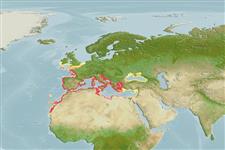
Native range | All suitable habitat | Point map | Year 2050
This map was computer-generated and has not yet been reviewed.
Atherina boyeri   AquaMaps   Data sources: GBIF OBIS
Envoyez vos Photos et vidéos
Images | Images Google
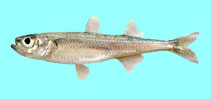
Image of Atherina boyeri (Big-scale sand smelt)
Atherina boyeri
Photo de Otel, V.


Greece territory information

Common names: Atherina, Souvlitis, Αθερίνα
Occurrence: native
Salinity: freshwater
Abundance: | Ref:
Importance: | Ref:
Aquaculture: | Ref:
Regulations: | Ref:
Uses: no uses
Comments: A euryhaline species found in Lesbos Island (56538). Also recorded from the Strymonikos Gulf (Ref. 74833) and permanent freshwater resident populations in Lakes Trichonis (Rfe. 59043). In range Ref. 5980. Also Ref. 42629.
National Checklist:
Territory Information: https://www.cia.gov/library/publications/resources/the-world-factbook/geos/gr.html
National Fisheries Authority:
Occurrences: Occurrences Point map
Main Ref: Papaconstantinou, C., 2014
National Database:

Common names from other countries

Classification / Noms Noms communs | Synonymes | Catalog of Fishes(Genre, Espèce) | ITIS | CoL | WoRMS | Cloffa

> Atheriniformes (Silversides) > Atherinidae (Silversides) > Atherininae
Etymology: Atherina: Greek, atherina, the Greek name for the eperlane; 1770 (Ref. 45335).
Eponymy: Guillaume Boyer de Nice was a poet. The species was described in a book about the ichthyology of Nice. Risso chose to name the smelt after a historic son of that city; the poet who was a “…troubadour distingué du troisième siècle.” (Ref. 128868), visit book page.
More on author: Risso.

Environnement : milieu / zone climatique / profondeur / gamme de distribution Écologie

marin; eau douce; saumâtre démersal; amphidrome (Ref. 59043); profondeur 1 - ? m. Subtropical; 53°N - 20°N, 18°W - 42°E

Distribution Territoires | Zones FAO | Écosystèmes | Occurrences | Carte par point | Introductions | Faunafri

Eastern Atlantic: Portugal and Spain to Nouadhibou in Mauritania and Madeira, and throughout the Mediterranean and Black Sea. Isolated populations on coasts of England and the Netherlands (Ref. 5980). Previously, two subspecies were recognized in Russian waters: Atherina boyeri pontica (Eichwald, 1838) from the Black Sea and the Sea of Azov and Atherina boyeri caspia (Eichwald, 1838) from the Caspian Sea (Ref. 26334).

Longueur à la première maturité / Taille / Poids / Âge

Maturité: Lm 5.8, range 5 - ? cm
Max length : 20.0 cm TL mâle / non sexé; (Ref. 30578); âge max. reporté: 4 années (Ref. 59043)

Description synthétique Clés d'identification | Morphologie | Morphométrie

Épines dorsales (Total) : 7 - 10; Rayons mous dorsaux (Total) : 8 - 16; Épines anales: 2; Rayons mous anaux: 10 - 18. Eye diameter wider than snout length (Ref. 35388).
Body shape (shape guide): elongated.

Biologie     Glossaire (ex. epibenthic)

A very euryhaline species, where adults are frequently found in brackish waters and more sporadically in freshwater (Ref. 3788), preferring still or slow flowing waters in freshwater (Ref. 59043). They are found in lower parts of rivers, estuaries, coastal lakes and sea; pelagic in lakes (Ref. 59043). Adults occur in great schools. They are carnivorous, feeding on small crustaceans, worms, mollusks (Ref. 5980) and fish larvae (Ref. 35388) in lakes and estuaries, and on benthos in rivers (Ref. 59043). Can usually live 1 to 2 years, rarely up to 4 years. Some populations undergo spawning migrations into estuaries. Mature individuals are fractional spawners, larger individuals spawn for a longer period. Eggs are demersal, with long hairy appendages attaching them to the substrate consisting of filamentous algae, often at depths of 2 to 6 m. Larvae are pelagic often forming schools close to the shores (Ref. 59043).

Cycle de vie et comportement reproducteur Maturité | Reproduction | Frai | Œufs | Fécondité | Larves

Référence principale Téléchargez vos références | Références | Coordinateur : Dyer, Brian S. | Collaborateurs

Maugé, L.A., 1990. Atherinidae. p. 604-605. In J.C. Quero, J.C. Hureau, C. Karrer, A. Post and L. Saldanha (eds.) Check-list of the fishes of the eastern tropical Atlantic (CLOFETA). JNICT, Lisbon; SEI, Paris; and UNESCO, Paris. Vol. 2. (Ref. 4499)

Statut dans la liste rouge de l'IUCN (Ref. 130435: Version 2025-2 (Global))

  Préoccupation mineure (LC) ; Date assessed: 01 June 2022

CITES

Not Evaluated

CMS (Ref. 116361)

Not Evaluated

Menace pour l'homme

  Harmless


Utilisations par l'homme

Pêcheries: commercial
FAO - pêcheries: débarquements; Publication: search | FishSource | Sea Around Us

Plus d'informations

Écologie trophique
Aliments (proies)
Composition du régime alimentaire
Consommation alimentaire
Rations alimentaires
Prédateurs
Écologie
Écologie
Home ranges
Cycle de vie
Reproduction
Maturité
Maturité/épines rel.
Fécondité
Frai
Agrégats de frai
Œufs
Développement de l'œuf
Larves
Dynamique des populations larvaires
Anatomie
Surface branchiale
Cerveau
Otolithe
Physiologie
Composition corporelle
Nutriments
Consommation d'oxygène
Type de natation
Vitesse de nage
Pigments visuels
Son de poisson
Maladies et parasites
Toxicité (CL50)
Génétique
génôme
Génétique
Hétérozygotie
Héritabilité
Liées à l'homme
Systèmes d'aquaculture
Profils d'aquaculture
Souches
Cas de ciguatera
Timbres, pièces de monnaie, divers
Sensibilisation
Collaborateurs
Références
Références

Outils

Articles particuliers

Télécharger en XML

Sources Internet

Estimations basées sur des modèles

Température préférée (Réf. 123201): 13.9 - 21, mean 18.3 °C (based on 136 cells).
Indice de diversité phylogénétique (Réf. 82804):  PD50 = 0.5312   [Uniqueness, from 0.5 = low to 2.0 = high].
Bayesian length-weight: a=0.00575 (0.00485 - 0.00683), b=3.07 (3.02 - 3.12), in cm total length, based on LWR estimates for this species (Ref. 93245).
Niveau trophique (Réf. 69278):  3.2   ±0.36 se; based on food items.
Résilience (Réf. 120179):  Milieu, temps minimum de doublement de population : 1,4 à 4,4 années (K=0.8; tm=1; tmax=4;).
Prior r = 0.57, 95% CL = 0.38 - 0.85, Based on 3 data-limited stock assessments.
Vulnérabilité de la pêche (Ref. 59153):  Moderate vulnerability (44 of 100). 🛈
Vulnérabilité climatique (Ref. 125649):  Moderate vulnerability (44 of 100). 🛈
Catégorie de prix (Ref. 80766):   High.
Nutriments (Ref. 124155):  Calcium = 134 [71, 293] mg/100g; Iron = 1.07 [0.63, 1.91] mg/100g; Protein = 20.4 [19.0, 21.6] %; Omega3 = 0.34 [0.18, 0.64] g/100g; Selenium = 14.4 [6.8, 32.4] μg/100g; VitaminA = 25.1 [8.8, 69.7] μg/100g; Zinc = 1.4 [0.9, 2.0] mg/100g (wet weight); based on nutrient studies.