Parastromateus niger, Black pomfret : fisheries

You can sponsor this page

Parastromateus niger (Bloch, 1795)

Black pomfret
Ajouter votre observation dans Fish Watcher
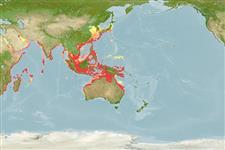
Native range | All suitable habitat | Point map | Year 2050
This map was computer-generated and has not yet been reviewed.
Parastromateus niger   AquaMaps   Data sources: GBIF OBIS
Envoyez vos Photos et vidéos
Images | Images Google
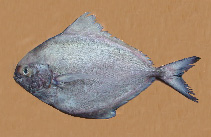
Image of Parastromateus niger (Black pomfret)
Parastromateus niger
Photo de Rahman, A.K.A.

Common names from other countries

Classification / Noms Noms communs | Synonymes | Catalog of Fishes(Genre, Espèce) | ITIS | CoL | WoRMS | Cloffa

> Carangiformes (Jacks) > Carangidae (Jacks and pompanos) > Caranginae
Etymology: Parastromateus: Greek, para in the side of + Greek, stromatos = a fish flattened body with a lot of colours (Stromateus sp.) (Ref. 45335).
More on author: Bloch.

Environnement : milieu / zone climatique / profondeur / gamme de distribution Écologie

marin; saumâtre récifal; amphidrome (Ref. 51243); profondeur 15 - 105 m (Ref. 12260), usually 15 - 40 m (Ref. 54702). Tropical; 42°N - 30°S, 32°E - 154°E

Distribution Territoires | Zones FAO | Écosystèmes | Occurrences | Carte par point | Introductions | Faunafri

Indo-West Pacific: East Africa to southern Japan and Australia.

Longueur à la première maturité / Taille / Poids / Âge

Maturité: Lm 23.0, range 22 - 24 cm
Max length : 75.0 cm TL mâle / non sexé; (Ref. 5284); common length : 30.0 cm TL mâle / non sexé; (Ref. 3287)

Description synthétique Clés d'identification | Morphologie | Morphométrie

Épines dorsales (Total) : 2 - 6; Rayons mous dorsaux (Total) : 41 - 46; Épines anales: 2; Rayons mous anaux: 35 - 40; Vertèbres: 24. Deep-bodied and strongly compressed fishes. Lateral line ends in weakly-developed scutes on the caudal peduncle. Pelvic fins lost in individuals over 9 cm. Color is brown above, silvery-white below. The anterior parts of the dorsal and anal fins bluish-gray. The other fins yellowish.
Body shape (shape guide): short and / or deep; Cross section: compressed.

Biologie     Glossaire (ex. epibenthic)

Adults inhabit coastal areas with muddy substrate. Found near the bottom during daytime and near the surface at night. They also enter estuaries (Ref. 1479). Normally form large schools (Ref. 5213). Swim on its side near the surface (Ref. 3197). Feed on zooplankton (Ref. 30573). Excellent food fish (Ref. 3197); marketed fresh, may be dried or salted (Ref. 5284).

Cycle de vie et comportement reproducteur Maturité | Reproduction | Frai | Œufs | Fécondité | Larves

Référence principale Téléchargez vos références | Références | Coordinateur : Smith-Vaniz, William F. | Collaborateurs

Paxton, J.R., D.F. Hoese, G.R. Allen and J.E. Hanley, 1989. Pisces. Petromyzontidae to Carangidae. Zoological Catalogue of Australia, Vol. 7. Australian Government Publishing Service, Canberra, 665 p. (Ref. 7300)

Statut dans la liste rouge de l'IUCN (Ref. 130435: Version 2025-2 (Global))

  Préoccupation mineure (LC) ; Date assessed: 17 July 2017

CITES

Not Evaluated

CMS (Ref. 116361)

Not Evaluated

Menace pour l'homme

  Harmless


Utilisations par l'homme

Pêcheries: hautement commercial
FAO - pêcheries: débarquements, Résumé espèce; Publication: search | FishSource | Sea Around Us

Plus d'informations

Écologie trophique
Aliments (proies)
Composition du régime alimentaire
Consommation alimentaire
Rations alimentaires
Prédateurs
Écologie
Écologie
Home ranges
Cycle de vie
Reproduction
Maturité
Maturité/épines rel.
Fécondité
Frai
Agrégats de frai
Œufs
Développement de l'œuf
Larves
Dynamique des populations larvaires
Anatomie
Surface branchiale
Cerveau
Otolithe
Physiologie
Composition corporelle
Nutriments
Consommation d'oxygène
Type de natation
Vitesse de nage
Pigments visuels
Son de poisson
Maladies et parasites
Toxicité (CL50)
Génétique
génôme
Génétique
Hétérozygotie
Héritabilité
Liées à l'homme
Systèmes d'aquaculture
Profils d'aquaculture
Souches
Cas de ciguatera
Timbres, pièces de monnaie, divers
Sensibilisation
Collaborateurs
Références
Références

Outils

Articles particuliers

Télécharger en XML

Sources Internet

Estimations basées sur des modèles

Température préférée (Réf. 123201): 24.3 - 29.1, mean 28.1 °C (based on 1436 cells).
Indice de diversité phylogénétique (Réf. 82804):  PD50 = 1.0000   [Uniqueness, from 0.5 = low to 2.0 = high].
Bayesian length-weight: a=0.02512 (0.02090 - 0.03018), b=2.89 (2.84 - 2.94), in cm total length, based on LWR estimates for this species (Ref. 93245).
Niveau trophique (Réf. 69278):  2.9   ±0.35 se; based on food items.
Résilience (Réf. 120179):  Milieu, temps minimum de doublement de population : 1,4 à 4,4 années (K=0.3-1.03; Fec=1,692).
Prior r = 0.57, 95% CL = 0.37 - 0.85, Based on 15 data-limited stock assessments.
Vulnérabilité de la pêche (Ref. 59153):  Moderate vulnerability (35 of 100). 🛈
Vulnérabilité climatique (Ref. 125649):  Very high vulnerability (86 of 100). 🛈
Catégorie de prix (Ref. 80766):   High.
Nutriments (Ref. 124155):  Calcium = 125 [23, 264] mg/100g; Iron = 0.892 [0.342, 2.262] mg/100g; Protein = 19.7 [18.3, 21.0] %; Omega3 = 0.112 [0.065, 0.213] g/100g; Selenium = 50.6 [24.2, 118.5] μg/100g; VitaminA = 27.8 [6.4, 116.0] μg/100g; Zinc = 0.594 [0.337, 1.944] mg/100g (wet weight); based on nutrient studies.