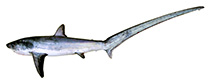
Alopias vulpinus, Thresher : fisheries, gamefish

You can sponsor this page

Alopias vulpinus (Bonnaterre, 1788)

Thresher
Ajouter votre observation dans Fish Watcher
Native range | All suitable habitat | Point map | Year 2050
This map was computer-generated and has not yet been reviewed.
Alopias vulpinus   AquaMaps   Data sources: GBIF OBIS
Envoyez vos Photos et vidéos
Images | vidéos | Images Google
Image of Alopias vulpinus (Thresher)
Alopias vulpinus
Photo de S. Iglesels et al


France territory information

Common names: Faux, Pèis rato, Pesciu volpe
Occurrence: native
Salinity: marine
Abundance: | Ref:
Importance: | Ref:
Aquaculture: | Ref:
Regulations: | Ref:
Uses: no uses
Comments: Also Ref. 247.
National Checklist:
Territory Information: https://www.cia.gov/library/publications/resources/the-world-factbook/geos/fr.html
National Fisheries Authority:
Occurrences: Occurrences Point map
Main Ref: Béarez, P., P. Pruvost, É. Feunteun, S. Iglésias, P. Francour, R. Causse, J. De Mazières, S. Tercerie and N. Bailly, 2017
National Database:

Common names from other countries

Classification / Noms Noms communs | Synonymes | Catalog of Fishes(Genre, Espèce) | ITIS | CoL | WoRMS | Cloffa

Élasmobranches (requins et raies) (sharks and rays) > Lamniformes (Mackerel sharks) > Alopiidae (Thresher sharks)
Etymology: Alopias: From alopex, Greek for fox, referring to the ancient vernacular “fox shark,” from its supposed cunning (ancients believed that when it took a bait, it swallowed the hook until it got to the cord, which it bit off and so escaped) (See ETYFish)vulpinus: Latin for fox-like (as for genus) (See ETYFish).
More on author: Bonnaterre.

Environnement : milieu / zone climatique / profondeur / gamme de distribution Écologie

marin pelagic-oceanic; océanodrome (Ref. 87829); profondeur 0 - 650 m (Ref. 106604), usually 0 - 200 m (Ref. 55168). Subtropical; 74°N - 58°S, 180°W - 180°E (Ref. 54279)

Distribution Territoires | Zones FAO | Écosystèmes | Occurrences | Carte par point | Introductions | Faunafri

Cosmopolitan in temperate and tropical seas (Ref. 6871, 58085). Population considered reduced (R) in the US Atlantic waters; lower risk/conservation dependent (LR/CD) in US Pacific waters; data deficient (DD) in the rest of Atlantic and rest of Pacific (Ref. 12451). Highly migratory species.

Longueur à la première maturité / Taille / Poids / Âge

Maturité: Lm 351.0, range 226 - 400 cm
Max length : 573 cm TL mâle / non sexé; (Ref. 106604); 549.0 cm TL (female); common length : 450 cm TL mâle / non sexé; (Ref. 5217); poids max. publié: 348.0 kg (Ref. 40637); âge max. reporté: 25 années (Ref. 81241)

Description synthétique Clés d'identification | Morphologie | Morphométrie

Épines dorsales (Total) : 0; Épines anales: 0. A large thresher with relatively small eyes, curved, narrow-tipped pectoral fins, a narrow-tipped caudal fin, and a conspicuous white patch over the pectoral fin bases (Ref. 5578). Second dorsal origin well behind the rear tip of the pelvic fin (Ref. 559). Upper lobe of caudal fin very long and strap-like, about as long as or longer than length of rest of shark; lower lobe short but well developed (Ref. 13570). Brown, grey, blue-grey, or blackish on back and underside of snout, lighter on sides and abruptly white below; a white area extends from the abdomen over the pectoral-fin bases; pectoral-, pelvic-, and dorsal fins blackish, white dots sometimes present on pectoral-, pelvic-, and caudal- fin tips (Ref. 13570).
Body shape (shape guide): fusiform / normal; Cross section: circular.

Biologie     Glossaire (ex. epibenthic)

Coastal over continental and insular shelves and epipelagic far from land (Ref. 30573, 43278, 58302). Oceanic although most abundant near land, pelagic at 1-366 m (Ref. 58302). Young often close inshore and in shallow bays (Ref. 5578). Feeds on schooling fishes (including mackerels, bluefishes, clupeids, needlefishes, lancetfishes and lanternfishes), squid, octopi, pelagic crustaceans, and rarely seabirds (Ref. 247). Ovoviviparous, embryos feeding on yolk sac and other ova produced by the mother (Ref. 43278, 50449). Uses its long caudal fin to bunch up and stun prey (Ref. 2850). Spatial and depth segregation by sex in northwestern Indian Ocean populations (Ref. 247). A few attacks on boats are doubtfully attributed to this species, but it is otherwise apparently harmless to humans, though the size of adults of this species command respect (Ref. 247). May cause damage to fishing gear (Ref. 6885). Valued for its meat, liver, hide, and fins; utilized fresh, dried-salted, smoked, and frozen (Ref. 9987).

Cycle de vie et comportement reproducteur Maturité | Reproduction | Frai | Œufs | Fécondité | Larves

Ovoviviparous, embryos feed solely on the ova produced by the mother after the yolk sac is absorbed (oophagy) (Ref. 50449), 2 to 4 young in a litter (usually 2) (Ref. 247). Size at birth 114-150 cm (Ref. 247). Distinct pairing with embrace (Ref. 205).

Référence principale Téléchargez vos références | Références | Coordinateur : Compagno, Leonard J.V. | Collaborateurs

Compagno, L.J.V., 1984. FAO Species Catalogue. Vol. 4. Sharks of the world. An annotated and illustrated catalogue of shark species known to date. Part 1 - Hexanchiformes to Lamniformes. FAO Fish. Synop. 125(4/1):1-249. Rome, FAO. (Ref. 247)

Statut dans la liste rouge de l'IUCN (Ref. 130435: Version 2025-2 (Global))

  Vulnérable (VU) (A2bd); Date assessed: 06 November 2018

CITES


Menace pour l'homme

  Harmless (Ref. 247)


Utilisations par l'homme

Pêcheries: commercial; pêche sportive: oui
FAO - pêcheries: débarquements, Résumé espèce; Publication: search | FishSource | Sea Around Us

Plus d'informations

Écologie trophique
Aliments (proies)
Composition du régime alimentaire
Consommation alimentaire
Rations alimentaires
Prédateurs
Écologie
Écologie
Home ranges
Dynamique des populations
Paramètres de croissance
Âges / tailles maximales
Longueur-poids rel.
Rel. longueur-longueur.
Fréquences de longueurs
Conversion de masse
Recrutement
Abondance
Cycle de vie
Reproduction
Maturité
Maturité/épines rel.
Fécondité
Frai
Agrégats de frai
Œufs
Développement de l'œuf
Larves
Dynamique des populations larvaires
Distribution
Territoires
Zones FAO
Écosystèmes
Occurrences
Introductions
BRUVS - Vidéos
Anatomie
Surface branchiale
Cerveau
Otolithe
Physiologie
Composition corporelle
Nutriments
Consommation d'oxygène
Type de natation
Vitesse de nage
Pigments visuels
Son de poisson
Maladies et parasites
Toxicité (CL50)
Génétique
génôme
Génétique
Hétérozygotie
Héritabilité
Liées à l'homme
Systèmes d'aquaculture
Profils d'aquaculture
Souches
Cas de ciguatera
Timbres, pièces de monnaie, divers
Sensibilisation
Collaborateurs
Références
Références

Outils

Articles particuliers

Télécharger en XML

Sources Internet

Estimations basées sur des modèles

Température préférée (Réf. 123201): 11.6 - 28.2, mean 23.3 °C (based on 8352 cells).
Indice de diversité phylogénétique (Réf. 82804):  PD50 = 0.7500   [Uniqueness, from 0.5 = low to 2.0 = high].
Bayesian length-weight: a=0.00851 (0.00364 - 0.01988), b=2.86 (2.66 - 3.06), in cm total length, based on LWR estimates for this species & (Sub)family-body (Ref. 93245).
Niveau trophique (Réf. 69278):  4.5   ±0.0 se; based on diet studies.
Generation time: 11.0 ( na - na) years. Estimated as median ln(3)/K based on 2 growth studies.
Résilience (Réf. 120179):  Faible, temps minimum de doublement de population : 4,5 à 14 années (K=0.1; tm=5-7; tmax=19; Fec=2-4).
Prior r = 0.05, 95% CL = 0.03 - 0.07, Based on 1 full stock assessment.
Vulnérabilité de la pêche (Ref. 59153):  Very high vulnerability (77 of 100). 🛈
Vulnérabilité climatique (Ref. 125649):  High vulnerability (62 of 100). 🛈
Catégorie de prix (Ref. 80766):   High.
Nutriments (Ref. 124155):  Calcium = 6.93 [1.98, 35.15] mg/100g; Iron = 0.726 [0.178, 2.143] mg/100g; Protein = 20.7 [18.3, 23.1] %; Omega3 = 0.379 [0.152, 0.923] g/100g; Selenium = 37.8 [10.7, 110.5] μg/100g; VitaminA = 4.78 [1.56, 14.81] μg/100g; Zinc = 0.28 [0.14, 0.52] mg/100g (wet weight);