Common names from other countries
Holocéphales (chimères) (chimaeras) >
Chimaeriformes (Chimaeras) >
Chimaeridae (Shortnose chimaeras or ratfishes)
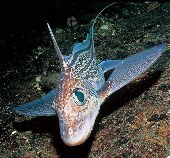
Etymology: Chimaera: Named for the mythological creature composed of parts of multiple animals, referring to their odd mix of characteristics (See ETYFish); monstrosa: Latin for strange or grotesque, referring to its strange appearance, as if composed of parts of multiple animals (See ETYFish).
More on author: Linnaeus.
Environnement : milieu / zone climatique / profondeur / gamme de distribution
Écologie
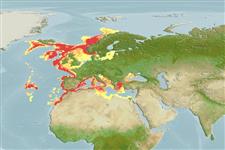
marin bathydémersal; océanodrome (Ref. 51243); profondeur 40 - 1400 m (Ref. 104125), usually 300 - 500 m (Ref. 4443). Deep-water; 75°N - 27°N, 32°W - 35°E
Northeast Atlantic (widespread), including the Mid-Atlantic Ridge and the Mediterranean Sea.
Longueur à la première maturité / Taille / Poids / Âge
Maturité: Lm 45.9 range ? - ? cm
Max length : 150 cm TL mâle / non sexé; (Ref. 35388); poids max. publié: 2.5 kg (Ref. 4645)
Description synthétique
Clés d'identification | Morphologie | Morphométrie
Bathydemersal to benthopelagic generally between 300 and 500 m depth. Found in the upper continental slope. Usually found in deeper waters in southern latitudes, while making a summer inshore migration up to 40-100 m in the northern areas. Sluggish, usually occurring in small groups. Feeds mainly on bottom-living invertebrates. The single dorsal spine is sharp and pointed, and although only mildly venomous can inflict a painful wound. Oviparous. Males have a clasper on the forehead that is probably used to hold on to the female during copulation. Egg capsules are about 17 cm long; young look alike adults and hatch when 10 cm long. Common by-catch when trawling for shrimps in the North Sea or Skaggerak.
Cycle de vie et comportement reproducteur
Maturité | Reproduction | Frai | Œufs | Fécondité | Larves
Oviparous; egg-capsules slender, club-shaped with narrow lateral membranes and a horny filament at the long pointed end, 17 cm long and 3 cm wide; deposited mainly in spring and summer. The embryos developing in about 9-12 months and hatch at 10 cm length.
Krefft, G., 1990. Chimaeridae. p. 111-113. In J.C. Quero, J.C. Hureau, C. Karrer, A. Post and L. Saldanha (eds.) Check-list of the fishes of the eastern tropical Atlantic (CLOFETA). JNICT, Lisbon; SEI, Paris; and UNESCO, Paris. Vol. 1. (Ref. 4443)
Statut dans la liste rouge de l'IUCN (Ref. 130435: Version 2025-2 (Global))
Menace pour l'homme
Traumatogenic (Ref. 4690)
Utilisations par l'homme
Pêcheries: intérêt commercial mineur
Outils
Articles particuliers
Télécharger en XML
Sources Internet
Estimations basées sur des modèles
Température préférée (Réf.
123201): 3.7 - 14.1, mean 7.9 °C (based on 179 cells).
Indice de diversité phylogénétique (Réf.
82804): PD
50 = 0.5000 [Uniqueness, from 0.5 = low to 2.0 = high].
Bayesian length-weight: a=0.00257 (0.00155 - 0.00426), b=3.01 (2.87 - 3.15), in cm total length, based on LWR estimates for this species & (Sub)family-body (Ref.
93245).
Niveau trophique (Réf.
69278): 3.5 ±0.0 se; based on diet studies.
Generation time: 16.4 ( na - na) years. Estimated as median ln(3)/K based on 2
growth studies.
Résilience (Réf.
120179): Faible, temps minimum de doublement de population : 4,5 à 14 années (Assuming Fec <100;).
Vulnérabilité de la pêche (Ref.
59153): High to very high vulnerability (68 of 100).
🛈
Vulnérabilité climatique (Ref.
125649): Moderate vulnerability (38 of 100).
🛈
Nutriments (Ref.
124155): Calcium = 7.33 [2.04, 25.54] mg/100g; Iron = 0.33 [0.11, 0.85] mg/100g; Protein = 14.7 [9.9, 18.5] %; Omega3 = 0.239 [0.093, 0.622] g/100g; Selenium = 22 [6, 73] μg/100g; VitaminA = 5.79 [1.22, 27.56] μg/100g; Zinc = 0.326 [0.169, 0.636] mg/100g (wet weight);