Common names from other countries
>
Clupeiformes (Herrings) >
Clupeidae (Herrings, shads, sardines, menhadens)
Etymology: Clupea: Latin, clupea = sardine, derived from Clupeus = shield; doubtless a reference to the scales covering the body of the fish + Greek, odous = teeth (Ref. 45335).
More on author: Linnaeus.
Taxonomic Remarks
The subspecies were not characterized well enough, that unless there is more evidence presented, Clupea harengus should be considered as one species with several known populations (S.Kullander, pers.comm. 07/09).
Miljö: miljö / Klimatzon / djupintervall / distributionsområde
Ekologi
marina; brackvatten bentopelagisk; havsvandrande (Ref. 51243); djupintervall 0 - 364 m (Ref. 58426), usually 0 - 200 m (Ref. 6683). Temperate; 0°C - 18°C (Ref. 188); 80°N - 33°N, 95°W - 70°E
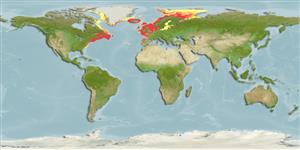
North Atlantic: in the west, it ranges from southwestern Greenland and Labrador southward to South Carolina, USA. In the east, it ranges from Iceland and southern Greenland southward to the northern Bay of Biscay and eastward to Spitsbergen and Novaya Zemlya in Russia, including the Baltic Sea (Ref. 188).
Längd vid första mognad / Storlek / Vikt / Ålder
Könsmognad: Lm 16.7 range ? - ? cm
Max length : 45.0 cm SL hane/ej könsbestämd; (Ref. 37032); common length : 30.0 cm SL hane/ej könsbestämd; (Ref. 37032); publicerad maxvikt: 1.1 kg (Ref. 6114); rapporterad maxålder: 25 år (Ref. 89560)
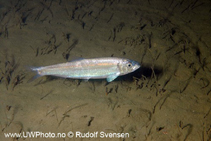
Taggstrålar i ryggfenan (totalt) : 0; Mjukstrålar i ryggfenan (totalt) : 13 - 21; Taggstrålar i analfenan: 0; Mjukstrålar i analfenan: 12 - 23; Ryggkotor: 51 - 60. Slender fish with a round belly. Scutes without prominent keel; 12 to 16 post-pelvic scutes (Ref. 188). No median notch in upper jaw; operculum without radiating bony striae; the posterior border of its gill opening is evenly rounded. It is blue to greenish-blue dorsally, becoming silvery ventrally. No distinctive dark spots on the body or fins (Ref. 188).
Body shape (shape guide): fusiform / normal; Cross section: compressed.
Herring schools move between spawning and wintering grounds in coastal areas and feeding grounds in open water by following migration patterns learned from earlier year classes (Ref. 88171). Juveniles (up to 2 years) shoal close inshore, while adults are found more offshore (Ref. 6683). Adults spend the day in deeper water, but rise to shallower water at night (Ref. 89562). Light is an important factor in controlling their vertical distribution. A facultative zooplanktivorous filter-feeder, i.e., it can switch to filter-feeding if the food density and particle size are appropriate (Ref. 28664). Feed mainly on copepods finding food by visual sense. Herring schools often attract predators such as fish, birds, and marine mammals (Ref. 89563). Schooling, silvery sides, excellent hearing (capable of detecting frequencies between 30-4,000 Hz , Refs. 89391, 89564, 89566), and very fast escape response act as anti-predator devices (Ref. 28664). The most important races in the East Atlantic are the winter-spawning Norwegian and Icelandic herring, the autumn spawning Icelandic and North Sea herring and the Baltic Sea herring. Utilized fresh, dried or salted, smoked, canned and frozen; can be fried, broiled, microwaved and baked (Ref. 9988).
The herring matures between 2-9 years (Refs. 35388, 82767, 89571). Herring populations are known to use traditional spawning grounds, many of which are along shallow coastal areas (15-40 m depth) or on offshore banks down to 200 m (Refs. 6684, 89572). Spawning usually occurs on gravel or rock bottoms, with the exception of Baltic populations which show a preference for shallow (less than 10 m depth) seaweed beds (Refs. 89520, 89572). Each population spawns only once a year over a relatively short time period (Ref. 89573). At least one population is spawning in any one month of the year, each having a different spawning time and place. The herring is a demersal spawner that releases a ribbon of sticky eggs that sink to the sea bed (Ref. 89574) and adhere to the substrate. The eggs released by a spawning population may be several layers thick which may deprive eggs in the bottom layers of oxygen, causing egg mortality (Ref. 89563). Although higher fecundities were reported earlier (e.g. Ref. 74523), fecundity now ranges from 10,000-60,000 eggs (Ref. 89571). Hatching may take up to 3 weeks, depending on temperature (Ref. 89571). Larvae are pelagic and drift with the current. Note: it is impossible to summarize briefly the wide range of spawning strategies of Atlantic herring; the best reviews are those of Svetovidov (Refs. 4608, 4609) for the Eastern Atlantic Ocean and Hildebrand (Ref. 4607) for the Western Atlantic Ocean.
Whitehead, P.J.P., 1985. FAO Species Catalogue. Vol. 7. Clupeoid fishes of the world (suborder Clupeoidei). An annotated and illustrated catalogue of the herrings, sardines, pilchards, sprats, shads, anchovies and wolf-herrings. FAO Fish. Synop. 125(7/1):1-303. Rome: FAO. (Ref. 188)
Status på IUCN:s rödlista (Ref. 130435: Version 2025-2 (Global))
Hot mot människor
Harmless
Mänskliga användningsområden
Fiskeri: kommersiellt viktig; sportfisk: ja
Verktyg
Särskilda rapporter
Ladda ner XML
Internet-källor
Uppskattningar baserade på modeller
Önskad temperatur (Ref.
123201): 0.5 - 11.2, mean 6.6 °C (based on 912 cells).
Index för fylogenetisk mångfald (Ref.
82804): PD
50 = 0.6250 [Uniqueness, from 0.5 = low to 2.0 = high].
Bayesian length-weight: a=0.00550 (0.00484 - 0.00624), b=3.10 (3.06 - 3.14), in cm total length, based on LWR estimates for this species (Ref.
93245).
Trofisk nivå (Ref.
69278): 3.4 ±0.1 se; based on diet studies.
Generation time: 3.3 (3.1 - 3.5) years. Estimated as median ln(3)/K based on 85
growth studies.
Resiliens (Ref.
120179): Mellan, lägsta populationsfördubblingstid 1,4-4,4 år (rm=0.1-0.5; K=0.2-0.6; tm=2-5; tmax=25; Fec=17,300-301,000).
Prior r = 0.44, 95% CL = 0.29 - 0.65, Based on 53 full stock assessments.
Sårbarhet i fisket (Ref.
59153): Moderate vulnerability (41 of 100).
🛈
Sårbarhet för klimatet (Ref.
125649): Low to moderate vulnerability (29 of 100).
🛈
Näringsämnen (Ref.
124155): Calcium = 75.4 [22.6, 182.8] mg/100g; Iron = 0.372 [0.199, 0.704] mg/100g; Protein = 17.5 [15.5, 19.5] %; Omega3 = 0.915 [0.561, 1.451] g/100g; Selenium = 16.5 [5.4, 49.4] μg/100g; VitaminA = 29.1 [6.6, 129.0] μg/100g; Zinc = 1.03 [0.58, 1.64] mg/100g (wet weight); based on
nutrient studies.