Common names from other countries
>
Centrarchiformes (Basses) >
Kuhliidae (Aholeholes)
Etymology: Kuhlia: Because of Heindrich Kuhl, 1797-1821; researcher also with lizards (Gekkonidae).
Eponymy: Dr Heinrich Kuhl (1797–1821) was a German naturalist and zoologist. [...] (Ref. 128868), visit book page.
Environnement : milieu / zone climatique / profondeur / gamme de distribution
Écologie
marin; eau douce; saumâtre benthopélagique; profondeur ? - 2 m (Ref. 86942). Tropical
Western Central Pacific: from the Ryukyus, Ogasawara, New Guinea, Vanuatu, eastern Australia, New Caledonia, and Fiji to Tahiti.
Taille / Poids / Âge
Maturité: Lm ? range ? - ? cm
Max length : 18.4 cm SL mâle / non sexé; (Ref. 137577)
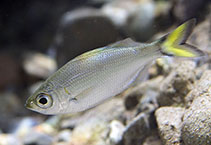
Épines dorsales (Total) : 10; Rayons mous dorsaux (Total) : 10 - 11; Épines anales: 3; Rayons mous anaux: 11. Preorbital serrae 14-21; body depth 2.55-2.85 in SL; orbit diameter 2.55-2.8 in head length; maxilla usually reaching to below anterior margin of pupil; caudal concavity 2.5-3.0 in head length. Silvery, front of lips and upper half of snout blackish; caudal fin yellow with a very broad black posterior margin, the upper and lower margins narrowly black, but broadening towards base, often connecting across base of fin (Ref. 41640).
Body shape (shape guide): fusiform / normal.
Found inshore (Ref. 75154); also in brackish waters and ascends to middle reaches of rivers (Ref. 559)..
Cycle de vie et comportement reproducteur
Maturité | Reproduction | Frai | Œufs | Fécondité | Larves
Randall, J.E. and H.A. Randall, 2001. Review of the fishes of the genus Kuhlia (Perciformes: Kuhliidae) of the Central Pacific. Pac. Sci. 55(3):227-256. (Ref. 41640)
Statut dans la liste rouge de l'IUCN (Ref. 130435: Version 2025-2 (Global))
Menace pour l'homme
Harmless
Utilisations par l'homme
Pêcheries: intérêt commercial mineur
Outils
Articles particuliers
Télécharger en XML
Sources Internet
Estimations basées sur des modèles
Indice de diversité phylogénétique (Réf.
82804): PD
50 = 0.5005 [Uniqueness, from 0.5 = low to 2.0 = high].
Bayesian length-weight: a=0.01413 (0.00597 - 0.03345), b=3.06 (2.86 - 3.26), in cm total length, based on LWR estimates for this (Sub)family-body shape (Ref.
93245).
Niveau trophique (Réf.
69278): 3.4 ±0.5 se; based on size and trophs of closest relatives
Résilience (Réf.
120179): Milieu, temps minimum de doublement de population : 1,4 à 4,4 années (Preliminary K or Fecundity.).
Vulnérabilité de la pêche (Ref.
59153): Low vulnerability (13 of 100).
🛈
Nutriments (Ref.
124155): Calcium = 215 [115, 427] mg/100g; Iron = 1.02 [0.59, 1.91] mg/100g; Protein = 18 [17, 19] %; Omega3 = 0.208 [0.095, 0.440] g/100g; Selenium = 20.1 [9.8, 40.3] μg/100g; VitaminA = 63.3 [23.1, 176.3] μg/100g; Zinc = 2.21 [1.53, 3.29] mg/100g (wet weight);