Engraulis encrasicolus, European anchovy : fisheries, bait

You can sponsor this page

Engraulis encrasicolus (Linnaeus, 1758)

European anchovy
Ajouter votre observation dans Fish Watcher
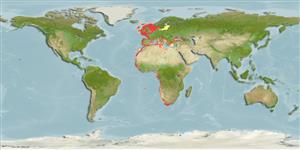
Native range | All suitable habitat | Point map | Year 2050
This map was computer-generated and has not yet been reviewed.
Engraulis encrasicolus   AquaMaps   Data sources: GBIF OBIS
Envoyez vos Photos et vidéos
Images | Timbres, pièces de monnaie, divers | Images Google
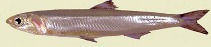
Image of Engraulis encrasicolus (European anchovy)
Engraulis encrasicolus
Photo de Dammous, S.

Common names from other countries

Classification / Noms Noms communs | Synonymes | Catalog of Fishes(Genre, Espèce) | ITIS | CoL | WoRMS | Cloffa

> Clupeiformes (Herrings) > Engraulidae (Anchovies) > Engraulinae
Etymology: Engraulis: Greek, eggraulis, -eos = anchovy (Ref. 45335).
More on author: Linnaeus.

Environnement : milieu / zone climatique / profondeur / gamme de distribution Écologie

marin; saumâtre pelagic-neritic; océanodrome (Ref. 51243); profondeur 0 - 400 m (Ref. 2683). Subtropical; 62°N - 37°S, 18°W - 42°E (Ref. 54230)

Distribution Territoires | Zones FAO | Écosystèmes | Occurrences | Carte par point | Introductions | Faunafri

Eastern Atlantic: Bergen, Norway to East London, South Africa (perhaps reaching Durban) (Ref. 10000). Also all of Mediterranean, Black and Azov seas, with stray individuals in Suez Canal and Gulf of Suez; also recorded from St. Helena (Ref. 189). Reported from Estonia (Ref. 33247).

Longueur à la première maturité / Taille / Poids / Âge

Maturité: Lm 10.1, range 9 - 14 cm
Max length : 20.0 cm SL mâle / non sexé; (Ref. 189); common length : 13.5 cm SL mâle / non sexé; (Ref. 189); poids max. publié: 0.00 g; âge max. reporté: 5 années (Ref. 92145)

Description synthétique Clés d'identification | Morphologie | Morphométrie

Épines dorsales (Total) : 0; Rayons mous dorsaux (Total) : 16 - 18; Épines anales: 0; Rayons mous anaux: 13 - 15; Vertèbres: 46 - 47. Snout pointed; maxilla short, tip blunt, reaching almost to front border of pre-operculum, not projecting beyond tip of second supra-maxilla; tip of lower jaw reaching almost to below nostril. Gill rakers present on hind face of third epibranchial. Pseudobranch longer than eye, reaching onto inner face of operculum. A silver stripe along flank, disappearing with age.
Body shape (shape guide): elongated; Cross section: oval.

Biologie     Glossaire (ex. epibenthic)

Mainly oceanic, marine species, forming large schools (see Ref. 126017:598). Tolerates salinities of 5-41 ppt and in some areas, enters lagoons, estuaries and lakes, especially during spawning. Tends to move further north and into surface waters in summer, retreating and descending in winter. Feeds on planktonic organisms. Spawns from April to November with peaks usually in the warmest months. Eggs are ellipsoidal to oval, floating in the upper 50 m and hatching in 24-65 hours. Marketed fresh, dried, smoked, canned and frozen; made into fish meal (Ref. 9987).

Cycle de vie et comportement reproducteur Maturité | Reproduction | Frai | Œufs | Fécondité | Larves

Pelagic spawners. Gametogenesis is continuous, multiple spawning. Spawning peaks are usually in the warmer months which makes this species a spring-summer spawner. The limits of the spawning season is dependent on temperature and is therefore more restricted in northern areas. Sex ratio: 45% female (Ref. 5580).

Référence principale Téléchargez vos références | Références | Coordinateur | Collaborateurs

Whitehead, P.J.P., G.J. Nelson and T. Wongratana, 1988. FAO Species Catalogue. Vol. 7. Clupeoid fishes of the world (Suborder Clupeoidei). An annotated and illustrated catalogue of the herrings, sardines, pilchards, sprats, shads, anchovies and wolf-herrings. FAO Fish. Synop. 125(7/2):305-579. Rome: FAO. (Ref. 189)

Statut dans la liste rouge de l'IUCN (Ref. 130435: Version 2025-2 (Global))

  Préoccupation mineure (LC) ; Date assessed: 23 May 2013

CITES

Not Evaluated

CMS (Ref. 116361)

Not Evaluated

Menace pour l'homme

  Harmless


Utilisations par l'homme

Pêcheries: hautement commercial; appât: usually
FAO - pêcheries: débarquements, Résumé espèce; Publication: search | FIRMS - Stock assessments | FishSource | Sea Around Us

Plus d'informations

Cycle de vie
Reproduction
Maturité
Maturité/épines rel.
Fécondité
Frai
Agrégats de frai
Œufs
Développement de l'œuf
Larves
Dynamique des populations larvaires
Anatomie
Surface branchiale
Cerveau
Otolithe
Physiologie
Composition corporelle
Nutriments
Consommation d'oxygène
Type de natation
Vitesse de nage
Pigments visuels
Son de poisson
Maladies et parasites
Toxicité (CL50)
Génétique
génôme
Génétique
Hétérozygotie
Héritabilité
Liées à l'homme
Systèmes d'aquaculture
Profils d'aquaculture
Souches
Cas de ciguatera
Timbres, pièces de monnaie, divers
Sensibilisation
Collaborateurs
Références
Références

Outils

Articles particuliers

Télécharger en XML

Sources Internet

Estimations basées sur des modèles

Température préférée (Réf. 123201): 7.1 - 18, mean 10.8 °C (based on 667 cells).
Indice de diversité phylogénétique (Réf. 82804):  PD50 = 0.5020   [Uniqueness, from 0.5 = low to 2.0 = high].
Bayesian length-weight: a=0.00457 (0.00414 - 0.00505), b=3.10 (3.07 - 3.13), in cm total length, based on LWR estimates for this species (Ref. 93245).
Niveau trophique (Réf. 69278):  3.1   ±0.36 se; based on food items.
Generation time: 2.2 (1.8 - 2.8) years. Estimated as median ln(3)/K based on 50 growth studies.
Résilience (Réf. 120179):  Milieu, temps minimum de doublement de population : 1,4 à 4,4 années (K=0.3-1.73; tmax=6; Fec =13,000-503,000).
Prior r = 0.59, 95% CL = 0.39 - 0.89, Based on 21 full stock assessments.
Vulnérabilité de la pêche (Ref. 59153):  Low vulnerability (18 of 100). 🛈
Vulnérabilité climatique (Ref. 125649):  Low vulnerability (9 of 100). 🛈
Catégorie de prix (Ref. 80766):   Medium.
Nutriments (Ref. 124155):  Calcium = 170 [78, 369] mg/100g; Iron = 1.21 [0.63, 2.85] mg/100g; Protein = 18.7 [17.6, 20.0] %; Omega3 = 0.976 [0.611, 1.574] g/100g; Selenium = 19.1 [9.3, 36.9] μg/100g; VitaminA = 15.5 [4.4, 51.5] μg/100g; Zinc = 1.24 [0.79, 1.84] mg/100g (wet weight); based on nutrient studies.