Cirrhinus molitorella, Mud carp : fisheries, aquaculture

You can sponsor this page

Cirrhinus molitorella (Valenciennes, 1844)

Mud carp
Hochladen Photos und videos
Bilder | Google Bild
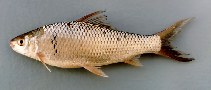
Image of Cirrhinus molitorella (Mud carp)
Cirrhinus molitorella
Photo von Warren, T.


China territory information

Common names: 侧斑鲮, 側斑鯪, 土鲮
Occurrence: native
Salinity: freshwater
Abundance: | Ref:
Importance: commercial | Ref: Rainboth, W.J., 1996
Aquaculture: commercial | Ref: Roberts, T.R., 1997
Regulations: | Ref:
Uses: live export: yes;
Comments: Widely distributed in southern China (Ref. 33488) where it is extensively cultured in ponds and widely transported from their native ranges to other regions in the country (Ref. 55380). Recorded from the Red River, Nanpangjiang basin (Ref. 27732) and the Mekong River (=Lan cang jiang) in Yunnan (Ref. 38630). Known from Guangxi: Nanning, Guilin, Guiping, Baise. Longzhou. Guangdong: Yangshan, Lianzhou. Yunnan: Hekou, Menglun. Fujian: Nanping. Hainan: Ledong, Nanfeng, Qionghai (Ref. 45621). Also Ref. 9671, 26563, 26920, 35840, 43281.
National Checklist:
Territory Information: https://www.cia.gov/library/publications/resources/the-world-factbook/geos/ch.html
National Fisheries Authority:
Occurrences: Occurrences Point map
Main Ref: Roberts, T.R., 1997
National Database:

Common names from other countries

Klassifizierung / Names Namen | Synonyme | Catalog of Fishes(Gattung, Arten) | ITIS | CoL | WoRMS | Cloffa

> Cypriniformes (Carps) > Cyprinidae (Minnows or carps) > Labeoninae
Etymology: Cirrhinus: Latin, cirrus = curl fringe (Ref. 45335).
More on author: Valenciennes.

Umwelt: Milieu / Klimazone / Tiefenbereich / Verbreitungsgebiet Ökologie

; süßwasser benthopelagisch; potamodrom (Ref. 33488); tiefenbereich 5 - 20 m (Ref. 6898). Tropical; 22°C - 26°C (Ref. 2059); 24°N - 12°N, 98°E - 108°E

Verbreitung Territorien | FAO Gebiete | Ökosysteme | Vorkommen | Punkt Karte | Einführungen | Faunafri

Asia: Mekong, Chao Phraya, Nam Theun, Xe Bangfai and the Nanpangjiang basins; also from the Red River (China and Viet Nam).

Größe / Gewicht / Alter

Geschlechtsreife: Lm ?  range ? - ? cm
Max length : 55.0 cm TL Männchen/unbestimmt; (Ref. 37769); common length : 15.2 cm SL Männchen/unbestimmt; (Ref. 35840); max. veröff. Gewicht: 1.5 kg (Ref. 128592)

Kurzbeschreibung Bestimmungsschlüssel | Morphologie | Morphometrie

Rückenflossenstacheln (insgesamt) : 0; Rückenflossenweichstrahlen (insgesamt) : 11 - 15; Wirbelzahl: 34 - 38. Has 37-43 scales on the lateral line (including those on base of caudal-fin); 7-8+1/2 scale rows between lateral line and dorsal-fin origin (Ref. 27732). Differs from all other species of the genus in having more or less discrete marks on each scale on the upper, middle, and sometimes lower parts of the body. Such marks, visible in most freshly caught and recently preserved specimens, are sometimes intensely developed, giving the fish a markedly reticulated appearance. C. molitorella often has a very intense humeral mark which is vivid bluish-green in life. In other Cirrhinus the humeral marks are black or bluish black (Ref. 33488). Usually a conspicuous black bar shortly behind pectoral base (Ref. 43281). Gill rakers on the lower arm of first arch 65-85 (Ref. 12693).
Body shape (shape guide): fusiform / normal.

Biologie     Fachlexikon (Englisch) (z.B. epibenthic)

Known from midwater to bottom depths of large and medium-sized rivers. Move into flooded forests during the rainy season and grazes on algae, phytoplankton and detritus (Ref. 12693). Occur in rapids and slow deep reaches (Ref. 37769). Reported to be omnivorous (Ref. 33813). Wild stocks are strongly migratory while the cultivated stocks probably have lost the migratory behavior (Ref. 33488). Prefer flowing water and not known to proliferate in impoundments. Large fish are marketed fresh, smaller ones are used to make prahoc (Ref. 12693). Attain at least 40 cm SL (Ref. 33488).

Lebenszyklus und Paarungsverhalten Geschlechtsreife | Fortpflanzung | Ablaichen | Eier | Fruchtbarkeit | Larven

Assuming standard cyprinid mode of reproduction. Replace ASAP.

Hauptreferenz Laden Sie Ihre Referenzen hoch | Referenzen | Koordinator | Partner

Roberts, T.R., 1997. Systematic revision of the tropical Asian labeon cyprinid fish genus Cirrhinus, with descriptions of new species and biological observations on C. lobatus. Nat. Hist. Bull. Siam Soc. 45:171-203. (Ref. 33488)

IUCN Rote Liste Status (Ref. 130435: Version 2025-2 (Global))

  Gefährdung zunehmend (NT) ; Date assessed: 19 April 2010

CITES

Not Evaluated

CMS (Ref. 116361)

Not Evaluated

Bedrohung für Menschen

  Harmless


Nutzung durch Menschen

Fischereien: kommerziell; Aquakultur: kommerziell
FAO - Aquakultur-Systeme: produktion, Artbeschreibung; Fischereien: landungen; Publication: search | FishSource |

Mehr Information

Trophische Ökologie
Lebensmittel (Beutetiere)
Nahrungszusammensetzung
Nahrungsaufnahme
Lebensmittelrationen
Räuber
Ökologie
Ökologie
Home ranges
Populationsdynamik
Wachstumsparameter
Max. Alter/Größen
Länge-Gewicht-Rel.
Länge-Länge-Verhältnis.
Längenhäufigkeiten
Massenkonvertierung
Rekrutierung
Dichte
Lebenszyklus
Fortpflanzung
Geschlechtsreife
Reifung/Kiemen rel.
Fruchtbarkeit
Ablaichen
Laichaggregationen
Eier
Eientwicklung
Larven
Larven Pop.Dyn.
Anatomie
Kiemenoberfläche
Gehirn
Otolith
Physiologie
Körperliche Zusammensetzung
Nährstoffe
Sauerstoffverbrauch
Schwimmart
Schwimmgeschwindigkeit
Visuelle Pigmente
Fischgeräusche
Krankheiten und Parasiten
Toxizität (LC50s)
Genetik
Genom
Genetik
Heterozygotie
Vererbbarkeit
Menschenbezogen
Aquakultur-Systeme
Aquakultur Profile
Zuchtlinien
Ciguatera-Fälle
Briefmarken, Münzen, Verschiedenes.
Aufsuchen
Partner
Referenzen
Referenzen

Tools

Zusatzinformationen

Download XML

Internet Quellen

AFORO (otoliths) | Alien/Invasive Species database | Aquatic Commons | BHL | Cloffa | Websites from users | FishWatcher Einträge suchen | CISTI | Catalog of Fishes: Gattung, Arten | DiscoverLife | ECOTOX | FAO - Aquakultur-Systeme: produktion, Artbeschreibung; Fischereien: landungen; Publication: search | Faunafri | Fishipedia | Fishtrace | GloBI | Google Books | Google Scholar | Google | IGFA World Record | Nationale Datenbanken | OneZoom | Open Tree of Life | Otolith Atlas of Taiwan Fishes | PubMed | Reef Life Survey | Socotra Atlas | TreeBase | Tree of Life | Wikipedia: Gehe zu, Suchen | World Records Freshwater Fishing | Zoologischer Rekord

Schätzungen auf der Grundlage von Modellen

Phylogenetischer Diversitätsindex (Ref. 82804):  PD50 = 0.5020   [Uniqueness, from 0.5 = low to 2.0 = high].
Bayesian length-weight: a=0.00933 (0.00798 - 0.01091), b=3.05 (3.01 - 3.09), in cm total length, based on LWR estimates for this species (Ref. 93245).
Trophische Ebene (Ref. 69278):  2.0   ±0.00 se; based on food items.
Generation time: 9.4 ( na - na) years. Estimated as median ln(3)/K based on 1 growth studies.
Widerstandsfähigkeit (Ref. 120179):  mittel, Verdopplung der Population dauert 1,4 - 4,4 Jahre. (tm=3; K=0.12; Fec=100,000-204,000).
Anfälligkeit der Fischerei (Ref. 59153):  Moderate vulnerability (42 of 100). 🛈
Preiskategorie (Ref. 80766):   Unknown.
Nährstoffe (Ref. 124155):  Calcium = 199 [104, 403] mg/100g; Iron = 1.44 [0.71, 2.74] mg/100g; Protein = 17 [16, 18] %; Omega3 = 0.387 [0.153, 1.082] g/100g; Selenium = 192 [71, 449] μg/100g; VitaminA = 26.7 [10.8, 69.9] μg/100g; Zinc = 0.99 [0.51, 1.77] mg/100g (wet weight); based on nutrient studies.