Common names from other countries
Klassifizierung / Names
Namen | Synonyme | Catalog of Fishes(Gattung, Arten) | ITIS | CoL | WoRMS | Cloffa
>
Characiformes (Characins) >
Stevardiidae (Stevardiids) > Stevardiinae
Etymology: Pseudocorynopoma: Greek, pseudes = false + Greek, koryne = stick + Greek, poma = cover, operculum (Ref. 45335).
Eponymy: Professor Dr Stanley Howard Weitzman (1927–2017) was honoured for his great contribution to our knowledge of Neotropical freshwater fish (see Weitzman, SH). (Ref. 128868), visit book page.
Umwelt: Milieu / Klimazone / Tiefenbereich / Verbreitungsgebiet
Ökologie
; süßwasser benthopelagisch. Tropical
South America: Brazil and Uruguay.
Größe / Gewicht / Alter
Geschlechtsreife: Lm ? range ? - ? cm
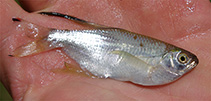
Max length : 6.2 cm SL Männchen/unbestimmt; (Ref. 123882); 6.1 cm SL (female)
Kurzbeschreibung
Bestimmungsschlüssel | Morphologie | Morphometrie
Rückenflossenweichstrahlen (insgesamt) : 9; Afterflossenweichstrahlen: 32 - 37; Wirbelzahl: 37 - 39. This species is distinguished from P. heterandria by the number of branched anal-fin rays 32-36 (vs. 35-40 in P. heterandria); presence in males of an intermediate lobe in the distal margin of the anal fin (vs. absence); presence of hooks on the anal-fin rays of the intermediate lobe only (vs. presence of hooks in the branched anal-fin rays of the anterior lobe); presence of marks coloured in pink, black and white at the tips of the caudal-fin lobes in both sexes (vs. absent). It differs from P. doriae in both sexes by the arrangement of the white, red and black marks at the tip of the dorsal lobe of the caudal fin and in mature males by the absence of black spots at the distal tip of the pectoral fin and by the absence of black spots in the distal tip of the rays of the anterior lobe of the anal fin (vs. present in P. doriae); differs further by the growth patterns of the caudal peduncle length in females and of the anal-fin base length in males and by 87 mutational steps in mtDNA sequences (COI and ND2) (Ref. 123882).
Cross section: compressed.
Lebenszyklus und Paarungsverhalten
Geschlechtsreife | Fortpflanzung | Ablaichen | Eier | Fruchtbarkeit | Larven
Malabarba, L.R., J. Chuctaya, A. Hirschmann, E.B. de Oliveira and A.T. Thomaz, 2020. Hidden or unnoticed? Multiple lines of evidence support the recognition of a new species of Pseudocorynopoma (Characidae: Corynopomini). J. Fsh. Biol. 98(1):219-236. (Ref. 123882)
IUCN Rote Liste Status (Ref. 130435: Version 2025-2 (Global))
Bedrohung für Menschen
Harmless
Nutzung durch Menschen
Tools
Zusatzinformationen
Download XML
Internet Quellen
Schätzungen auf der Grundlage von Modellen
Phylogenetischer Diversitätsindex (Ref.
82804): PD
50 = 0.6250 [Uniqueness, from 0.5 = low to 2.0 = high].
Bayesian length-weight: a=0.01995 (0.00906 - 0.04395), b=3.01 (2.83 - 3.19), in cm total length, based on all LWR estimates for this body shape (Ref.
93245).
Trophische Ebene (Ref.
69278): 3.0 ±0.4 se; based on size and trophs of closest relatives
Anfälligkeit der Fischerei (Ref.
59153): Low vulnerability (10 of 100).
🛈