Pomatomus saltatrix, Bluefish : fisheries, aquaculture, gamefish, bait

You can sponsor this page

Pomatomus saltatrix (Linnaeus, 1766)

Bluefish
Añada su observación en Fish Watcher
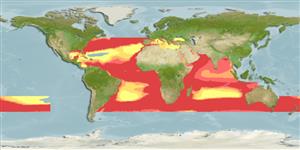
Native range | All suitable habitat | Point map | Year 2050
This map was computer-generated and has not yet been reviewed.
Pomatomus saltatrix   AquaMaps   Data sources: GBIF OBIS
Sube tu fotos y Vídeos
Imágenes | Vídeos | Sonidos | Google image
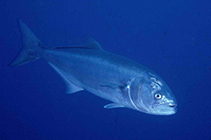
Image of Pomatomus saltatrix (Bluefish)
Pomatomus saltatrix
Foto de Wirtz, P.


Angola territory information

Common names: Anchova, Chova, Enchova
Occurrence: native
Salinity: marine
Abundance: | Ref:
Importance: | Ref:
Aquaculture: | Ref:
Regulations: | Ref:
Uses: no uses
Comments:
National Checklist:
Territory Information: https://www.cia.gov/library/publications/resources/the-world-factbook/geos/ao.html
National Fisheries Authority:
Occurrences: Occurrences Point map
Main Ref: Bianchi, G., 1986
National Database:

Common names from other countries

Clasificación / Nombres Nombres comunes | Sinónimos | Catalog of Fishes(Género, Especie) | ITIS | CoL | WoRMS | Cloffa

> Scombriformes (Mackerels) > Pomatomidae (Bluefishes)
Etymology: Pomatomus: Greek, poma, -atos = cover, operculum + Greek, tomos = portion (Ref. 45335).
More on author: Linnaeus.

Entorno: milieu / zona climática / rango de profundidad / gama de distribución Ecología

marino; salobre pelagic-oceanic; oceanodromo (Ref. 51243); rango de profundidad 0 - 200 m (Ref. 54708). Subtropical; 53°N - 44°S, 98°W - 180°E

Distribución Territorios | Áreas FAO | Ecosistemas | Ocurrencias, apariciones | Mapa de puntos | Introducciones | Faunafri

Circumglobal: In tropical to subtropical waters; except the eastern Pacific (Ref. 33390). Eastern Atlantic: Portugal to South Africa, including the Mediterranean and Black Sea, Madeira, and the Canary Islands. Western Atlantic: Canada and Bermuda to Argentina (Ref. 7251). Indian Ocean: along the coast of East Africa, Madagascar, southern Oman, southwest India, the Malay Peninsula, and Western Australia (Ref. 11441). Southwest Pacific: Australia except the Northern Territory, and New Zealand (Ref. 11441). Absent from eastern Pacific and northwest Pacific. Barely entering the Western Central Pacific region. Records from the Northern Territory, Australia and from Indonesia appear to be erroneous (Ref. 9860). Occurrence in Taiwan (Ref. 5193) and Hawaii (Ref. 4517) need verification.

Longitud en la primera madurez / Tamaño / Peso / Edad

Madurez: Lm 30.0  range ? - ? cm
Max length : 130 cm TL macho / no sexado; (Ref. 11441); common length : 60.0 cm TL macho / no sexado; (Ref. 3482); peso máximo publicado: 14.4 kg (Ref. 4699); edad máxima reportada: 14 años (Ref. 128525)

Descripción breve Claves de identificación | Morfología | Morfometría

Espinas dorsales (total) : 8 - 9; Radios blandos dorsales (total) : 23 - 28; Espinas anales: 2 - 3; Radios blandos anales: 23 - 27. Jaw teeth prominent, sharp, compressed, in a single series. Two dorsal fins, the first short and low, with 7 or 8 feeble spines connected by a membrane. Back greenish, sides and belly silvery (Ref. 9860).
Body shape (shape guide): fusiform / normal; Cross section: compressed.

Biología     Glosario (por ej. epibenthic)

Occur in oceanic and coastal waters (Ref. 26340). They are most common along surf beaches and rock headlands in clean, high energy waters, although adults can also be found in estuaries and into brackish water (Ref. 6492). Small fish may be found in shallow coastal waters at least 2 m depth (Ref. 9563), in schools pursuing and attacking small fishes (Ref. 9626). Adults are in loose groups, often attacking shoals of mullets or other fishes and destroying numbers apparently far in excess of feeding requirements (Ref. 9860). Feed on other fish (Ref. 5377), crustaceans and cephalopods (Ref. 47377). Associated with sharks and billfishes (Ref. 26340). Voracious and aggressive (Ref. 9626), reported to bite when handled. Migrate to warmer water during winter and to cooler water in summer (Ref. 9987). Popular game fish (Ref. 6638). Good food fish; marketed mostly fresh (Ref. 9860), but also dried or salted (Ref. 5284), and frozen (Ref. 9987).

Ciclo vital y comportamiento de apareamiento Madurez | Reproducción | Puesta | Huevos | Fecundidad | Larva

Fecundity varies from 400,000 to 2,000,000 eggs depending on the size of the individual (ranging from 370,000 in a 31 cm fish to 1,240,000 in a 54 cm fish) (Ref. 27695). Tailor are serial spawners (Ref. 6390).

Referencia principal Suba sus referencias | Referencias | Coordinador | Colaboradores

Dooley, J.K., 1990. Pomatomidae. p. 721-722. In J.C. Quero, J.C. Hureau, C. Karrer, A. Post and L. Saldanha (eds.) Check-list of the fishes of the eastern tropical Atlantic (CLOFETA). JNICT, Lisbon; SEI, Paris; and UNESCO, Paris. Vol. 2. (Ref. 9986)

Situación en la Lista Roja de la UICN (Ref. 130435: Version 2025-2 (Global))

  Vulnerable (VU) (A2bd); Date assessed: 07 July 2014

CITES

Not Evaluated

CMS (Ref. 116361)

Not Evaluated

Amenaza para el ser humano

  Traumatogenic (Ref. 27695)


Usos humanos

Pesquerías: muy comercial; Acuicultura: comercial; pesca deportiva: si; carnada: usually
FAO - Sistemas de acuicultura: producción; pesquerías: desembarques, perfil de la especie; Publication: search | FishSource | Sea Around Us

Más información

Ciclo de vida
Reproducción
Madurez
Madurez/Gills rel.
Fecundidad
Puesta
Agregaciones de desove
Huevos
Desarrollo de los huevos
Larva
Dinámica larvaria
Distribución
Territorios
Áreas FAO
Ecosistemas
Ocurrencias, apariciones
Introducciones
BRUVS - Vídeos
Relacionados con el ser humano
Sistemas de acuicultura
Perfiles de acuicultura
Razas
Ciguatera cases
Sellos, monedas, varios
Divulgación
Colaboradores
Referencias
Referencias

Herramientas

Informes especiales

Descargar XML

Fuentes de Internet

Estimaciones basadas en modelos

Temperatura preferida (Referencia 123201): 8.4 - 27.5, mean 21.1 °C (based on 1273 cells).
Índice de diversidad filogenética (Referencia 82804):  PD50 = 1.5000   [Uniqueness, from 0.5 = low to 2.0 = high].
Bayesian length-weight: a=0.01072 (0.00839 - 0.01369), b=2.96 (2.89 - 3.03), in cm total length, based on LWR estimates for this species (Ref. 93245).
Nivel trófico (Referencia 69278):  4.5   ±0.3 se; based on diet studies.
Generation time: 6.1 (4.1 - 8.1) years. Estimated as median ln(3)/K based on 14 growth studies.
Resiliencia (Referencia 120179):  Bajo, población duplicada en un tiempo mínimo de 4.5-14 años (K=0.09-0.4; tm=2.4; tmax=14; Fec=1 million).
Prior r = 0.47, 95% CL = 0.31 - 0.71, Based on 3 full stock assessments.
Vulnerabilidad pesquera (Ref. 59153):  Moderate vulnerability (42 of 100). 🛈
Vulnerabilidad climática (Ref. 125649):  Moderate to high vulnerability (46 of 100). 🛈
Categoría de precios (Ref. 80766):   Very high.
Nutrientes (Ref. 124155):  Calcium = 35.4 [23.1, 58.7] mg/100g; Iron = 1.68 [0.54, 4.47] mg/100g; Protein = 20 [19, 21] %; Omega3 = 0.417 [0.268, 0.647] g/100g; Selenium = 28.5 [15.9, 46.0] μg/100g; VitaminA = 12.4 [4.6, 33.9] μg/100g; Zinc = 0.539 [0.407, 0.733] mg/100g (wet weight); based on nutrient studies.