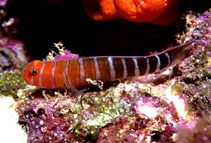
| Family: |
Gobiidae (Gobies), subfamily: Gobiinae |
| Max. size: |
3.33 cm TL (male/unsexed) |
| Environment: |
demersal; marine |
| Distribution: |
Eastern Central Pacific: Mexico. |
| Diagnosis: |
Anal spines: 1-1; Anal soft rays: 7-10. This species is distinguished from all its congeners by the following set of characters: head
plump, more or less rounded, dorsoventrally compressed; head broad, with the anterior
outline of the head forming a smooth convex curve when viewed dorsally; most males with
one, rarely two, dorsal-fin spines filamentous first spine reaching to between last first dorsal-
fin spine base to fifth second dorsal-fin ray base, occasionally to ninth second dorsal-fin
ray base; pectoral rays usually 20-21; D2 usually I,10; A usually I,9; basicaudal scales absent; body with broad dark brown bands, with smooth vertical margins (Ref. 87125). |
| Biology: |
Observed cleaning other fishes and commonly occurs with Elacatinus digueti (Ref. 87125). From the subtidal to depths of at least 35 m and commonly found below 15 m (Ref. 87125). |
| IUCN Red List Status: |
Least Concern (LC); Date assessed: 15 February 2024 Ref. (130435)
|
| Threat to humans: |
harmless |
Source and more info: www.fishbase.org. For personal, classroom, and other internal use only. Not for publication.