
|
Pseudorhombus diplospilus Norman, 1926 Four twin-spot flounder |
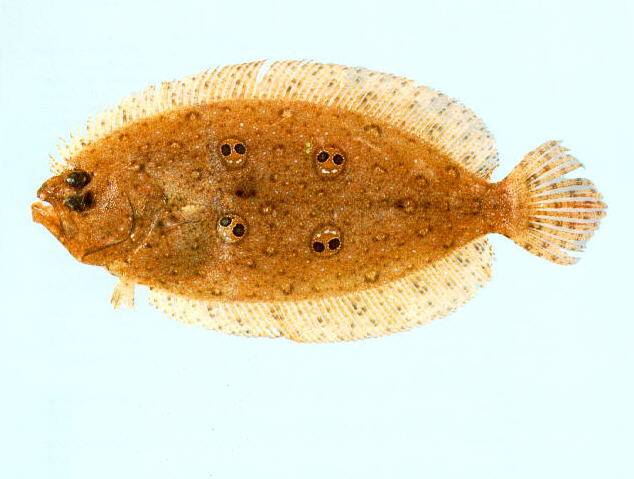
|
|
photo by
CSIRO |
| Family: | Paralichthyidae (Large-tooth flounders) | |||
| Max. size: | 40 cm SL (male/unsexed) | |||
| Environment: | demersal; marine; depth range 10 - 75 m | |||
| Distribution: | Western Pacific: South China Sea to the Indo-Australian Archipelago (including Western Australia). | |||
| Diagnosis: | Dorsal spines (total): 0-0; Dorsal soft rays (total): 75-81; Anal spines: 0-0; Anal soft rays: 61-64. Pectoral fin on ocular side with 11-12 soft rays. | |||
| Biology: | Inhabits shallow water (10 m) on mud and sand bottoms of coastal zones (Ref. 9774) to a depth of 150 m (Ref. 9494). Feeds on small benthic animals (Ref. 9774). Caught mainly with prawn trawls (Ref. 9774). Marketed fresh and considered a good food fish. | |||
| IUCN Red List Status: | Least Concern (LC); Date assessed: 13 November 2019 Ref. (130435) | |||
| Threat to humans: | harmless | |||